Have one like this?
Upload a photo for a free check of what yours may be worth.
Lot description
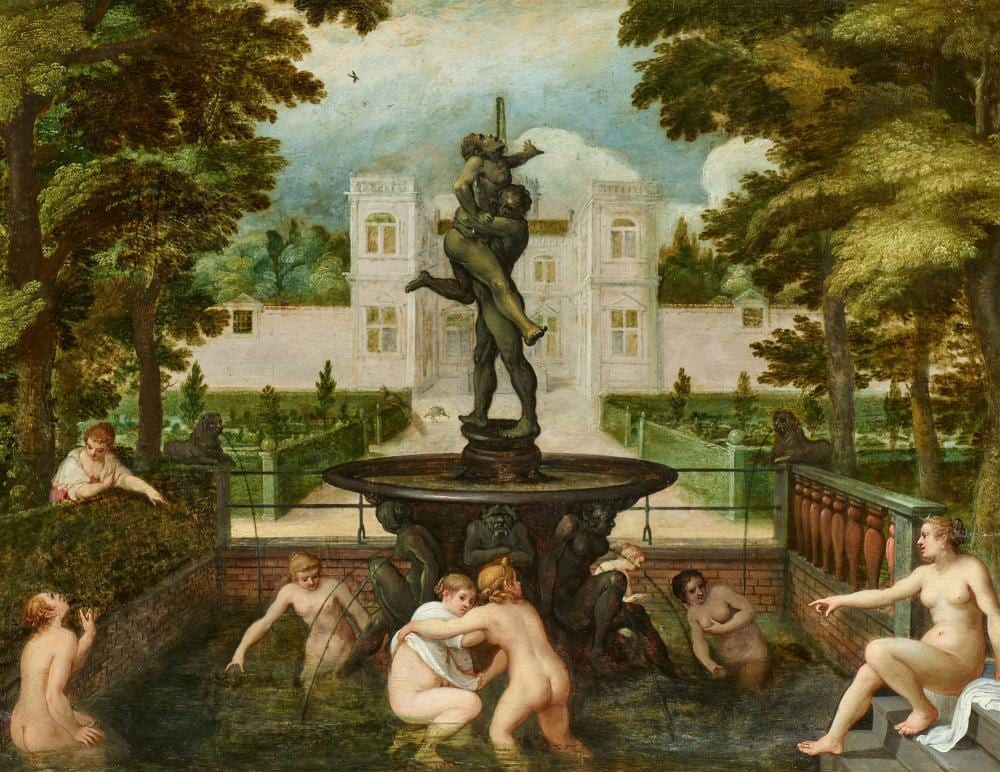
In the critical catalogue of paintings, drawings and prints by Adriaen van Stalbemt, this painting is listed in the addenda under Add. 4. Klaus Ertz dates the work – like all mythological depictions from the thematic series ‘Bathers in the Castle Garden,’ ‘Diana and her Nymphs Bathing and Dancing in an Elegant Castle Complex’ or ‘Diana and Callisto’ (cf. cat. nos. 213 and 218 ff.) – to the period after 1620. The decisive factor for this chronological classification is above all the elegant, elongated type of female figures, which clearly reflects the influence of Hendrick van Balen. A well-known group of figures appears as the central fountain figure within the French park with a mythological pictorial programme: standing firmly on a platform, Hercules grabs the giant Antaeus and lifts him into the air. Antaeus, son of Poseidon and Gaia, was considered invincible because he drew his strength from contact with the earth. By lifting him off the ground, Hercules was able to overpower him. The fountain water flows out of Antaeus' open mouth. The motif had been widespread in Florentine art since Antonio da Pollaiolo. The group of figures depicted here could be attributed to the workshop of the Flemish sculptor Giambologna.The fountain figure therefore acts as a programmatic counterpoint to the female-dominated bathing and nymph scene – it structures the image not only formally, but also in terms of content through the tension between nature and culture, purity and violence, femininity and heroic masculinity.