Have one like this?
Upload a photo for a free check of what yours may be worth.
Lot description
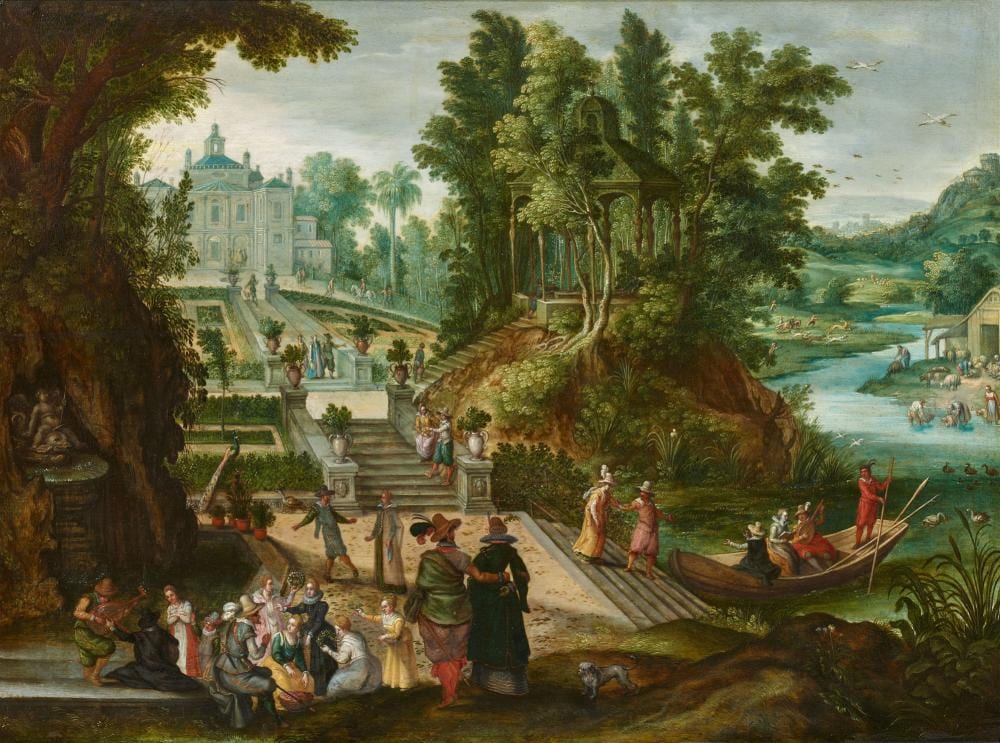
This garden landscape by Sebastian Vrancx must have approximated closely the contemporary ideal of aristocratic country life: a hunting lodge with extensive grounds; a pavilion commanding views over the surrounding landscape; a terrace directly on the river for elegant boating excursions; all of this set amid woods and meadows that afford the noble company both the pleasures of the deer hunt and the contemplation of the simple, ostensibly happy existence of peasants and shepherds. The composition is exceptionally refined. The terrace in the foreground, peopled by a celebrating company of aristocratic figures, serves as the point of departure for two contrasting recession axes into pictorial depth: on the left, the formal gardens of the château with geometrically arranged hedges and domesticated birds such as the peacock; on the right, the river winding into the distance, along whose banks shepherds water their animals before modest cottages, while further back a stag hunt is in progress. On the horizon, barely perceptible, the silhouette of a city appears — the scene of busy activity from which the celebrating company has withdrawn. In this way the artist brings together two distinct traditions of Netherlandish landscape: on the one hand, the representation of formally laid-out gardens in perspective, popularised by Hans Vredeman de Vries through his series of engravings Hortorum viridariorumque elegantes et multiplices formae of 1583, a work that also influenced Sebastian Vrancx (fig. 1); on the other, the depiction of apparently unspoilt nature, evoking the simple country life idealised since antiquity. Sebastian Vrancx painted garden and park landscapes of this kind principally during his early period, roughly between 1605 and 1615, before turning with increasing frequency to battle painting, a genre of which he is regarded as the founding figure in the Netherlands. Fig. 1: From Hans Vredeman de Vries, Hortorum viridariorumque elegantes etc., Antwerp 1583.