Have one like this?
Upload a photo for a free check of what yours may be worth.
Lot description
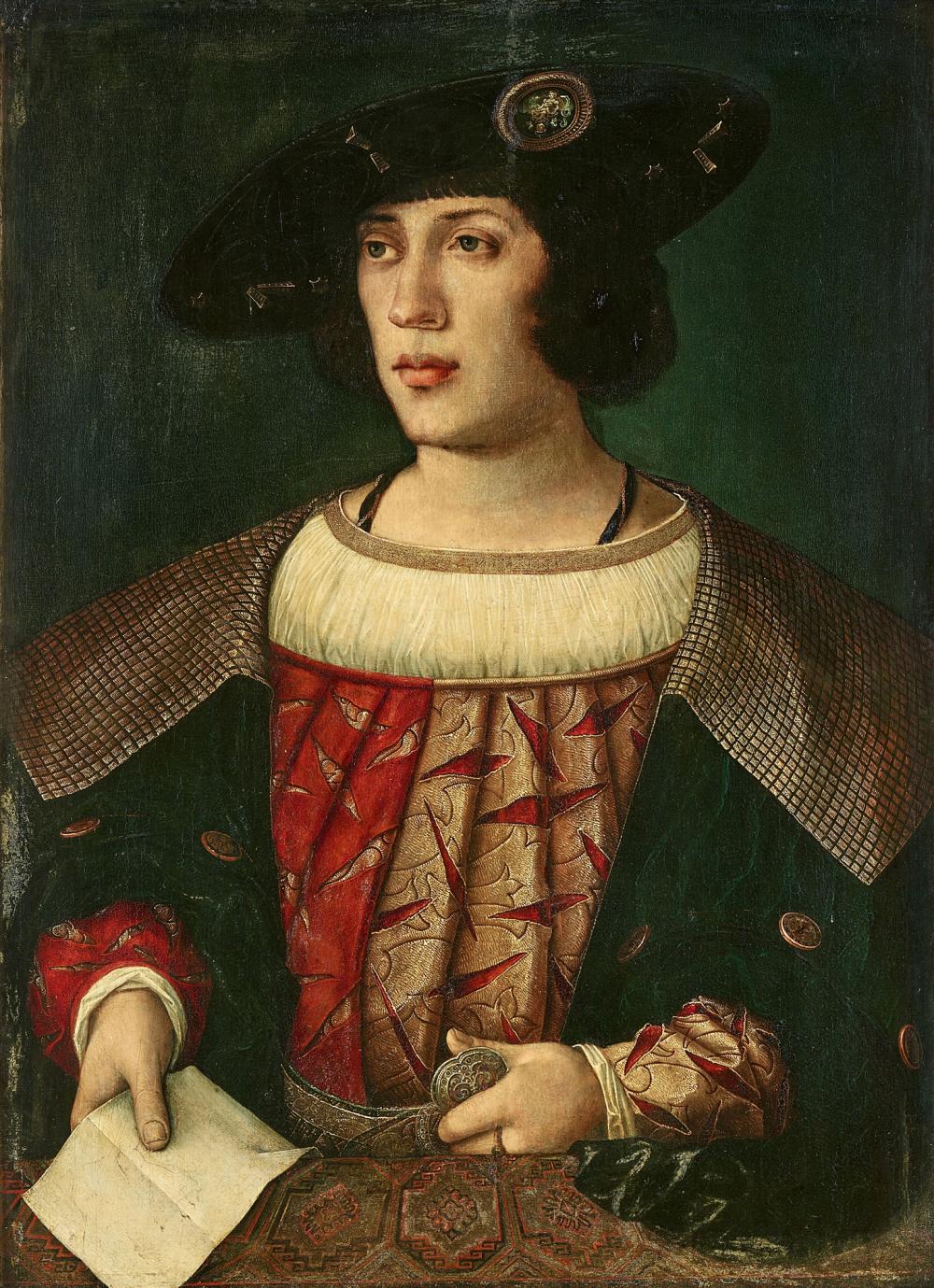
This “Portrait of a Young Nobleman” by Bernard van Orley, probably painted around 1520, was for a long time part of the distinguished collection of the Earls of Rosebery at Mentmore House and was sold at a widely noted auction in 1977. Thereafter the work was known only through the black-and-white illustration in the sale catalogue; even on the occasion of the major Brussels exhibition of 2019, Cécile Scailliérez expressed her urgent wish to study this portrait in particular, in order to gain a better understanding of the artist's portraiture: "...en particulier le Portrait de gentilhomme de l'ancienne collection Rosebery à Mentmore, disparu depuis la vente de 1977 et que l'on aimerait pouvoir étudier..." (Scailliérez, op. cit., p. 63). Now that the portrait is coming to auction again after nearly fifty years, it can be studied in the original, and one may conclude with confidence: it is indeed a remarkable, significant, and brilliantly executed portrait by Bernard van Orley. The young nobleman is dressed in the court fashion of the early sixteenth century. A black beret, adorned with a medallion brooch, covers his head. Beneath a linen shirt he wears a sumptuous and exceptionally refined doublet of silk brocade decorated with diagonal slashings, or crevés. One side is red, the other gold; through the slashes the contrasting fabric shows through, so that the vivid colours mutually enhance one another. Over the doublet he wears a dark green schaube, the collar of which is trimmed with a costly gold lattice-work border. In one hand he holds a sheet of paper; with the other he grasps the pommel of a sword. It is above all in the astonishing rendering of these precious textiles that Bernard van Orley's mastery is fully revealed; the quality of the painting leaves no doubt as to its autograph execution. The sitter was in all probability a member of the Brussels court, the residence of Margaret of Austria, Regent of the Netherlands. The self-assured pose, the elegant dress, and the close framing against a neutral background are all characteristic elements of Bernard van Orley's court portraiture, as a comparison with the portrait of Charles of Habsburg, the future Emperor Charles V, makes clear (fig. 1). The production of such portraits formed part of van Orley's duties as court painter. Charles of Habsburg was certainly the more prominent figure at court; it is therefore all the more striking how generously the present portrait is conceived in comparison with his likeness: the picture field is more expansive; the beret is not cropped by the upper edge; the sitter's torso is shown in its entirety; and the posture, particularly the disposition of the hands, appears more open. What preoccupied Scailliérez in this and other portraits by Bernard van Orley was the complete absence of Italian influence ("profondément étranger à l'italianisme"; Scailliérez, op. cit., p. 63), so conspicuous in his large altarpieces and tapestry cartoons. This phenomenon may be explained by a range of political, sociological, and historical conditions that shaped portraiture in Italy and the Netherlands in differing ways. In any case, Bernard van Orley's portraiture reflects the influence of his contemporaries in the transalpine tradition, among them Quentin Massys and Albrecht Dürer, whom he met in person during the latter's celebrated journey through the Netherlands. This northern tradition offered van Orley ample means by which to convey the standing, self-confidence, and taste of a young nobleman at the Habsburg court. BERNARD VAN ORLEY'S PORTRAIT OF A NOBLEMAN IN THE ROTHSCHILD-ROSEBERY COLLECTION AT MENTMORE HOUSE When the works of art and decorative objects at Mentmore House in Buckinghamshire (fig. 2; also known as Mentmore Towers) were dispersed at auction in 1977, the one-hundred-and-twenty-year history of a great English collection came to an end — that of Baron Mayer de Rothschild and the Earls of Rosebery. Mentmore House had been built in the mid-nineteenth century by the former: a monumental country house intended to accommodate a superabundance of artistic treasures. Further country seats established in the region by branches of the Rothschild family in the ensuing decades — Waddesdon Manor, Ascot House, Halton House, Aston Clinton House — gave rise to the sobriquet "Rothschildshire." Mayer de Rothschild's only daughter Hannah married the 5th Earl of Rosebery, and Mentmore House became his second seat. Bernard van Orley's “Portrait of a Young Nobleman” was purchased in 1859 by the London art dealers P. & D. Colnaghi & Co.; it may therefore be surmised that it was acquired for Mentmore House during Mayer de Rothschild's lifetime. It hung — attributed to Mabuse — in the Green Drawing Room, alongside works by Peter Paul Rubens, Alessandro Allori, Giambattista Moroni, and Francesco Guardi. Following the death of the 6th Earl of Rosebery in 1974, the British government declined to acquire Mentmore House together with its collection. The entire contents, including Bernard van Orley's “Portrait of a Young Nobleman”, were subsequently sold at auction, now bearing the correct attribution. Fig. 1: Bernard van Orley, Charles of Habsburg, later Emperor Charles V, Budapest, Szépművészeti Múzeum. Fig. 2: Mentmore House, Buckinghamshire.