Have one like this?
Upload a photo for a free check of what yours may be worth.
Lot description
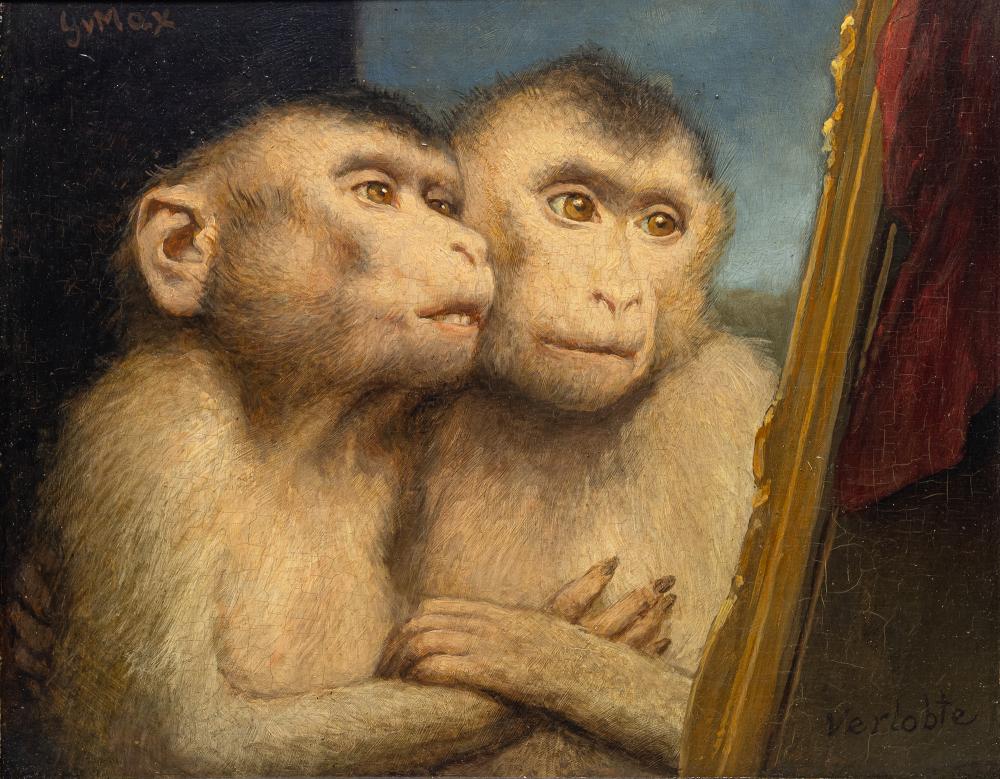
Max, Gabriel von Prag 1840 - München 1915 22 x 28 cm "Verlobte" (Engaged Couple). Two little monkeys, embracing, gaze at themselves in a mirror. Oil/panel, signed top left, titled bottom right. Private collection, Stuttgart. His intense study of Charles Darwin’s theory of human origins led, among other things, to Gabriel von Max acquiring his first live monkey in 1869 - a macaque - which was soon followed by further animals. Eventually, he kept as many as 14 monkeys, which he housed in a garden shed on Schwanthaler Straße. Later, as the monkeys frequently could not tolerate the Munich climate and died despite careful care, he kept only a few animals, which he observed closely, examined scientifically after their death, and photographed. The monkeys were also integrated into family life as household companions, a fact documented by various photographs and sketches by the artist (see also the numerous illustrations in: Gabriel von Max. Malerstar, Darwinist, Spiritist. Exhibition catalogue, Städtische Galerie im Lenbachhaus, Munich, Oct. 2010 to Jan. 2011, Munich 2010) . The only known self-portrait, dating from 1910, accordingly shows the artist with a monkey in his arms (Reiss-Engelhorn-Museum, Mannheim). From the very beginning, religious and mystical themes were at the heart of his artistic work; the psychological interpretation of pictorial content characterised Max’s oeuvre throughout his life. His paintings depicting monkeys made the artist famous. The first documented monkey painting, ‘Schmerzvergessen’ (Forgetting Pain), was created in 1871, followed by numerous others. ‘Monkeys as Art Critics’, arguably his most famous work, was acquired for Munich’s Neue Pinakothek in 1889. By attributing human characteristics to the monkey and thus making it a mirror image of human behaviour, Gabriel von Max follows in a long tradition. In many of his paintings, he places monkeys in human poses and situations, making this clear through titles such as “Entsagung” (Renunciation), “Lied ohne Worte” (Song Without Words), “Schmerzvergessen” (Forgetting Pain) or “Botaniker” (Botanists). It is in this context that our “Engaged Couple” in an intimate embrace should also be viewed. Max, Gabriel von Prag 1840 - München 1915 22 x 28 cm "Verlobte" Zwei Äffchen in Umarmung betrachten sich in einem Spiegel. Öl/Holz, oben links signiert, unten rechts betitelt. Stuttgarter Privatsammlung. Die intensive Beschäftigung mit Charles Darwins Lehre vom Ursprung des Menschen führte unter anderem dazu, dass Gabriel von Max 1869 den ersten lebenden Affen erwarb, einen Makako, dem bald weitere Tiere folgten. Schließlich hielt er sich bis zu 14 Affen, die er in einem Gartenhaus in der Schwanthaler Straße beherbergte. Später, da auch trotz sorgfältiger Pflege die Affen das Münchner Klima häufig nicht vertrugen und starben, umgab er sich nur noch mit wenigen Tieren, die er aufmerksam beobachtete, nach ihrem Tode wissenschaftlich untersuchte und photographierte. Die Affen wurden auch als Hausgenossen in das Familienleben integriert, was durch verschiedene Fotografien und auch Skizzen des Künstlers dokumentiert ist (vgl. hierzu die zahlreichen Abbildungen in: Gabriel von Max. Malerstar, Darwinist, Spiritist. Ausst.-Kat. Städtische Galerie im Lenbachhaus, München Okt. 2010 bis Jan. 2011, München 2010). Das einzige bekannte Selbstporträt zeigt 1910 den Künstler dementsprechend mit einem Affen auf dem Arm (Reiss-Engelhorn-Museum, Mannheim). Im Mittelpunkt seines künstlerischen Schaffens standen von Beginn an religiös-mystische Themen, die Psychologisierung der Bildinhalte zeichnet das Schaffen Max lebenslang aus. Seine Gemälde mit Darstellungen von Affen machten den Künstler berühmt. Das erste dokumentierte Affengemälde "Schmerzvergessen" entstand 1871, dem sich zahlreiche andere anschlossen. Die "Affen als Kunstrichter", sein wohl berühmtestes Werk, wurde 1889 für die Münchner Neue Pinakothek erworben. Indem er dem Affen mensch