Have one like this?
Upload a photo for a free check of what yours may be worth.
Lot description
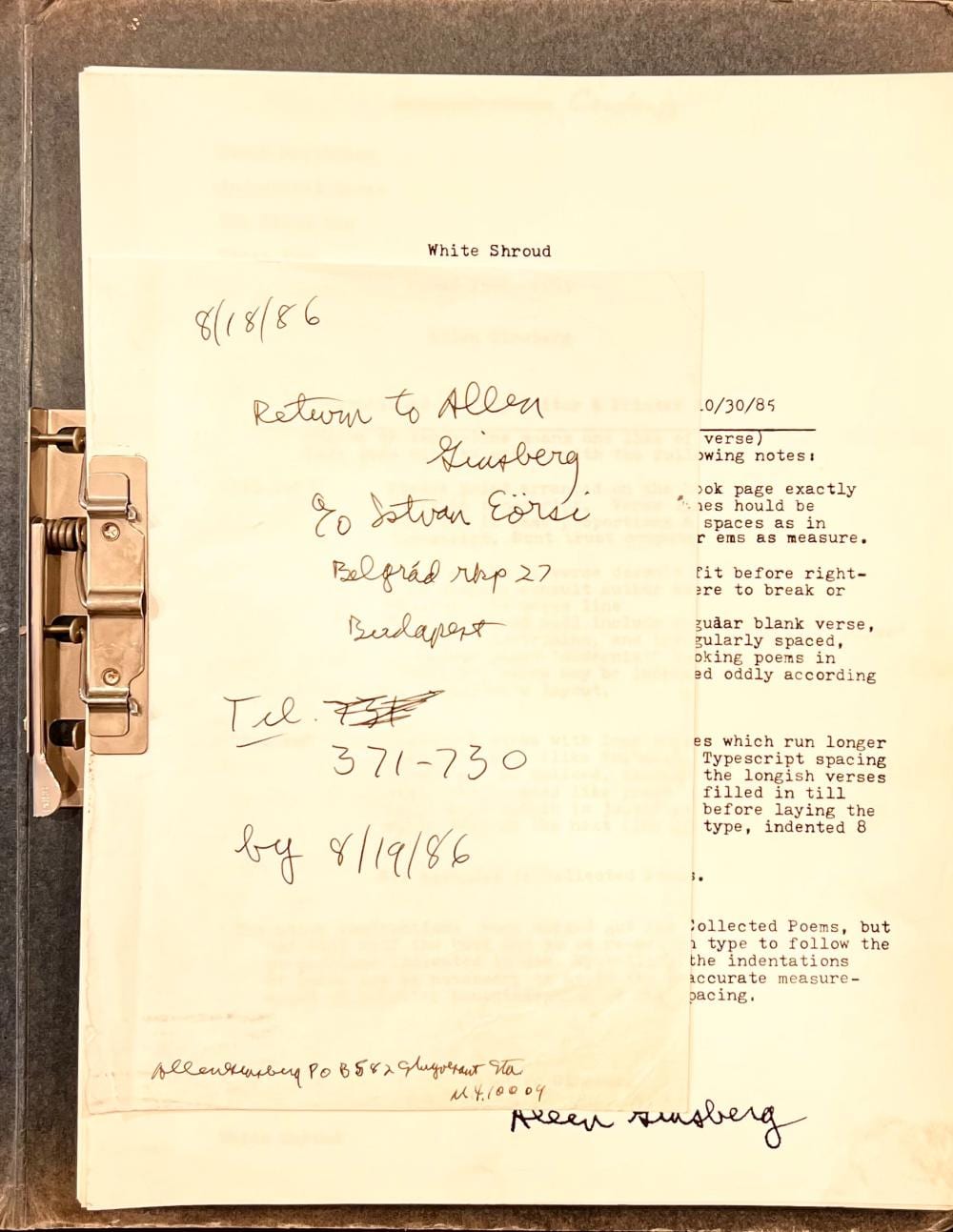
GINSBERG, ALLEN. (1926-1997). American poet; author of the cult favorite Howl. ANS. (Signed twice “Allen Ginsberg”). 1p. 8vo. New York, August 18, 1986. To his friend, Hungarian writer and translator ISTVÁN EÖRSI (1931-2005). A handwritten message accompanying a photocopied typescript and notes for Ginsberg’s poetry collection White Shroud. “Return to Allen Ginsberg c/o Istvan Eörsi Belgrád Rep [?] 27 Budapest Tel. 371-730 by 8/19/86 Allen Ginsberg POB 582 Stuyvesant Station NY 10004” After befriending Beat icons Jack Kerouac, William S. Burroughs and Neal Cassidy while attending Columbia University, Ginsberg followed Cassidy to San Francisco and erupted onto the scene with his now legendary reading and 1955 publication of Howl, a long prose poem in the tradition of Kerouac. Ginsberg became one of America’s best-known contemporary poets due in part to his prolific output in diverse media. In 1961, he published a poem about his mother’s mental illness and death entitled Kaddish, generally regarded as his finest work. Thematically, though written several decades later and published in 1985, White Shroud serves as an epilogue to Kaddish. In addition to his own work, Ginsberg influenced America’s literary landscape as a creative writing teacher at several universities and co-founding a summer writing institute, the Jack Kerouac School of Disembodied Poetics at Boulder, Colorado’s Buddhist Naropa University. Ginsberg’s poetry and political activism in the US and abroad made him one of America’s most celebrated counterculture representatives. In his youth, Eörsi supported the Russian Communist rule of his native Hungary but he was later jailed for writing ideological poetry that helped incite the 1956 Hungarian Revolution. After his release from prison, Eörsi was banned from publishing his own work and turned, instead, to translating Goethe, Brecht, Shelley, Keats, Lorca, and Ginsberg. “Ginsberg was popular and appreciated in Hungary, his intrinsic message of individual freedom resonated with Hungarian youth, writers, and artists who lived under Communist dictatorship. With poetry celebrating democratic sensibilities and championing free expression, Allen Ginsberg was well-represented in Hungarian publications, aided by the enthusiastic translations of Eorsi Istvan,” (“Looking for Ginsberg in Hungary, lescaret.blogspot.com). Contained in the original paper binder with a note by Eorsi’s on the cover identifying the contents. Normal wear and in good condition.