Have one like this?
Upload a photo for a free check of what yours may be worth.
Lot description
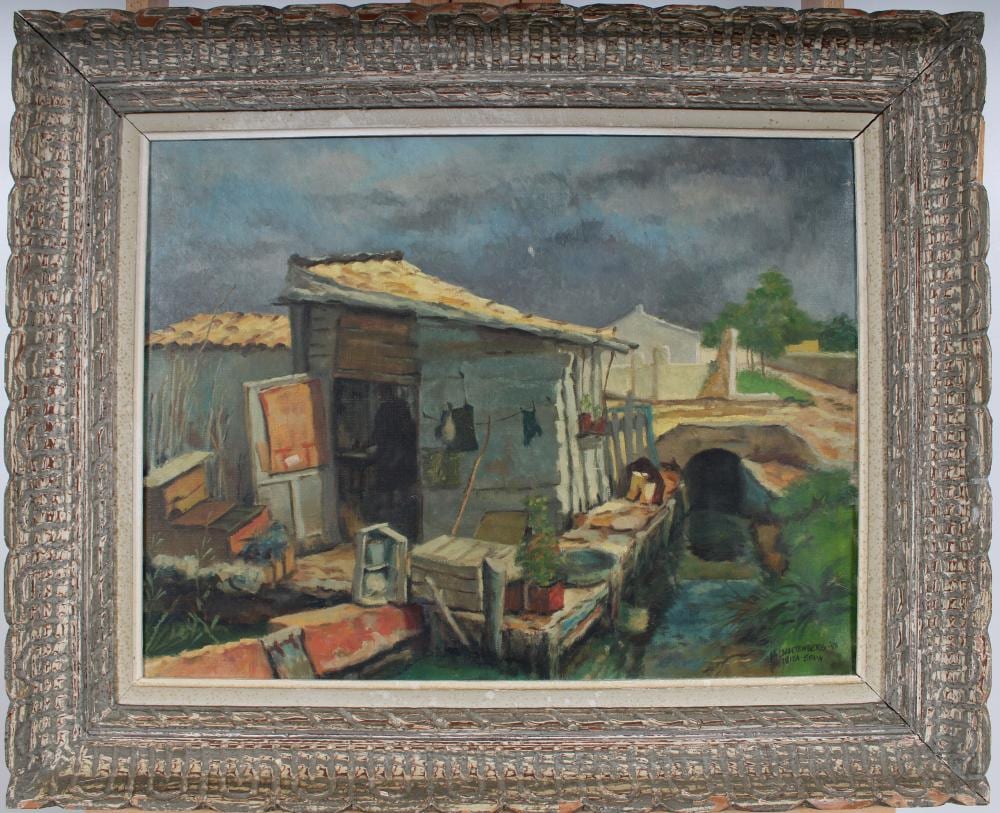
Vintage European modernist oil painting. Measuring: 25.5 by 31.5 inches overall, and 18 by 24 painting alone. Please see all images for condition. Size is measured and written on the back of the painting or next to each object. The first size is the overall size, the second size is the image size. For detailed condition questions please email charles@curatedgallery.com. Domestic flat rate shipping with Fedex is set to $125 for this lot. Pick up at our 21 Hopkins St, Hillsdale NJ 07642 location in is available 10-6pm by appointment for two weeks following the sale by appointment. Transfer from NJ to Greenpoint Brooklyn is available for $20 fee per lot or a maximum of $50 per order. We can also deliver to NJ, NYC, BK and CT for this sale! Pick up will then be available in Brooklyn as well. Please call or email and let us know when you would like to pick up! Local delivery is also available around the area for large pieces or large orders. Flat rate delivery to, NY, PA, OH, NJ, CT, MA, DC as well as NYC and Brooklyn available as well. Thank you and good luck. ARTIST BIO: "Artist sets sights on community," The Tampa Bay Times, by Jorge Sanchez, Sep. 21, 2005The cover of a telephone directory is an unlikely place to find fine art, but Sugarmill Woods residents can look forward to another keepsake when the community's 1997 phone books arrive.If you want to cut out and frame the second scenic cover illustration created by Manes Lichtenberg for the Sugarmill Woods directory, that's understandable.You would be in good company, too. Lichtenberg's work has been on display in leading art galleries in Europe and the United States for the past 30 years. His latest exhibit is at the Nolan Rankin Art Gallery in Houston through February.Lichtenberg's career has led him to roam European and American countrysides, painting richly detailed scenes of natural beauty. The paintings set moods, tell stories and help define cultures.The works also expose the artist's love of life and his vision of the everyday world as a majestic vista of serenity and beauty.An artist's story usually lies in that space between the canvas and the brush. It's the how and the why as much as the when and where.Lichtenberg's life story could be a Hollywood movie. An American In Paris comes pretty close.The year was 1964. Lichtenberg was in Paris, staying on the fabled Left Bank, the cultural and artistic heart of the city. Poets, painters, writers and musicians roamed the streets and cafes."I was on the last year of the GI Bill, studying art and painting," said Lichtenberg, who had served with the U.S. militaryin Europe years earlier.One afternoon, while in a sidewalk cafe, he saw a beautiful young woman sitting with a group of mutual friends. Their eyes met across the terrace. The warm sun and the Parisian spirit worked their charm.All I could think of was telling her, "You look like a cross between Ingrid Bergman and Gina Lollobrigida,' " he said."But in that split second I thought how corny that sounded, so I added "but that doesn't mean you're beautiful,' " he said.The woman who caught the middle-aged artist's eye, Eva Reichel, had made it to Paris after escaping the totalitarian grip of East Germany. Accustomed to being addressed in a proper, European manner, she let Manes, and his American remarks and mannerisms, slide by.A year later, while once again sitting in a Paris cafe with the same group of friends, Eva asked about Lichtenberg. At that moment, a shadow floated across the table. It was Manes, back from a trip to America, where he had delivered his latest works of art."He was all tanned from the sun in the U.S., wearing dark slacks, looking awfully handsome, and that's how it happened," she said.From Paris, Manes (pronounced Mannis) and Eva trekked through Europe, living in far-flung places such as Morocco and Corsica, Normandy and Dubrovnik, Yugoslavia.Schooled at the Art Students League in New York and the Academie de la Grande Chaumiere in Paris, his trained eye captured the little-noticed elements of everyday life. An archway in Corsica; a snow-covered towing path along a silent canal.Using a naturalist style, Lichtenberg created sweeping outdoor scenes, portraits and interiors. When the paintings were complete, he had them transported across the ocean to New York and then shipped to art galleries around the country.Awards and critically acclaimed one-man shows soon followed.Lichtenberg has won practically all major international art awards, including the Prix Maurice Utrillo (International) award in Paris (1964); the Allied Artists Award in New York (1955); the Prix S. Roy Award in Cannes, France (1964); and the Gold Medal of Honor, Allied Artists of America in New York (1964).Galleries like the Allied Artists of America, The Galerie de Siene and The Galerie des Arts in Paris; the Chelsea in London; and the Tossa de Mar in Spain are among the many art houses where a Lichtenberg has hung, and likely has been snapped up by an eager collector. He's listed both in Who's Who in America and Who's Who in American Art.The Lichtenbergs came to America and settled in New Haven, Conn., in 1973. Three years later, Eva entered nearby Yale University. She studied anthropology, earning a coveted Phi Beta Kappa key.After a lifetime of travel and mingling in international art circles, how is it that the Lichtenbergs chose to live in quiet Citrus County?A friend who bought a home in Sugarmill Woods in the late 1980s raved about the community to Manes and Eva. They visited one day and were impressed with the area's beauty."With so much of Florida, they've done a good job of destroying what it was that brought people here in the first place," Eva said. "As soon as we drove into Crystal River, I knew this was where I wanted to live."And, she added, after years of the horrid climate of eastern Europe, the idea of living on the Gulf of Mexico was truly appealing.After spending several years as winter residents, the couple built a home in Sugarmill Woods in 1993.Decorating was no problem: Their home is a showcase of Manes' private collection. It also serves as his studio and a quiet place of reflection for both of them.Lichtenberg said he has had limited involvement with the local art scene in Citrus County other than contributing the artwork for the community phone directory.Earlier this year, however, at the urging of a friend, he took on a major community project.As the new Lecanto branch of the Central Florida Community College was being completed, efforts began to have the campus named in honor of David Walker, a longtime government watchdog and environmental advocate.College officials decided instead to name the naturalist section in the campus' library for Walker. A friend asked Lichtenberg if he would paint a portrait of Walker for the library.Lichtenberg spent time with Walker, visiting him at home and trying to tap into his spirit. Walker's fragile health prevented him from sitting for the portrait, forcing Lichtenberg to break a long-standing rule of not working from photographs.Lichtenberg drove himself hard to create the portrait, working ceaselessly for weeks. The stress caused the 76-year-old Lichtenberg to be hospitalized for several days.Finally, the portrait was complete. In an October dedication ceremony for the campus, the portrait was unveiled to cheers from the audience and a heartfelt embrace from Walker.The portrait, showing a serene and more robust Walker, hangs in the new library wing, calmly watching over the boxes of notes, photos and naturalist books that Walker donated to the school.Lichtenberg is once more in search of places that speak to his artistic heart. The couple are planning a trip to Portugal, where he will sketch scenes to be completed later at his Sugarmill Woods studio.Will he ever slow down?"Artists," Eva said, "don't retire."