Have one like this?
Upload a photo for a free check of what yours may be worth.
Lot description
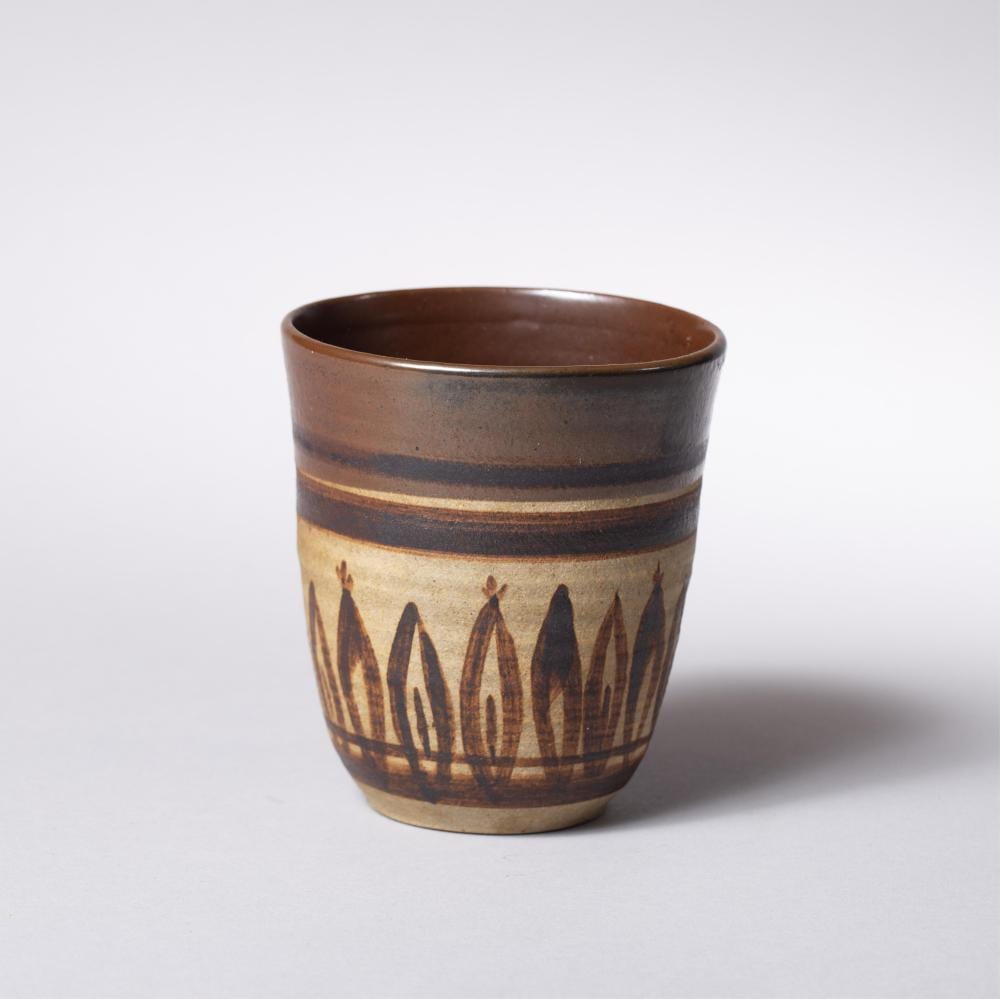
Charles Sequevya Loloma Hopi, 1921-1991 Corn Motif Mug fired clay Signed bottom: Loloma Provenance: The artist The Collection of John L. Schweitzer (1922–2012) & Mary Alice Cox "Mac" Schweitzer (1921–1962) By descent to Thomas White Statement from consignor: "Charles and my father were very good friends for many years up to Charles's passing. My father was an archeologist for the national park service. They met in the 50s before Charles was "Charles Loloma" during the time my father was the superintendent at Navajo National Monument, and he is the one who taught my father silversmithing, a craft he continued to practice until his death. I don't know exactly when that pot was either purchased or gifted, but it was always a fixture in our home when I was growing up. It sat next to the Mr. Coffee pot filled with sugar and was used every day and not given any special treatment. I would guess it was acquired in the early 60s, but possibly in the 50s. We moved around quire a lot as my father graduated through the upper levels of the NPS senior administration, ultimately landing in Farmington in charge of 7 National Parks. Even though Charles eventually became a well known artist, he would frequently fly into town on his way someplace in his private plane and visit with my family. It was a privilege, and my dad always complained that he should have bought more jewelry before he became so well known!" Description: Mug painted with corn motifs around the bottom circumference. Brown paint/glaze along the top rim and inside walls. Artist Bio: Charles Loloma was born in Hotevilla on Third Mesa of the Hopi Reservation. From 1941 to 1945 he served in the army, spending over three years in the Aleutians. He married Otellie Pasivaya in 1942. Immediately following his discharge, they settled in Shipaulovi on the Second Mesa. Late in 1945, the GI Bill made it possible for him to begin studies in ceramics at the School for American Craftsmen at Alfred University, in Alfred, New York. There he received a fellowship from the Whitney Foundation for research in ceramics on the Hopi Reservation. He worked on this project from 1949 to 1951. In 1954 he and his wife opened a pottery shop in Scottsdale, becoming the first tenants of the successful Kiva Craft Center, founded by Lloyd Kiva New. It was in 1955 that Loloma began turning his creative efforts toward jewelry, and gradually this new art form took precedence over the popular Lolomaware pottery line. During the six-year period he had the shop, he devoted his time to teaching at the University of Arizona in Tucson, at Arizona State University in Tempe, and at their summer extension courses in Sedona, AZ. In 1959 he took part in the initial conference, which launched the Rockefeller Foundation's Southwest Indian Art Project at the University of Arizona, and was an instructor for its three succeeding summer sessions. In 1962, with the founding of the Institute of American Indian Arts in Santa Fe came the realization of a long time dream he had shared with Lloyd New, a school directed toward helping Indian students find an individual expression of their cultures through the arts. Loloma and New were appointed heads of the Department of Plastic Arts, as well as the Sales Department where student work was sold. Loloma's jewelry became internationally known and pieces can be found in the collections of many distinguished persons, including Mrs. Dwight D. Eisenhower and Mrs. Frank Lloyd Wright. In the 1960's, President Lyndon B. Johnson commissioned pieces to be presented to the Queen of Denmark and the wife of the Philippine president. During the sixties, Loloma won First Prize seven years in a row at the Scottsdale National Indian Arts Exhibition.