Have one like this?
Upload a photo for a free check of what yours may be worth.
Lot description
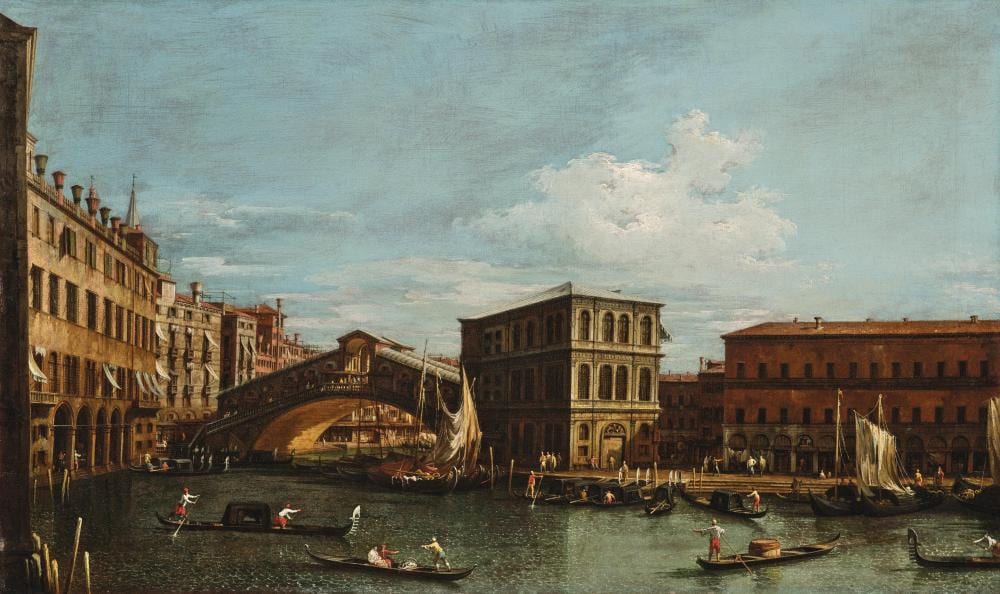
(Venice 1688–1782) The Rialto Bridge, Venice, with the Fondaco dei Tedeschi and Palazzo dei Camerlenghi, oil on canvas, 48.5 x 80 cm, framed Provenance: Duke of Abercorn (according to Galliera); Marquess of Hamilton (according to Galliera); Mrs Barnett (according to Galliera); sale, Christie’s, London, 6 October 1944, lot 26 (according to Galliera); sale, Galliera, Paris, 29 November 1976, lot 25 (as Attributed to Bernardo Bellotto); sale, Franco Semenzato, Venice, 20 October 1985, lot 95 (as Francesco Guardi); Private collection, Italy We are grateful to Bozena Kowalczyk for endorsing the attribution of the present painting and for her help in cataloguing this lot. Antonio Visentini was a highly accomplished figure in eighteenth-century Venice: a painter, engraver, draughtsman, architect and professor of architectural perspective at the Academy. Over the course of his long career, he engaged with the full range of artistic currents that animated the lagoon city, from the exuberance of the Baroque in the early decades of the century to the profound transformations of Neoclassicism. Following his early training with Giovanni Antonio Pellegrini, from whom he absorbed the spontaneous vivacity that characterises the figures in his compositions, Visentini went on to develop a deep admiration for the art of Andrea Palladio and for classical antiquity. This is most evident in his capricci, which remain strikingly free from any direct reference to Venetian iconography. The artist is also well known for his collaboration with Joseph Smith, the English banker and merchant resident in Venice with whom Visentini worked in his capacity of engraver, book illustrator, designer, architectural scholar and architect. This relationship, which is documented from 1717 onwards, places Visentini within the circle of painters favoured by Smith (who would later become British Consul) alongside Marco Ricci, Sebastiano Ricci, Rosalba Carriera, Francesco Zuccarelli, and above all Canaletto. In the late 1720s, Joseph Smith commissioned Antonio Visentini to make engravings of the Grand Canal views by Canaletto, an experience that afforded him an exceptional insight into the master’s technique and compositional methods, which he translated into refined preparatory drawings and meticulously controlled etching. The resulting series, published in 1735 by Giambattista Pasquali as the Prospectus Magni Canalis Venetiarum, and later expanded in 1742 as the Urbis Venetiarum Prospectus Celebriores, enjoyed remarkable and lasting success, with numerous reprints extending into the nineteenth century. Visentini further reinforced this editorial achievement with additional large-format engravings after Canaletto’s views of Piazza San Marco and the Piazzetta in 1744. The present composition, a view of the Rialto Bridge with the imposing Fondaco dei Tedeschi and the elegant Renaissance Palazzo dei Camerlenghi, framed by Palazzo Civran to the left and the Fabbriche Vecchie to the right, recurs frequently in the repertoire of Canaletto and his followers, including Francesco Guardi. The present canvas, together with other variants from Canaletto’s Grand Canal series, was most likely executed by Visentini on commission from Joseph Smith, in response to the strong demand for Venetian views among British collectors during Canaletto’s absence, when he was working in London from May 1746 until December 1755.