Have one like this?
Upload a photo for a free check of what yours may be worth.
Lot description
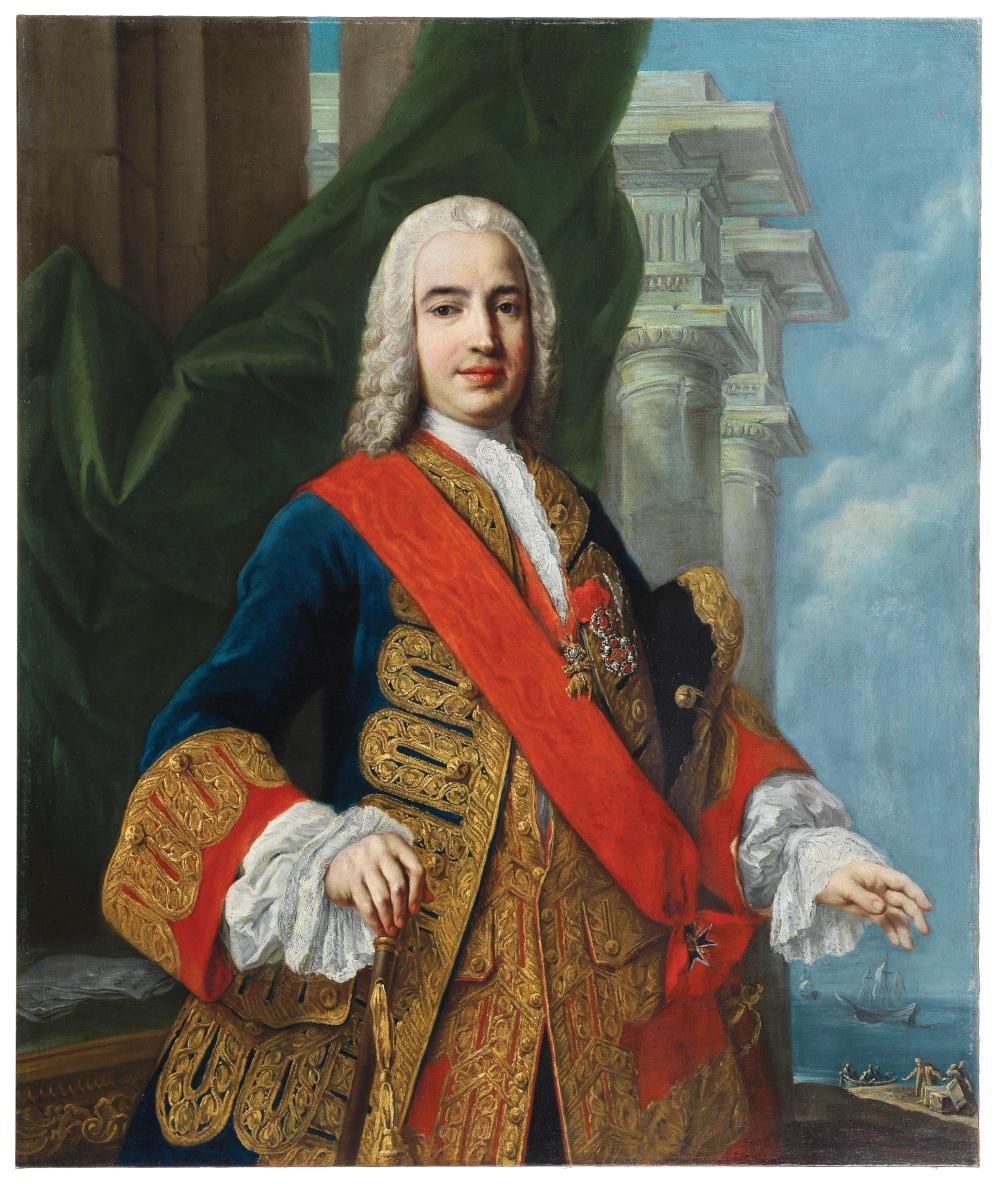
(Venice 1682–1752 Madrid) Portrait of Zenón de Somodevilla y Bengoechea (1702–1781), I Marqués de la Ensenada, three-quarter-length, oil on canvas, 126 x 105.5 cm, framed Provenance: probably collection of Nicolás de Francia y Pascual (1696–1766), I Marqués de San Nicolás, Spain; thence by descent, Cáceres, Spain, until 2024; Private collection, Spain; where acquired by the present owner The present portrait represents Zenón de Somodevilla y Bengoechea (1702–1781), I Marqués de la Ensenada, in a powdered wig, an opulent blue gold-embroidered coat, a red gold-embroidered waistcoat and a broad red sash of high office, corresponding to that of a Distinguished Member of the Royal Order of Saint Januarius. He was a statesman who dominated Spanish government under King Ferdinand VI of Spain (1713–1759). The classical architecture in the background, together with the distant seascape animated by ships, alludes both to the Marqués’s role of state administration and reorganisation of the Spanish navy. He was created marquis in 1736 for his services during the Bourbon campaigns in Southern Italy under the Infante Don Carlos and appointed in 1743 to oversee the ministries of Hacienda, Guerra, Marina and Indias. Ensenada became the most powerful minister of Ferdinand VI’s reign and received the order of the Golden Fleece in 1750. However, he was dismissed from office in 1754 and went into exile. Amigoni’s portrait became of the ‘official’ image of the statesman, a status reflected in the existence of other versions. One version of the present composition is conserved in the Museo Nacional del Prado, Madrid (inv. no. P002939), and has been dated to circa 1750 and a second closely related version is conserved in the Museu Nacional d’Art de Catalunya, Barcelona (inv. no. MNAC 11598). When the present portrait is compared to the other versions, the treatment of the sitter’s regalia is of interest. In the version conserved in Barcelona the Order of the Golden Fleece is not present, where as in the Prado version, the insignia is present, but according to a recent analysis it was not part of the original painted conception, but was added at a later stage (see À. Comella, J. Yeguas, Jacopo Amigoni i les rèpliques del «Retrat del marquès de l’Ensenada», updated in July 2022). An examination of the area surrounding the decoration of the Golden Fleece of the present painting shows that the ribbon of the order was also painted over an already completed passage comprising of the white shirt and the red sash, both of which remain beneath this later addition. The X-radiograph further records localised adjustments in the composition, notably in the left lapel and in the yellow-brown ornament at the tip of the hat under his arm. It should be noted that the sitter received the order in 1750 and therefore both the present painting and the Prado version must have been altered slightly later. Therefore the revisions of the present painting distinguish the present work from the Barcelona version, where the decoration is omitted altogether, and align it more closely with the Prado version. Jacopo Amigoni arrived in Spain around 1747, following a distinguished international career that had taken him from Venice to Germany and England before his final move to Spain. Shortly thereafter he was appointed Pintor de Cámara to Ferdinand VI of Spain and later became the first director of the newly founded Real Academia de Bellas Artes de San Fernando. In the present work, he deploys the full range of his cosmopolitan experience, combining the ceremonial decorum of Bourbon court portraiture with a luminous, characteristically Venetian palette. The meticulous rendering of brocades, gold braid and velvet contrasts with the supple modelling of the face and hands, achieving a balance between representational authority and painterly refinement. The present, recently rediscovered, portrait is an important example of Bourbon state portraiture executed in mid-18th century Madrid it was painted during the most prestigious phase of Amigoni’s Spanish career.