Have one like this? Check yours freeOr have an appraiser value it
Lot description
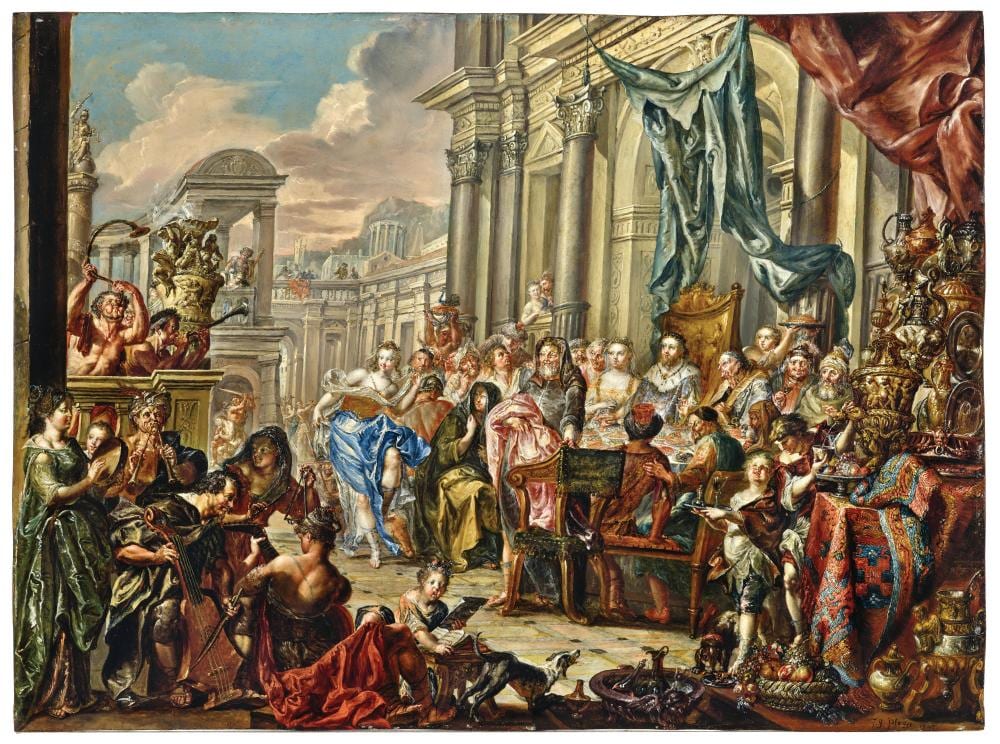
(St. Michael-Eppan 1704–1761) Salome dancing before Herod, bears signature and date lower right: J. G. Plazer 1745, oil on copper, 48 x 65 cm, framed Provenance: sale, Internationales Kunst- und Auktionshaus, Berlin, 24 February 1934, lot 72; with Dr. Walter Bernt, Munich (according to literature); Private collection, Germany Literature: G. Agath, Johann Georg Plazer (1704–1761). Ein Beitrag zur etschländischen Kunstgeschichte des 18. Jahrhunderts, in: Der Sciliar [Schlern], 1938, 7/8, p. 116, illustrated on p. 118, fig. 3; K. Plunger, Johann Georg Plazer. Der Rokokomaler aus dem Überetsch, Eppan 1986, p. 52, no. 7; M. Krapf, Johann Georg Platzer. Der Farbenzauberer des Barock. 1704–1761, Vienna 2014, p. 313, cat. no. 115, illustrated on p. 231 The present painting depicts the biblical episode of Salome’s dance at the Feast of Herod, set against the opulent backdrop of a palace. In the foreground, young attendants serve food and wine on the right-hand side, while a musical ensemble is positioned to the left, the figures and objects forming triangular groupings at the corners which is a compositional device characteristic of Platzer’s work. In the middle ground, Salome is shown in elegant movement, while a vignette in the background subtly records the beheading of John the Baptist. An Austrian painter and draughtsman, Platzer came from a family of artists in South Tyrol, studying first with his stepfather Josef Anton Kessler and then with his uncle Christoph Platzer, who was court painter in Passau. In circa 1726 he moved to Vienna, where he was admitted to the Akademie der Bildenden Künste and became a friend of Franz Christoph Janneck. His oeuvre is made up of mostly small paintings, predominently on copper, and he was celebrated as the leading master of the conversation piece in eighteenth-century Austria, combining a masterful technique, vibrant colours, and attention to detail, with influences drawn from Italian, Flemish, and French models. The recurring use of architectural motifs in his work, such as in the present painting, derives from Northern Italian quadratura painting. Platzer’s compositions are distinguished by a delicate blend of coquettish charm and elegance, achieved through the finest gradations of colour extending even into the background. This sensibility, with its nuanced interplay of figures and space, occasionally recalls the fêtes galantes of Watteau, situating Platzer firmly within the refined decorative tradition of European Rococo.