Have one like this?
Upload a photo for a free check of what yours may be worth.
Lot description
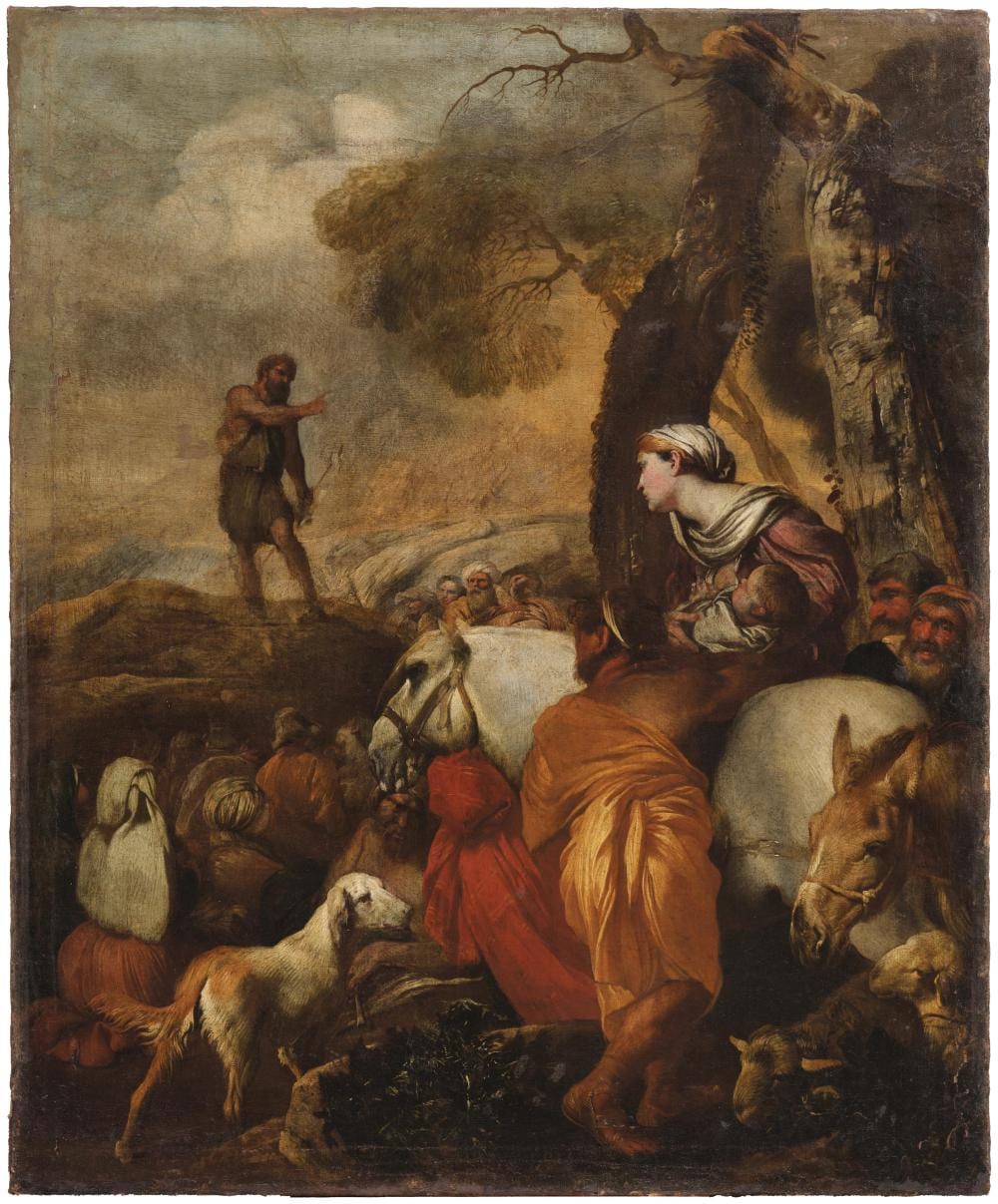
(Genoa 1609/16–1664/70 Mantua) The Sermon of Saint John the Baptist, oil on canvas, 133 x 110 cm, unframed Provenance: Private European collection; where acquired by the present owner We are grateful to Anna Orlando for endorsing the attribution of the present painting on the basis of a photograph and for her help in cataloguing this lot. We are also grateful to Vilmos Tátrai for independently endorsing the attribution on the basis of a photograph. Born in Genoa, but active in Rome and later in Mantua, where he became court painter to Duke Carlo II Gonzaga-Nevers, Giovanni Benedetto Castiglione stands apart from his contemporaries for the originality and imaginative freedom of his artistic vision. His works not only display remarkable technical skill but also reveal a distinctly independent and innovative spirit. This is already evident in his earliest paintings, among which the present work should be included. The painting is datable to the early 1630s during the artist's first Roman sojourn and can be compared to compositions such as the Journey of Jacob and Rachel in the Museo del Prado (inv. no. P000086) and the Journey of Jacob in the Galleria Borghese (inv. no. 550). Castiglione's activity in Rome has recently been reassessed in a monographic study that proposes a catalogue raisonné of works associated with his first and second periods there, respectively circa 1632–37 and circa 1647–51 (see A. Orlando and F. Rotatori [eds.], Giovanni Benedetto Castiglione Genovese. Il Grechetto a Roma: committenza e opere, Genoa 2022). Orlando considers the present Sermon of Saint John the Baptist to display stylistic features that are fully consistent with Castiglione's works from the 1630s. A key element of this composition is the landscape, which reflects the artistic developments taking place in Rome at that time and finds parallels in Castiglione's graphic works and etchings, revealing his debt to leading landscape painters active in the city, such as Claude Lorrain and Nicolas Poussin. In this work, Castiglione creates a transformation in the depiction of sacred narrative. In a striking and almost provocative manner, he relegates the principal subject to the background, as Saint John the Baptist is rendered almost as a silhouette in the distance, nearly disappearing when compared to the young woman on horseback holding a child and the figure leaning on the horse, who commands the viewer's attention. The foreground is dominated by animals, also effectively shifting the visual focus away from the primary subject. Stylistically, the painting is distinguished by Castiglione's characteristic hatched brushwork, which translates into paint the effects he also achieved in his etchings.