Have one like this? Check yours freeOr have an appraiser value it
Lot description
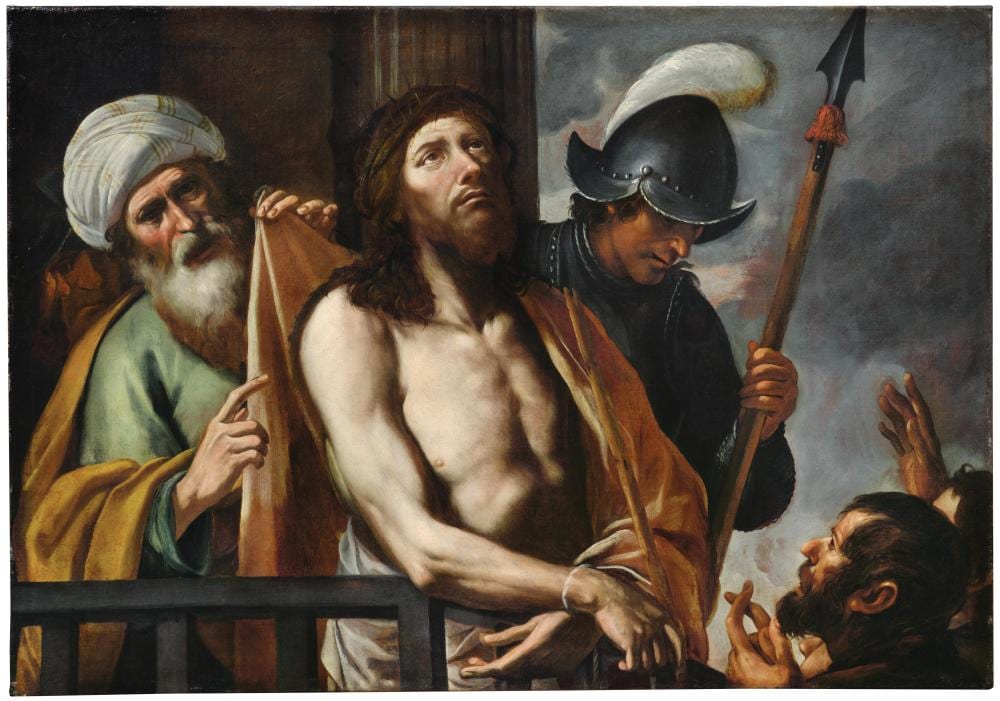
(Taverna 1603–1672 Rome) Christ before Pontius Pilate, oil on canvas, 94 x 134.5 cm, framed Provenance: sale, Sotheby’s, London, 30 Oktober 1996, lot 164 (as Bolognese School, 17th Century); sale, Meeting Art Auctions, Vercelli, 12 November 2023, lot 166 (as Gregorio Preti); Private collection, Rome Exhibited: Rome, Gallerie Nazionali d’Arte Antica, Palazzo Barberini, Il Trionfo dei Sensi. Nuova luce su Mattia e Gregorio Preti, 22 February – 16 June 2019; Taverna, Museo Civico, Gregorio Preti, Pittore di buon nome. Storia di una riscoperta, 22 December 2022 – 20 February 2023 Literature: G. Valentino, J. T. Spike, L. Calenne, Gregorio Preti. Pittore di buon nome. Storia di una riscoperta, Gangemi, Roma 2023, p. 105, fig. 10; F. Gatta, Un inedito dipinto di Gregorio Preti: il ‘Cristo mostrato ai giudei da Ponzio Pilato’, in A. Anselmi (ed.), La Calabria del viceregno spagnolo, Gangemi 2009, p. 475, fig. 1 (as Gregorio Preti); T. Borgogelli, Gregorio Preti. Una nuova Pala Romana e altre aggiunte al suo catalogo, in: Bollettino d’Arte, 7th series, vol. 102, 33–34, 2017, p. 150, fig. 5 (as Gregorio Preti); A. Bartolucci, Un nuovo dipinto di Gregorio Preti ai musei civici di Reggio Emilia, in: Taccuini d’arte, vol. 13, 2021, p. 73, fig. 5 (as Gregorio Preti); Y. Primarosa, Il Trionfo dei Sensi. Nuova luce su Mattia e Gregorio Preti, De Luca Editore 2019, pp. 144–145; L. Calenne, Il laboratorio iconografico di Gregorio Preti, in: A. Vannugli, Amica Veritas. Studi di storia dell’arte in onore di Claudio Strinati, Rome 2020, p. 82, fig. 4 (as Gregorio Preti) The present work may be understood as a direct development of the Pilate Washing His Hands executed by Gregorio Preti in collaboration with his younger brother Mattia Preti (see C. Carlino, Gregorio Preti. Da Taverna a Roma. 1603–1672, Reggio Calabria 2003, p. 90, cat. no. 10), which probably predates the present painting by roughly a decade (see G. Porzio, Per una rivalutazione di Gregorio Preti, in: Artitalies, 18, 2012, pp. 39–45, with earlier bibliography). Although it remains difficult to establish a precise chronology within Gregorio’s oeuvre, the close relationship between the present painting of Christ before Pontius Pilate and his works in San Venanzio in Fabriano – particularly the Return of the Prodigal Son (see C. Carlino, ibid., 2003, p. 138, cat. no. 55) – should be noted. These works belong to a period, perhaps in the late 1640s or early 1650s, when the artist had reached the height of his career, culminating, together with Mattia, in the prestigious commission for the two frescoes on the counter-façade of San Carlo ai Catinari (1652). Gregorio Preti was active predominantly in Rome, where, under the patronage of the Aldobrandini, he established connections with important collectors and introduced his younger brother Mattia Preti to the city’s artistic milieu. His early work, often intended for private settings, reflects a balance between the classicism of Domenichino and a more measured response to Caravaggesque naturalism, while his later production remained firmly rooted in an idealizing, devotional language. Though long overshadowed by Mattia, he was regarded by contemporaries as a ‘painter of good repute’ and occupies a distinct place among the proponents of mid-17th-century Roman classicism.