Have one like this? Check yours freeOr have an appraiser value it
Lot description
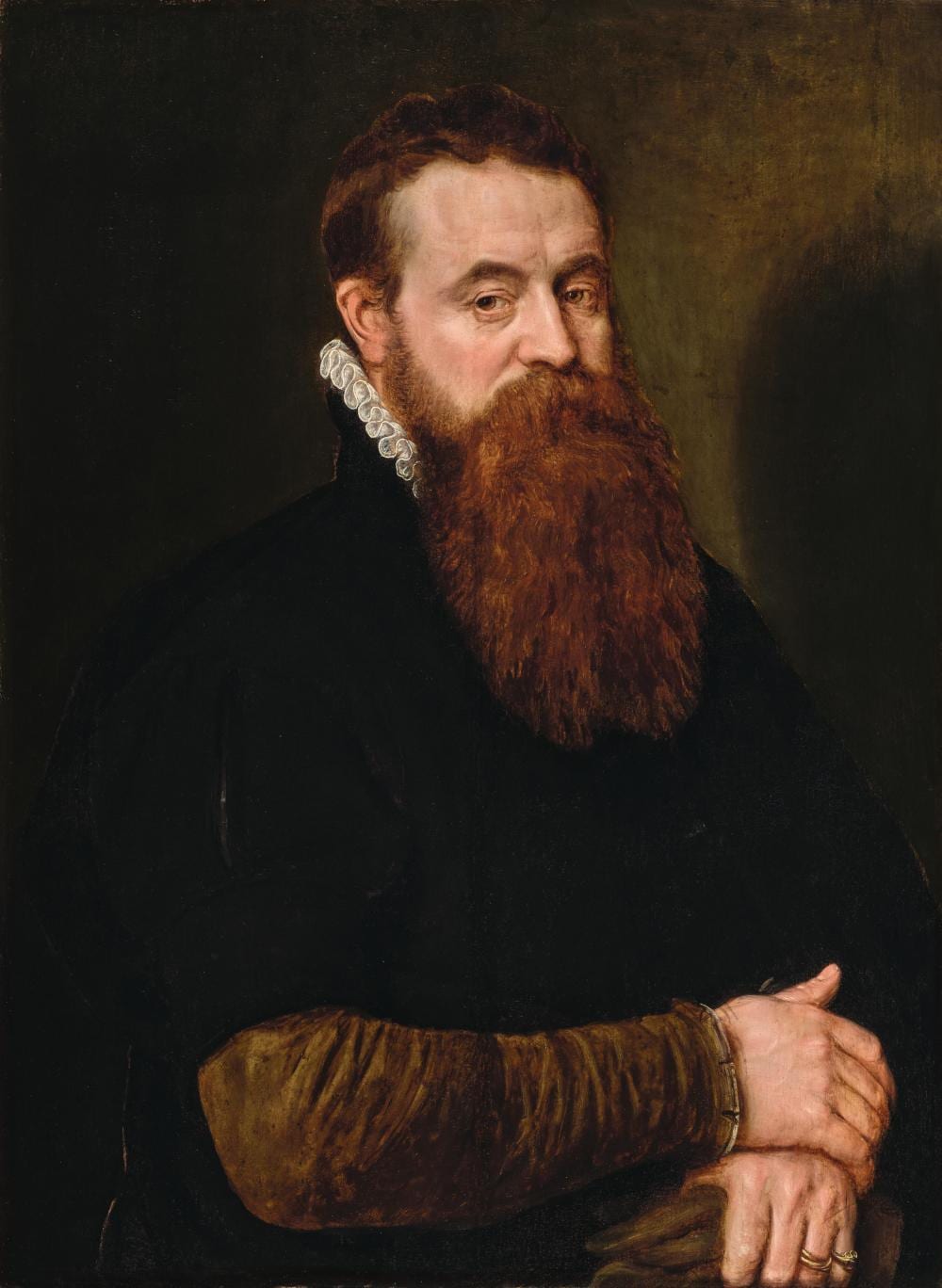
(Antwerp circa 1545 – after 1589) Portrait of a bearded man, half-length, oil on panel, 78 x 58 cm, framed Provenance: art market, Belgium; where acquired by the present owner Literature: L. Vandenberghe, Willem and Adriaen Thomasz. Key. Fresh Perspectives on their Oeuvres, Pictura Nova XXVIII, Turnhout 2025, pp. 166–167, no. add. A20 (as Adriaen Thomasz. Key) We are grateful to Koenraad Jonckheere for confirming the attribution of the present painting after inspection of original. He dates this work to circa 1570. This striking portrait of a bearded man, notable for its intimate, naturalistic portrayal of the features and the contemplative gaze of the sitter, is an outstanding example of the oeuvre of the Antwerp master, Adriaen Thomasz. Key. The sitter is dressed in an expensive and modish ‘Burgundian black’ doublet, his hands unsheathed from fine kid gloves revealing fingers adorned with rings, the sitter can be assumed to be a nobleman, but a precise identification remains uncertain, as not even his nationality can be determined. Antwerp was the major economic hub of Northern Europe at this time and the Key workshop, founded by Adriaen Thomasz’s master, Willem Key (1516–1578), boasted a wealthy, international clientele, which included Margaret of Parma, and William the Silent, Prince of Orange. Adriaen Thomasz Key was thought to be the son of Willem Key, however recent research has revealed that was only related to Willem only by marriage. He added the ‘Key’ suffix to his name when he took over his late master’s workshop. Following the Beeldenstorm, or iconoclasm of 1566, Antwerp was at the centre of intense religious and political turbulence, yet amid this uncertainty, the superb quality of the Key workshop offered a consistent assurance of work of the highest standard. Jonckheere has suggested that it can be argued that the work of Adriaen was more refined than that of Willem Key as he “succeeded much more than his master in transforming his observations of nature into a detailed image”.