Have one like this?
Upload a photo for a free check of what yours may be worth.
Lot description
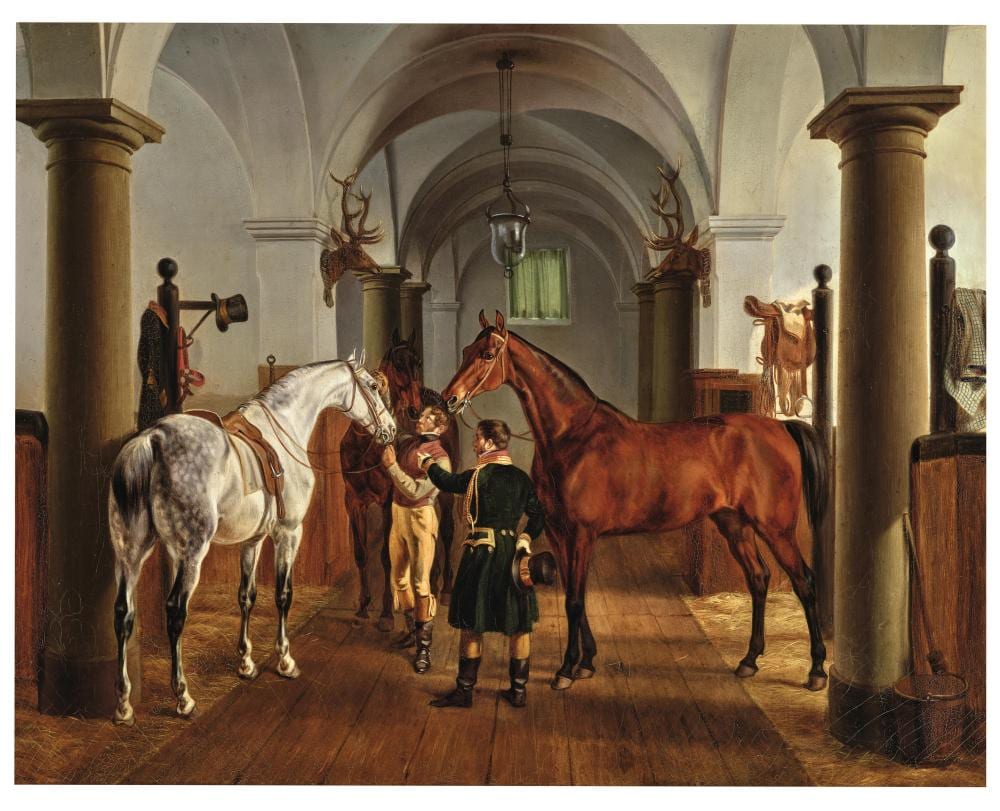
(Nördlingen 1786–1862 Munich) Three horses in a stable, one being groomed by its handler, signed and indistinctly dated A. Adam 18.1., oil on canvas, 54 × 69 cm, framed Albrecht Adam, born in Nördlingen in 1786, became the founding father of a large and influential family of artists. He was originally intended to become a confectioner. In 1803, he moved to Nuremberg as an apprentice. There he met the director of the drawing school, Christoph Johann Sigmund Zwinger (1744–1813), produced his first drawings and received his initial training in oil painting. From 1806 onwards, he turned his attention to battle and equine painting, particularly under the influence of the Augsburg painter Johann Lorenz Rugendas (1775–1826). In this genre, he became one of the outstanding masters of his time. Adam received a crucial early boost in 1807 through his acquaintance with the Royal Master of the Horse, Karl Ludwig Baron Kesling von Bergen (1788–1868), which was arranged by Count Montjoye (Froberg). He received riding lessons and was permitted to study and paint in the stables and riding halls. This direct observation of horses in motion had a lasting influence on his work and laid the foundation for his extraordinary mastery in depicting their anatomy. Adam experienced the Austrian campaign of 1809 at close quarters. He subsequently stayed in Vienna, where he caught the attention of Prince Eugène de Beauharnais, Duke of Leuchtenberg and stepson of Napoleon Bonaparte. From 1809 to 1814, Adam was in his service. He accompanied the Duke on his travels and into the campaigns of the Napoleonic Wars, including the Russian campaign. These experiences provided the subject matter for a wealth of paintings and studies. Until 1815, he spent most of his time in the viceroy’s entourage, chiefly in Italy, and worked exclusively for him. After the Congress of Vienna, he was summoned to Munich, where he settled permanently. There he initially worked for King Maximilian I Joseph of Bavaria and later for Ludwig I of Bavaria and Maximilian II of Bavaria. His patrons also included Prince Karl Philipp von Wrede, the Duke of Leuchtenberg, King Wilhelm of Württemberg, and the Emperor of Austria, for whom he painted The Deeds of Radetzky’s Army in 1850. To accommodate his large-scale compositions, he acquired a garden plot with a ground-floor studio into which horses could be led directly. It was there that the so-called ‘Adamei’ was created. In 1841, Adam undertook a study trip to Malborghetto, south of Villach, and to the Piave. The return journey took him via Venice and Verona. Visits to his old patron Baron Kesling in Bergstetten, to Prince Wrede in Ellingen, and to the Duke of Leuchtenberg in Eichstätt document the continuity of his princely networks. Even King Ludwig I visited him in his studio. His particular strength lay in the study of the horse, whose anatomy, movement and character he captured with unrivalled precision. In this genre, he was regarded as the most significant painter of his time. This lot depicts two purebred Arabians and a grey horse in a well-maintained and well-equipped stable, reminiscent of the royal stables of the Bavarian King in Nymphenburg or the Residenz in Munich. A gentleman in a dark frock coat and light-coloured riding breeches holds his top hat behind his back and appears to be giving instructions to the groom who is grooming the horse.