Have one like this?
Upload a photo for a free check of what yours may be worth.
Lot description
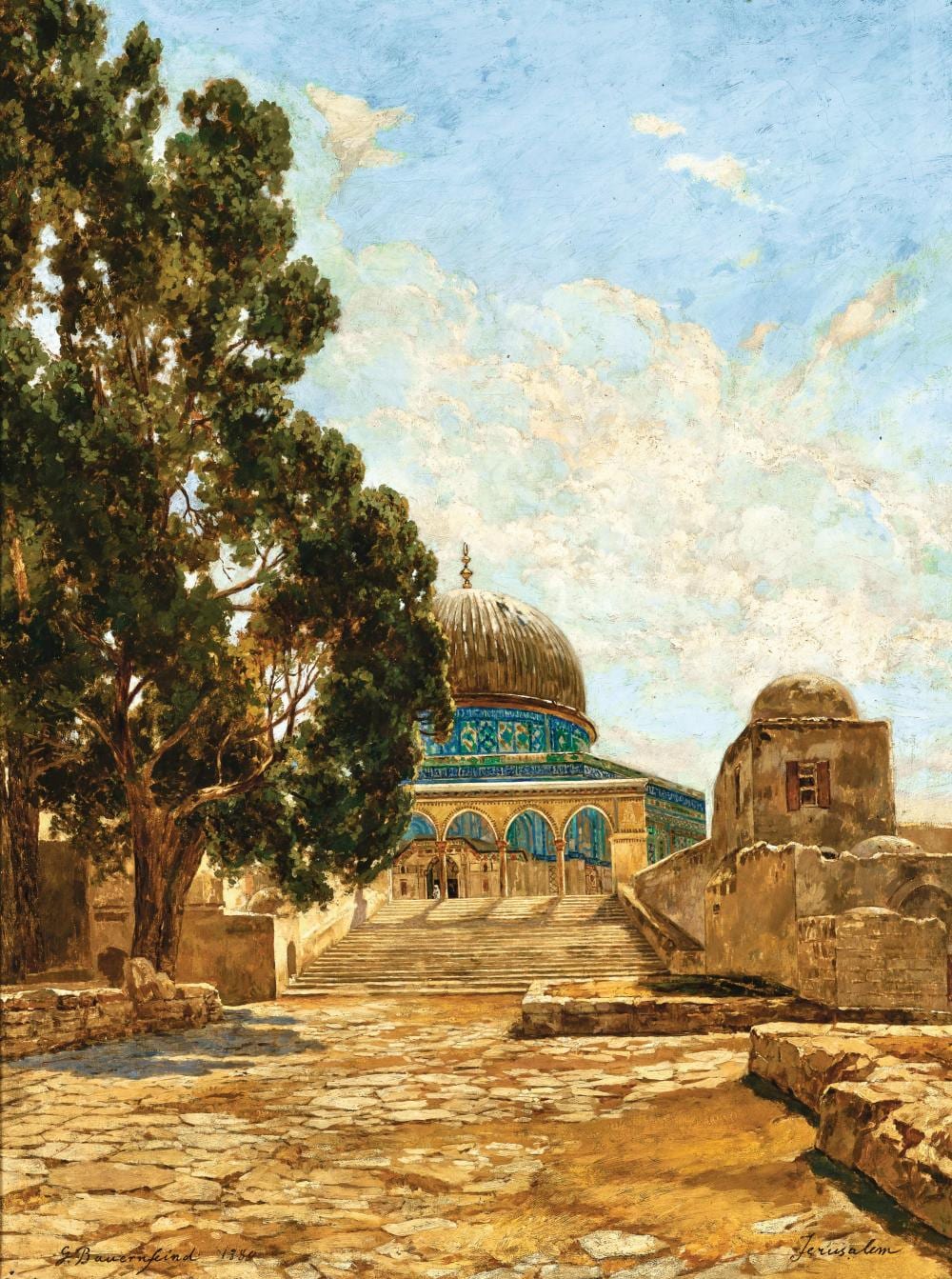
(Sulz am Neckar 1848–1904 Jerusalem) Jerusalem, a view of the Mosque of Omar, signed, dated G. Bauernfeind 1880 Jerusalem, oil on canvas, 60 x 46 cm, framed Provenance: European Private Collection. Compare: Richard Weinzierl, Gustav Bauernfeind. Der Orientmaler, Stuttgart 2021, p. 224, ill. 177. We are grateful to Richard Weinzierl, Bauernfeind Museum, Sulz am Neckar for the scholarly advice. Gustav Bauernfeind is regarded as one of the most significant German artists working in the Orientalist style of the late 19th century. He initially trained as an architect at the Polytechnic School in Stuttgart, an experience that had a decisive influence on his artistic work. This is particularly evident in the precise depiction of buildings and perspectives in his paintings. In 1870, he completed his architectural studies and subsequently turned to painting. With the support of his professor, Adolf Gnauth (1840–1884), he was able to undertake his first extended journey to Italy in 1873. On this journey, he turned to oil painting and produced various studies and paintings. His travels to the Orient marked a decisive turning point in his artistic development. After extensive preparations, he set off on his first journey to the Orient, bound for Beirut, in April 1880. His sister Emilie had been living there with her family since 1871, having moved to Alexandria in October 1869 to join her husband, the missionary Wilhelm Staiger. From Beirut, he travelled through Palestine and Syria, finding in the region’s cities, landscapes and religious sites a central source of inspiration for his art. In the years that followed, he returned to the Orient on several occasions and created detailed views of cities such as Jaffa, Damascus and Jerusalem. In early 1887, he met Elise Bertsch in Jerusalem, who was working for the Basel Mission on her way to India. Two years later, in July 1889, the couple married in Baden-Baden and lived in his Munich flat. During this period, drawing on his numerous studies, sketches and watercolours, he produced oil paintings—some of them large-scale—in his studio, which he sold to England and America. After years in Munich, Bauernfeind moved permanently to Palestine with his family in 1896 and eventually settled in Jerusalem. There he worked in close proximity to the very places he depicted. As this lot illustrates, his paintings are characterised by an extraordinary precision in the rendering of architectural details, as well as by an impressive atmosphere of light. The painting, which depicts the Omar Mosque in Jerusalem, was created in his studio in Munich following his first journey to the Orient, using a sketch he had brought back with him. A watercolour that Bauernfeind produced on site to determine the colour scheme is now housed in the Bauernfeind Museum in Sulz am Neckar. During his lifetime, Bauernfeind was regarded as one of the most popular German Orientalist painters, but after his death in Jerusalem in 1904, he initially fell into obscurity. It is only since the late 20th century that his work has once again been increasingly appreciated; today it ranks among the outstanding examples of European Orientalist painting.