Have one like this? Check yours freeOr have an appraiser value it
Lot description
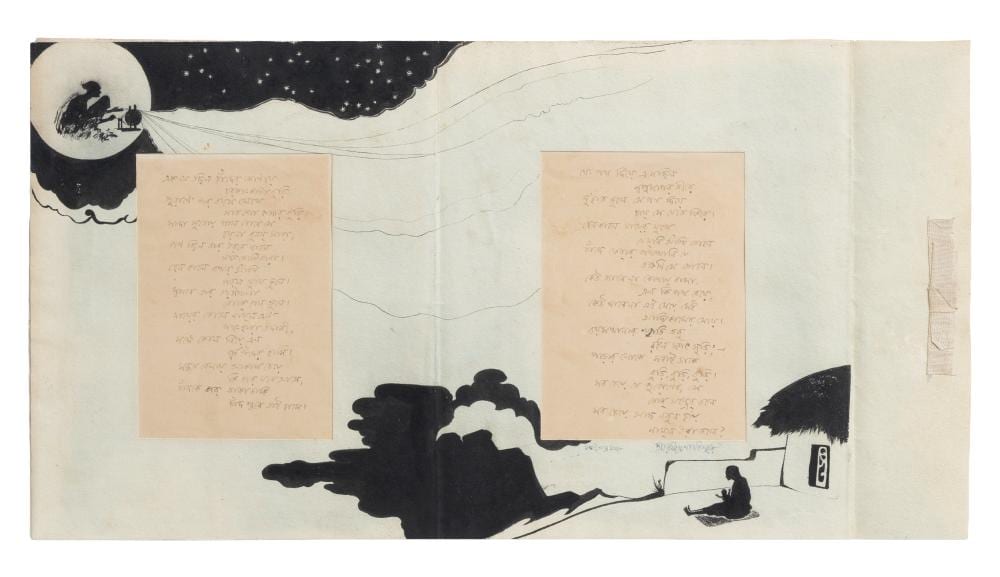
Autograph Bengali Poem within a Santiniketan Illustrated Passepartout, handwritten by Rabindranath Tagore (1861-1941),inscribed in pencil 'Rabindranath Tagore poetry/written 4 days before/birth of Atasi' (on the reverse of the passe-partout),ink and pencil on paper, two sheets: 19x18 cm, passe-partout: 4x 26x21,5 cm,,Provenance:-Collection Asit Kumar Haldar (1890-1964), thence by descent to the present owners.,Ink on paper, comprising an autograph manuscript poem in Bengali in Tagore’s hand, written on two leaves and mounted within a purpose-designed illustrated passepartout executed in the Santiniketan artistic idiom and most likely drawn by Tagore. The surrounding monochrome pen-and-ink drawing depicts a nocturnal landscape with moon, stars, distant figure and village dwelling, evoking the lyrical atmosphere central to Tagore’s late poetic imagination and characteristic of the Visva-Bharati art school.The poem tells of an old woman who lives on the moon and spends her nights spinning a net of white thread in hopes of catching the stars. One night she dozes off, dreams herself young again, and awakens as a smiling child on earth. Blending fantasy, cosmic imagery and gentle humour, the poem exemplifies Tagore’s talent for turning philosophical ideas into playful fairy-tale scenes for children. The motif of an old woman living on the moon in Bengali folklore likely dates back several centuries, transmitted orally long before it was ever recorded in writing. Rural Bengali storytelling traditions surrounding the moon are ancient, probably originating in the medieval period or even earlier. This particular adaptation of the traditional tale forms part of Tagore’s wider contribution to children’s literature, which played an important role in shaping early twentieth-century Bengali cultural and educational life. Tagore’s poem appeared in print in 1922, under the title ‘Chander Buri / Buri' in the children’s poetry collection Shishu Bhōlanāth. This handwritten manuscript is very likely the original text composed by Tagore around 31 August 1921 for Atasi, the eldest daughter of the artist Asit Kumar Haldar, and presented to Haldar as a gift. The verso bears a contemporary annotation reading: “four days before the birth of Atasi” (born 4 September 1921). Tagore himself is understood to have bestowed the name Atasi. Surviving autograph literary manuscripts by Tagore in private hands are exceedingly scarce, most comparable material being preserved at Rabindra Bhavana and other institutional repositories.