Have one like this? Check yours freeOr have an appraiser value it
Lot description
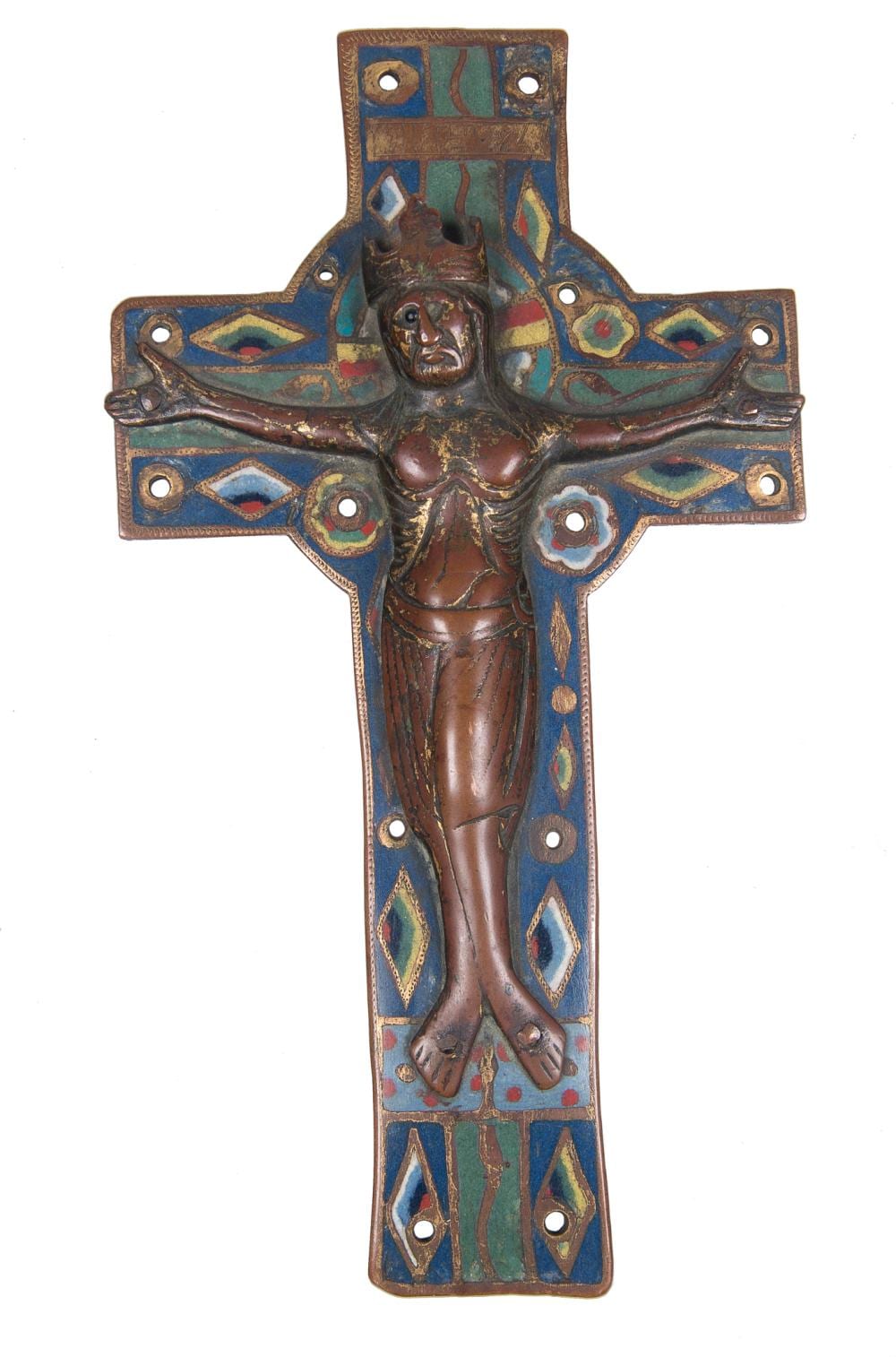
A important central plaque from the cover of a Gospel book, in chiselled, engraved, and gilded copper with champlevé enamel. Limoges. France. Romanesque. First third of the 13th century. Set upon an engraved and gilded copper cross, richly decorated with champlevé enamels in tones of lapis lazuli blue, light blue, white, yellow, green, turquoise, and red, is an applied figure of Christ with a crowned head and long locks falling over the shoulders. He wears a long perizonium. The eyes (one now missing) are inlays of blue glass or jet. The cross is topped by the Christogram “IHS.” Cross measurements: 20 x 11 cm. Christ measurements: 14 x 11 cm. Our cross is virtually identical to the example preserved in the Museu Episcopal de Vic (Inv. no. 181). As noted in the museum’s catalogue, “luxurious covers intended to protect the texts of the Holy Scriptures were very common from the earliest periods of medieval European art. From the last quarter of the 12th century and throughout the 13th century, the workshops of Limoges, in Aquitaine, produced various types of covers of great artistic quality, which were highly appreciated among Christian religious centers. These may be included within Byzantine-derived traditions due to their gilded surfaces, the use of opaque champlevé enamel, and, in general, the iconographic and ornamental arrangement of the ensemble.” Another comparable example, although in considerably poorer condition than ours, is preserved in the Salisbury Museum. Of particular interest is the information regarding the origin and wide dissemination of Limoges production found on the website www.limousin-medieval.com/emaux. As explained there, champlevé enameling on copper (a thick plate into which cavities or cells are carved to receive the enamel) developed at the beginning of the 12th century in two main centers: a northern one (Rhine-Meuse) and a southern one (Limousin and Spain). From the second quarter of the 12th century onwards, Limousin workshops produced objects in champlevé enamel on copper. By 1169, referred to in texts as “Œuvre de Limoges” or “Opus lemovicense,” the production of Limousin workshops spread throughout Europe, supported by commissions from major abbeys such as Saint-Martial and the Order of Grandmont, as well as their patrons, the Plantagenets. It was further encouraged by the decision of Pope Innocent III at the Fourth Lateran Council in 1215, which authorized the use of champlevé enamel for sacred vessels. The great success of these works was also due to the relatively modest cost of materials, the brilliance of the colors used, and the diversity of objects produced, both religious and secular. Notably, a Gospel Book cover is precisely the object mentioned in the earliest text describing the “Œuvre de Limoges.” Written between 1167 and 1169, it refers to a “book cover” kept at the Abbey of Saint-Victor in Paris, as recorded by a cleric from the circle of Thomas Becket. This text was soon followed by others that again mention book covers, this time in southern Italy, at Santa Maria di Veglia in 1197. “Limoges crosses” also appear, alongside various other goods, in the toll register of Bapaume in 1202. Reference comparisons: - https://museuartmedieval.cat/es/colleccions/orfebreria-y-metal/placa-de-cubierta-de-evangeliario-con-un-crucifijo-mev-181 - https://salisburymuseum.org.uk/collections/limoges-enamel-crucifix/ This lot is of imported origin and is accompanied by an export permit issued by the Ministry of Culture; it is exempt from export taxes for buyers outside the European Union. Selected bibliography: - https://www.limousin-medieval.com/crosses-and-reliquary-crosses - P. Thoby, Les croix limousines de la fin du XIIe siècle au début du XIVe siècle, Paris, 1953. - M.-M. Gauthier, E. Antoine, and D. Gaborit-Chopin, Corpus des émaux méridionaux, vol. II, L’apogée, 1190–1215, Paris, 2011. Medieval.