Have one like this? Check yours freeOr have an appraiser value it
Lot description
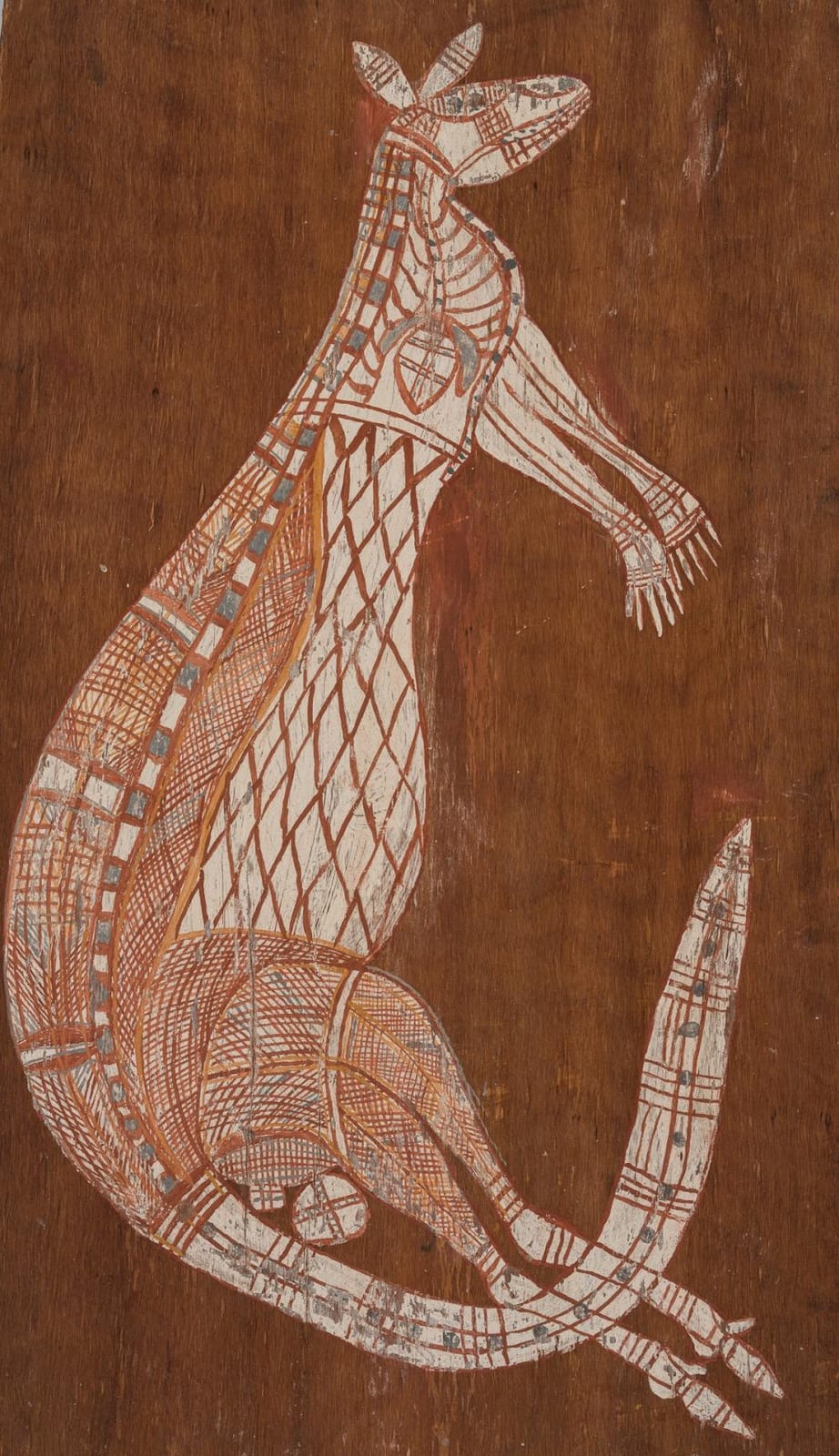
YIRAWALA (1897-1976): ‘KANGAROO’ Australia, c. 1962. Natural earth pigments on eucalyptus bark. Finely painted with ochre and white pigments, depicting a kangaroo shown in a dynamic, upright pose with an elongated body and arching tail. Articulated internal patterning fills the form, with rhythmic cross-hatching and linear motifs suggesting musculature and bone structure, set against the warm, unpainted surface of the bark. Signed on the reverse. David Yirawala (1897-1976) was an Aboriginal Australian leader, ceremonial figure, and one of the most influential painters of Western Arnhem Land, celebrated for transforming traditional bark painting into a dynamic and widely recognized art form. His work is distinguished by its innovative use of rarrk (fine cross-hatching), fluid compositions, and the integration of ancestral ceremonial designs, which he adapted from sacred ceremonial body and rock art into compelling visual narratives that communicated complex cosmologies to broader audiences. As a cultural custodian and mentor, he played a pivotal role in educating younger artists and advocating for the significance of Indigenous art, earning him the reputation as the ‘Picasso of Indigenous Australian art’. Yirawala’s paintings were exhibited and are held in major national and international collections including the Art Gallery of New South Wales, the Museum of Contemporary Art Sydney, and the Seattle Art Museum. Provenance: J. A. Davidson, Melbourne, 1960s. The Joan and Robert Rowland Collection, Melbourne, Australia, acquired from the above. Sotheby's Sydney, 18 October 2011, lot 112. The Samuel and Esther Sarick Collection, Canada, acquired from the above. James A. ‘Jim’ Davidson (1908-1994) was a pioneering Australian collector and dealer whose work helped bring Indigenous and Oceanic art to broader public and scholarly attention. Born in South Africa and later based in Melbourne, Davidson developed a lifelong passion for Pacific and Aboriginal art inspired by early travels in Fiji, Samoa, Tonga, and New Guinea, and by encounters with notable figures such as anthropologist Margaret Mead. He was a founding force behind ArtOceanic Gallery in Melbourne, one of Australia’s longest-running tribal art institutions, and formed deep friendships with artists and communities in Arnhem Land, actively supporting and collecting works that might otherwise have remained unseen. His collections and writings helped elevate Australian Indigenous art in major public institutional contexts and contributed to its recognition as a significant artistic tradition. Joan and Robert Rowland were private collectors who assembled a focused and high-quality collection of Aboriginal and Oceanic art over several decades, acquiring many works directly from Jim Davidson. Formed well before the market’s expansion, their collection reflects early connoisseurship, favoring important bark paintings, shields, and rare objects held intact in their Melbourne home for many years. Samuel and Esther Sarick were among Canada’s most passionate and discerning collectors of Fine Art, Inuit Art, and Indigenous works, assembling an extraordinary collection over several decades. They collected with conviction, engaging personally with artists, galleries, and dealers while traveling widely to acquire works firsthand. Together, they formed one of Canada’s most significant private collections, parts of which have since been donated to major Canadian institutions and were sold in a successful Bonhams sale in 2025. Samuel Sarick (d. 2018) often remarked that he never became a collector — he was born one. “If collecting is in your blood,” he said, “it doesn't matter what you collect, as long as you accumulate.” What began with a single work soon grew into a vast and carefully assembled collection; as Samuel wryly observed, “you start with one piece, and by the time you acquire three or four thousand more, it's a collection.” Condition: Very good condition with minor wear and natural imperfections including expected age cracks, light scratches, and few minor losses to pigments. Dimensions: Size 100 x 59 cm Literature comparison: Compare a closely related painting of a kangaroo by the same artist, dated c. 1970, 82.5 x 43.5 cm, in the Museum of Contemporary Art, accession number 1993.273. Compare a closely related smaller painting of a kangaroo by the same artist, dated early 1970s, 31 x 56 cm, in the Art Gallery New South Wales, accession number 682.1996. Auction result comparison: Type: Closely related Auction: Bonhams Sydney, 24 November 2013, lot 72 Price: AUD 19,520 or approx. EUR 16,000 converted and adjusted for inflation at the time of writing Description: Yirawala (circa 1897-1976), Grey Rock Wallaby - Mardayin Ceremony Expert remark: Compare the closely related manner of painting and subject. Note the size (109.5 x 47 cm). Auction result comparison: Type: Related Auction: Sotheby’s Melbourne, 31 July 2006, lot 67 Price: AUD 31,200 or approx. EUR 26,000 converted and adjusted for inflation at the time of writing Description: Sacred Kangaroo following the dreaming Track, c. 1965 Expert remark: Compare the closely related manner of painting and subject. Note the size (77 x 44.5 cm) and that two kangaroos are depicted.