Have one like this?
Upload a photo for a free check of what yours may be worth.
Lot description
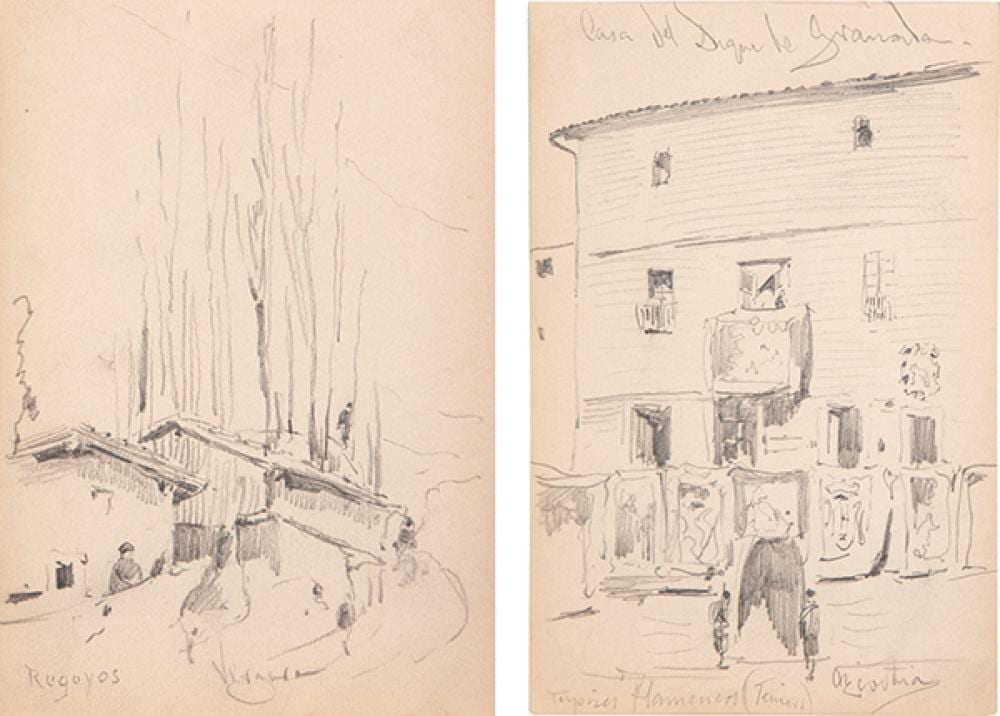
DARIO DE REGOYOS Asturias 1857 - Barcelona 1913 House of the Duke of Granada and Nájera. c. 1888 Pencil on paper (two drawings) One signed Both titled On the back of one, another work, "Sketch of a Monastery" Written: Flemish Tapestries (Teniers). Dimensions 19 x 12.5 cm (each) Text for drawing 1: This drawing was made around 1888 during a trip the artist took to Azpeitia, Azkoitia, and Vergara, probably departing from San Sebastián. This quick pencil sketch shows an architectural structure in horizontal profile which, based on its typology, suggests it is a rural hermitage or the chapel of a convent in the vicinity of Azkoitia. The drawing is much more schematic and lighter than that on the reverse, executed with loose, barely suggested lines that seek to capture the overall volume of the building rather than its ornamental details. The most distinctive architectural element is found at the top of the roof: a two-opening bell gable (wall-mounted bell tower), characteristic of Basque folk religious architecture. Below it, the main entrance is shown, protected by a portico or covered atrium, topped by what appears to be a classical pediment or a gabled roof, which projects from the main body of the building with its smooth, solid walls, similar to that of San Martín de Iraurgi or the hermitage of San José, which is itself the Pantheon of the Dukes of Granada de Ega. Text for drawing 2: This pencil drawing documents the side façade of the historic Idiáquez Tower (or Etxe Beltz) in Azkoitia, identified in the inscription above as "House of the Duke of Granada." The sketch captures the building on a day of solemn celebration, as the masonry walls appear hidden beneath ephemeral decoration. The focal point is the display of tapestries hanging from and flanking the entrance arch. The artist has specifically noted at the bottom "Flemish Tapestries (Teniers)," referring to the style or authorship of the tapestries (probably based on cartoons by David Teniers), indicating that the noble family had adorned the façade for a public celebration, a common tradition of social distinction. The composition is completed by the sketch of the coat of arms of the Idiáquez-Granada de Ega family on the right and two small figures at street level that provide scale. The inscription "Azcoitia" geographically situates the scene, making the sketch a valuable graphic record of the movable heritage of the Basque aristocracy displayed in public spaces. Texts by Juan San Nicolás, to whom we are grateful for his assistance.