Have one like this?
Upload a photo for a free check of what yours may be worth.
Lot description
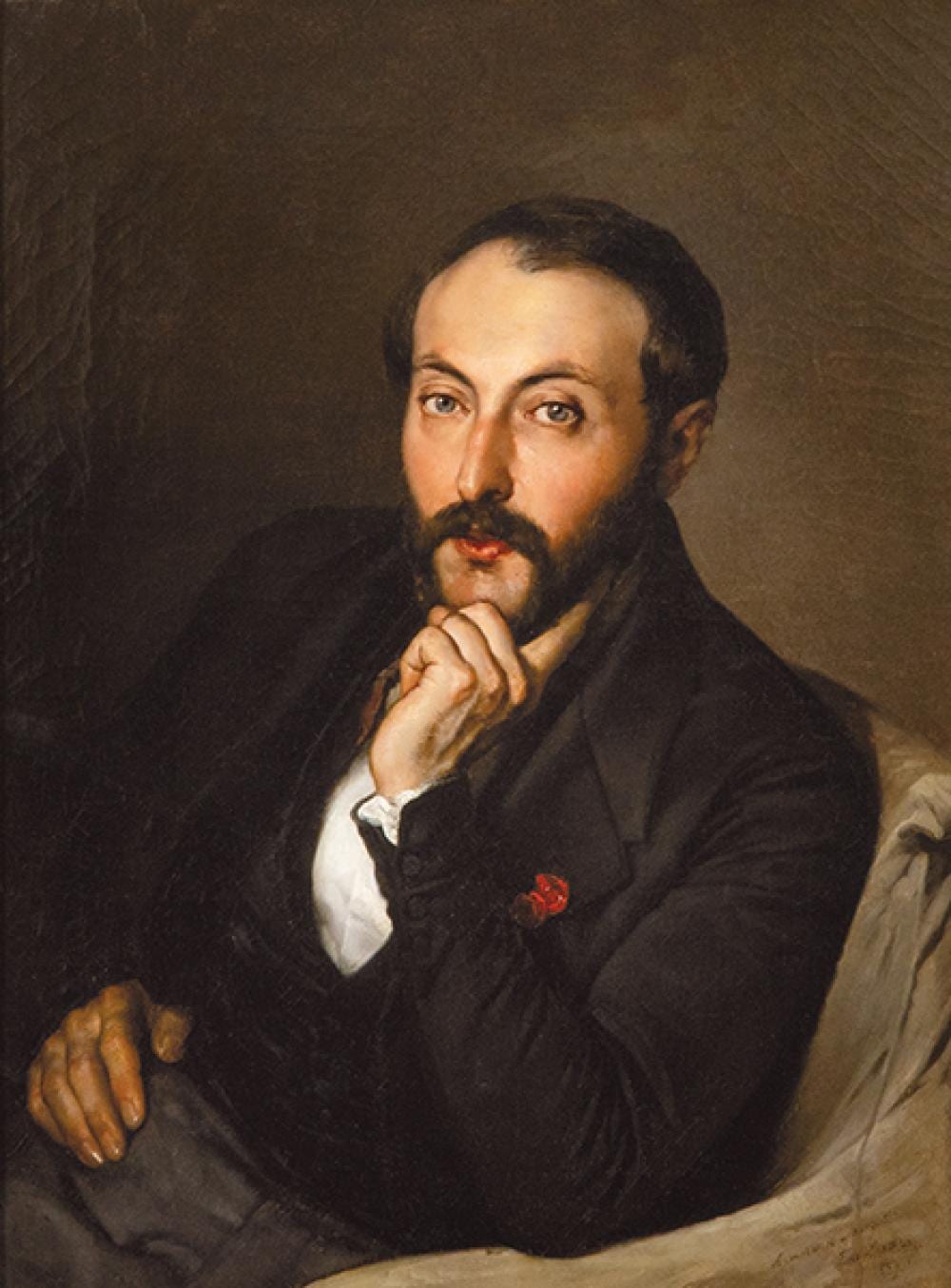
FEDERICO DE MADRAZO Y KUNTZ Rome 1815 - Madrid 1894 Portrait of the painter's friend, Adrien Dauzats. 1839 Oil on canvas Signed, dated, and dedicated Dimensions: 77 x 57.5 cm On the reverse, an old label from the artists' supply store A. BINANT, 7 Rue de Cléry, Paris, and A. OTTOZ, Rue de la Michidière, Paris. Work exhibited: - Salon of the Louvre, Paris, 1845. Provenance: - Federico de Madrazo Collection, Madrid. - Raimundo de Madrazo Collection, Versailles. - Private collection, Paris. "I have finished the portrait of Dauzats, which has been very well received by those who have seen it, and which its owner will frame beautifully for display next year, if possible (...) I would be very pleased if you could see the portrait of Dauzats; in it I have tried to indicate the movement or rotation of the skin both in the head and in the hands. I truly believe you will not dislike it." (Correspondence, Letter to José Madrazo, August 25, 1839 and August 31, 1839) This portrait by Federico de Madrazo depicts his friend, the French painter and traveler Adrien Dauzats, and is an eloquent testament to the close personal and professional relationship that united both artists during the Spanish master's formative years in Paris. Madrazo captures Dauzats in a reflective and elegant pose, his head resting on his hand and his gaze directed straight at the viewer, a device that intensifies the sitter's psychological impact. The chromatic restraint, dominated by deep blacks and neutral backgrounds, contrasts with the delicate luminosity of the face and the subtle touch of red on the lapel, demonstrating the assimilation of contemporary French portraiture principles and the technical refinement Madrazo achieved during these years. This portrait bears a direct relation to the earlier effigy of Dauzats painted by Madrazo in 1837, now held at the Musée National du Château de Versailles (51 x 44 cm). Comparing the two canvases, the 1839 work reveals an evolution toward greater monumentality and compositional sophistication, enlarging the format and accentuating the intimate character through the handwritten dedication. The repetition of the same subject in two such closely spaced periods confirms the strength of the friendship between Madrazo and Dauzats, forged in the Parisian artistic milieu and grounded in shared interests: portraiture, travel, and cultural exchange between Spain and France. Dauzats, renowned for his Orientalist scenes and architectural views, shared with Madrazo not only academic and social circles, but also a Romantic sensibility that valued introspection and the dignification of the individual. The 1839 canvas can thus be interpreted as a work of homage and affection, where technical virtuosity is placed at the service of a personal relationship. Beyond its artistic value, it constitutes a visual document of a fruitful friendship that contributed to the mutual enrichment of both artists and to the international consolidation of the young Madrazo within the 19th-century European art scene.