Have one like this? Check yours freeOr have an appraiser value it
Lot description
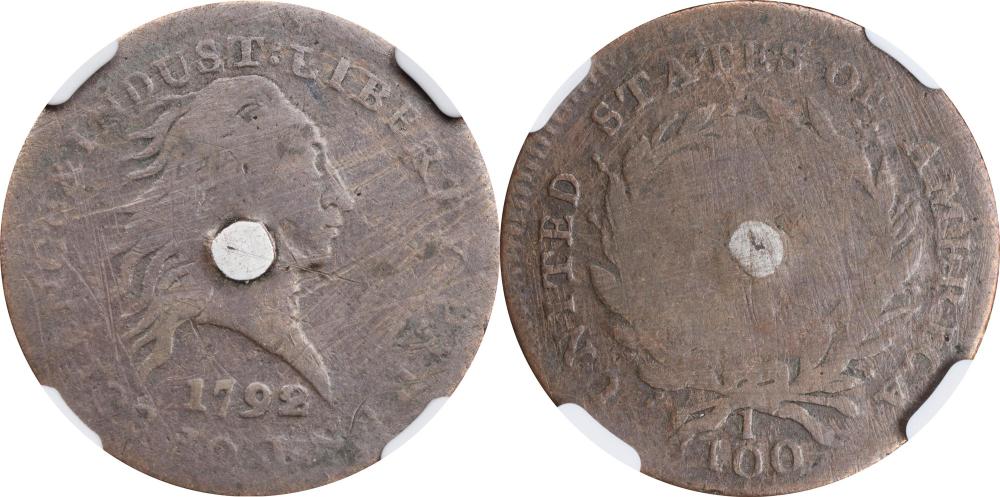
3.9 grams. Smith-Orosz-Augsburger 14. The NGC insert further states regarding their Repaired qualifier: "Plug replaced with ferrous alloy." Obv: Liberty bust faces right, with flowing hair curls, the legend LIBERTY PARENT OF SCIENCE & INDUST: around the border and the date 1792 tucked in below the truncation, yet above the letters NT and OF in the legend. Rev: An open laurel wreath with fruit on strings and tied with a ribbon with bow surrounds the denomination ONE / CENT. The legend UNITED STATES OF AMERICA is around the border and the denomination 1/100 is below the wreath stems. Arguably one of the more interesting examples of this classic rarity traced in the modern numismatic market, the earliest confirmed appearance of this coin was in a 2006 Modesto, California Police Department auction of unclaimed property. The coin's rarity and significance went unrecognized in that event, and it was acquired by a Northern California collector for a mere $400. The coin was later submitted to ANACS and certified VG Details, in which grade it is included in the roster of known examples of Judd-1 published in the 2017 reference 1792: Birth of a Nation's Coinage by Pete Smith, Joel J. Orosz and Leonard Augsburger. A possible, although unconfirmed earlier market appearance for this coin is lot 209 in Lyman H. Low's October 1904 sale of the H.G. Brown Collection, which was cataloged as: Silver Center Cent, 1792. LIBERTY PARENT OF SCIENCE & INDUSTRY: Head r. R Type of the wreath Cent of 1793. The centre has been abused, probably when reinstating the small silver piece, otherwise good. Extremely rare. The silver plug has certainly been replaced (by a plug of ferrous alloy), and both sides show the ill effects of this process in the form of numerous fine and moderate-size scratches in and around the centers, but whether or not this is the H.G. Brown specimen remains unknown. When consigned to the firm in 2017, the Heritage cataloger took up the modern numismatic history of this coin where the Smith-Orosz-Augsburger reference left off, in the process conjecturing about when and why the silver plug was replaced: When Heritage numismatists examined this coin in 2017, the lack of detail on the silver plug caused concern. It was decided to have the piece recertified by NGC, to maximize collector confidence and interest. In their initial investigation, the NGC graders determined that the "silver" plug was magnetic (apparently, ANACS failed to perform this simple test when they certified it in 2008). Elemental analysis revealed the plug is actually ferrous alloy (iron). The copper planchet is undoubtedly genuine, however. Colonial specialists and prominent numismatists Alan Weinberg, John Kraljevich, Ken Bressett, Julian Leidman, and Tony Terranova all examined this piece in November of 2008 and believed the copper planchet was authentic, but they had no way to test the composition of the plug. The silver plug was probably removed from the coin at an early date, before there was any numismatic market for rare coins in this country. The copper planchet was then carried as a pocket piece for some time. After coin collecting became widespread in the late 1850s, some enterprising coin doctor must have substituted the ferrous alloy plug to restore the coin's original appearance, if not its original composition. The noted scratches probably occurred when the plug was replaced, as the protruding plug would have to be filed down to the level of the copper planchet. The appearance is not unlike some early silver dollars that were holed, plugged, and filed to adjust their weight. Regarding the detail on the copper planchet, enough of it remains to allow easy confirmation and ready appreciation of the design. Indeed, all major design elements are well outlined and clear except for the denomination ONE CENT at central reverse and some of the letters in the obverse legend, namely those at the right, left and lower borders. Liberty's portrait and the date are clear, the wreath on the reverse sufficiently so. The deep copper-brown surfaces are microgranular; the numerous scratches on both sides have been described above. The uspatterns.com website traces only 14 examples of the Judd-1 Silver Center cent, including one unplugged specimen and the present repaired example. One of the most famous American rarities from this first year of United States coinage or any other, this issue is ranked 35 in the reference 100 Greatest U.S. Coins by Garrett and Guth (fifth edition, 2019). By the time of Lyman Low's October 1904 sale of the H.G. Brown specimen, the remarkable story of the 1792 Silver Center cents was already well known. Sylvester Crosby described the Parmelee specimen in his 1875 work The Early Coins of America and knew about the Appleton piece, earlier ex. Mickley-Cohen. James Ross Snowden had described the Silver Center cents as early as 1860, but it's uncertain what researcher was the first to discover this coin's intimate connection to Thomas Jefferson and the origins of the American monetary system. Any great historical object benefits from a paper trail, and perhaps no early American coin has a longer and more impressive paper trail than the Silver Center cent. The trail starts before the founding of the U.S. Mint, in the casual correspondence between the man whose brainchild the Silver Center cent was long thought to be and the man whose brainchild it actually was. Thomas Paine wrote to Thomas Jefferson on September 28, 1790, soon after Jefferson's April 1790 Report on Copper Coinage and his July 1790 report on Weights, Measures, and Coinage, which espoused a thoroughly interconnected decimal-based system. Into this conversation, Paine interjected some thoughts on how to give fractional coins real value: Of compositions, three methods present themselves -- 1st. Mixing silver and copper in fusion -- 2d. Plating the copper with silver -- 3d. Plugging the copper with silver. But against all these there are very capital objections. -- Wherever there is a want of satisfaction there must necessarily be a want of confidence; and this must always take place in all compounded metals. There is also a decrease in the intrinsic value of metals when compounded; one shilling worth of silver compounded with one shilling worth of copper, the composition is not worth two shillings, or what the metals were worth before they were compounded, because they must again be separated to acquire their utmost value, and this only can be done at a refiner's. It is not what the coin cost to make, but what the coin is intrinsically worth when made; that only can give it currency in all cases. Plugging copper with silver is the least detrimental to the intrinsic value of the metals, because they are the easiest separated; but in all these cases the value of the silver put into the composition will be so predominant to the value of the copper, that it will be rather a base silver coin than a copper coin. Paine suggested a fiat currency, with no consideration of the intrinsic value of the copper coin, made more economic sense: "It is convenience only that ought to be considered with respect to copper coinage, and not money or riches." Jefferson apparently disagreed. He wrote back almost a year after Paine had sent his note, on July 29, 1791, explaining that he hadn't received the letter until February and figured he would see him that spring. He suggested that Paine publish his observations (which was done, possibly with Jefferson's assistance) but otherwise tabled the discussion, saying: Your observations on the subject of a copper coinage have satisfied my mind on that subject, which I confess had wavered before between difficulties. As a different plan is under consideration of Congress, and will be taken up at their meeting, I think to watch the proper moment. With that, Jefferson apparently put the conversation out of his mind until late 1792, when a copper coin plugged with silver, just like Paine had suggested, was struck at the First United States Mint in Philadelphia. Presumably the suggestion for their construction had come from Jefferson, though Jefferson offers the credit to the Mint's coiner, Henry Voigt. Jefferson wrote to George Washington on December 18, 1792, enclosing two coins just like the one here offered: Th. Jefferson has the honor to send the President 2 cents made on Voigt's plan, by putting a silver plug worth 3/4 of a cent into a copper worth 1/4 of a cent. Mr. Rittenhouse is to make a few by mixing the same plug by fusion with the same quantity of copper. He will then make of copper alone of the same size, and lastly he will make the real cent, as ordered by Congress, four times as big. Specimens of these several ways of making the cent will be delivered to the Committee of Congress now having that subject before them. Jefferson and Rittenhouse had gone about producing cents using two of the three methods Paine had suggested. They were pleased enough that they sent specimens of this particular type (and maybe the others, though the paper trail on that question is silent) to President Washington. They would have also sent Silver Center cents to the members of the "committee...to prepare and report a bill to amend the act establishing a Mint and regulating the coins of the United States, so far as respects the copper coinage," named on November 30, 1792 as Rep. Hugh Williamson of North Carolina, Rep. John Page of Virginia, and Rep. John W. Kittera of Pennsylvania. Williamson was a native of Chester County, Pennsylvania, a former mathematics professor and a physician. John Page was a college chum of Thomas Jefferson's and served as his lieutenant governor during the Revolution. Kittera was a Princeton-educated lawyer. No mintage figure has ever been published, or even guessed at, but we can identify two sent to Washington and one to each of these three gentlemen. Perhaps they each received two or more. Given that at least 14 survive, the mintage could have been as high as 50 or more. Today, any example of this issue is a prize. While that offered here is far from perfect, that may be its strongest suit. While the finest specimens have realized hundreds of thousands of dollars at auction in recent years, this one will surely give a greater number of collectors the opportunity to compete for an example of this historic rarity.