Have one like this? Check yours freeOr have an appraiser value it
Lot description
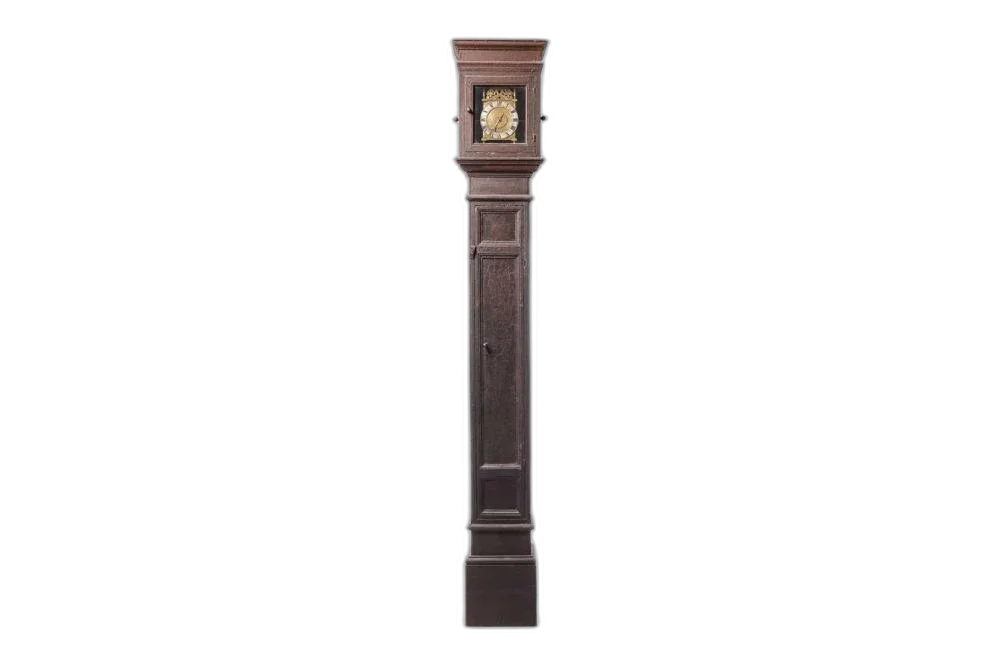
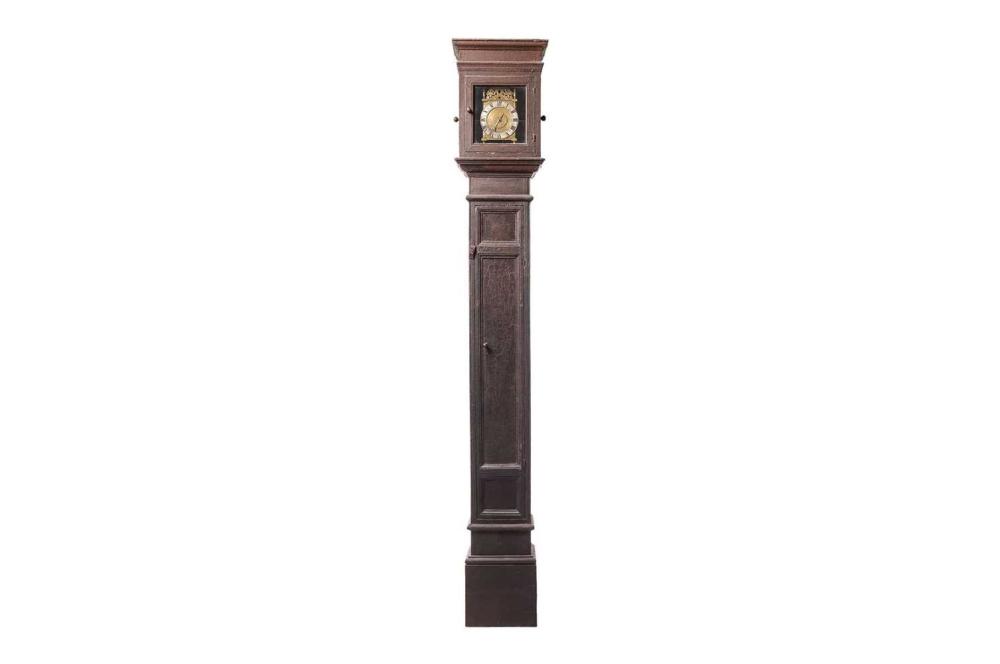
A 30-hour brass lantern clock in a painted pine long case, Thomas Knifton, London, circa 1660, the dial engraved with tulips and signed Thomas Knifton at the (crossed keys) in Lothbury Londini, the conventional posted movement with later conversion to anchor escapement and now lacking all alarm work, count wheel striking on the top-mounted bell, the count wheel with “matchstick man” foundry mark, the case with tall turned finials above dolphin frets, on ball feet, the original iron backplate retaining its spurs, 40 cm high; the painted pine case with moulded flat top above a glazed door and panelled side doors, the slender trunk with panelled door, on a re-built plinth, 241.5 cm high, second half of the 17th century, later weights and pendulum. This clock was bought by Mr Thornton at auction at Bonhams, London on 15th December 2004, Lot 126. Included in the catalogue was an indistinct 1938 photograph of the clock in a long case. Following the sale, Mr Thorton was able to contact the vendor and, from information gained, was able to thoroughly research the provenance of the clock. This culminated in the publication of an article in the September 2005 edition of Antiquarian Horology where full details and photographs are included. The publication of the 2005 article, including the 1938 photograph, led to the re-discovery of the longcase in an antique shop in Brighton and ultimately the case being re-united with the clock. Whether the clock was originally supplied with the case by Knifton is almost certainly impossible to prove. However, it must be contemporary as the case was originally designed for a clock to be hung from a hoop and both hoop and spur marks in the case match with this clock. The seat board, upon which the clock now sits is later, necessitated by the removal of the hoop when the clock was converted to long pendulum. The provenance dictates that the conversion was likely carried out before 1673. Apart from the re-building of the plinth, the case is, as the clock, in remarkably good original condition. From the estate of the late William John Thornton (1937-2025), of Groby, Leicestershire. Known as 'John' to his friends and family, he became interested in steam engines from an early age, and then traction engines and aircraft, before building an extensive knowledge and collection of clocks, notably early Lantern clocks and longcases. He was a very keen member of the Antiquarian Horological Society, and gave several lectures to their members at Keble College, Oxford. John was also a member of the Furniture Society in Groby village, and the Groby allotment Society, being chairman of the latter for over 30 years. Thomas Knifton (Nottingham 1614 – London 1667) was apprenticed in 1632 to William Selwood in the Clothworkers Company. Selwood became a Free Brother in the Clockmakers’ Company in 1633 and although Knifton was never officially admitted to the Clockmakers, he took apprentices through them. Thomas Knifton was a prolific maker of lantern clocks and had his premises at the sign of the crossed keys in Lothbury. Provenance: Sir Thomas Wendy (1613 – 1673) of Haslingfield Manor, Cambridgeshire Lady Letitia Wendy (died 1696) Cassandra Willoughby The Barnard Family, Green Farm and Knapp Farm, Haslingfield Thence by descent and purchase within the family Ex lot: Bonhams London, 15th December 2004, Lot 126 Literature: For the clock see Antiquarian Horology, Vol 29, No.1, September 2005, pp. 28-36, Sir Thomas Wendy’s Lantern Clock. For information regarding the “matchstick man” foundry mark see Antiquarian Horology, Vol 33, No.5, September 2012, p. 622 An extensive file of research and provenance information for both clock and case is included with this lot. This most interesting lantern clock is in particularly good condition with the only alterations being the conversion from verge and balance to anchor escapement and the removal of the alarm work necessitated by the addition of the seconds pendulum for the anchor escapement at the rear of the case. At the same time the suspension hoop was removed, although the iron spurs were retained, and the holes for the alarm work can still be seen in the iron rear panel. The 'matchstick man' foundry mark is found on the brass castings of clocks dating between circa 1640 and 1685. It is particularly found on clock made in the Lothbury area and the clocks of William Selwood, Knifton’s Master, usually have at least one of these marks.