Have one like this?
Upload a photo for a free check of what yours may be worth.
Lot description
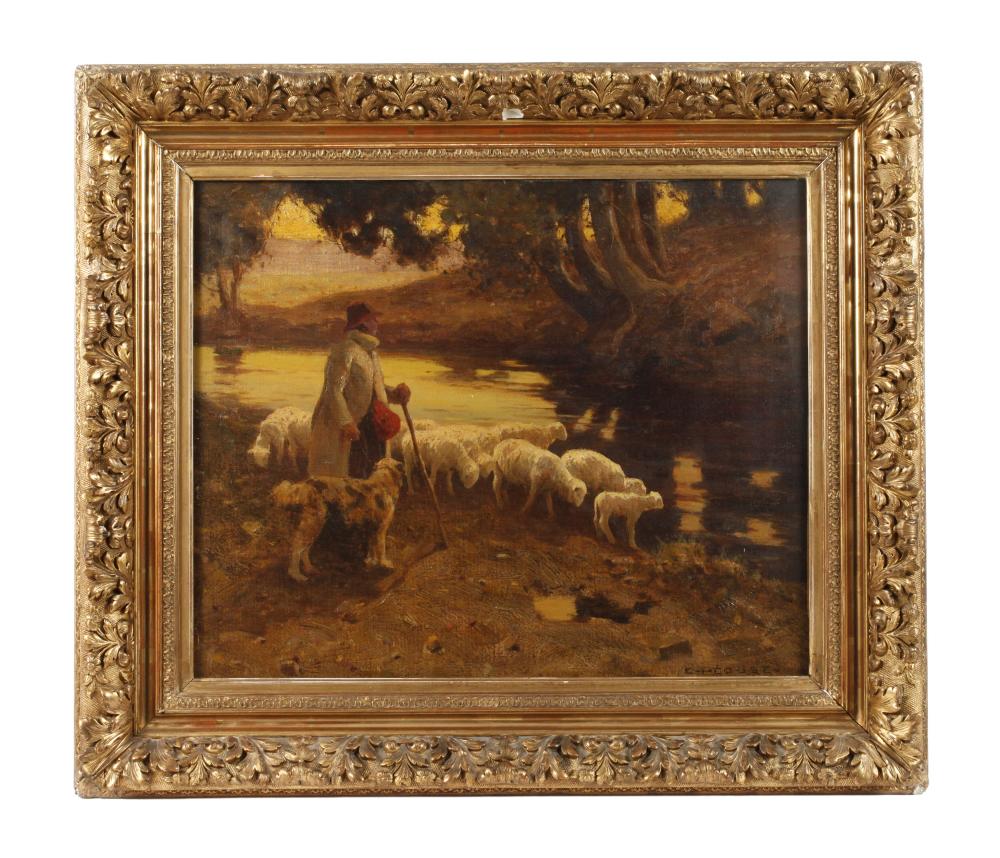
Eanger Irving Couse, Schäferidyll Schäfer mit Herde unter Bäumen, am Fluss in herbstlicher Landschaft, gering pastose Genremalerei, das Motiv entstand wohl in Couses Pariser Zeit, hierzu bemerkt AKL: "... Während in Frankreich hauptsächlich kommerziell erfolgreiche Landschafts- und Genrebilder entstehen, ist Couse in Amerika nur durch seine Darstellungen und Portraits von Indianern bekannt ...", Öl auf Leinwand, um 1890, rechts unten signiert "E-I-Couse", hinter Glas im Goldstuckrahmen (Altersspuren), Falzmaße ca. 45,5 x 55,5 cm. Künstlerinfo: us-amerikanischer Maler (1866 Saginaw/Michigan bis 1936 Albuquerque/New Mexico), schon seit der Kinderzeit Kontakt zum indigenen Stamm der Chippewa, den er zeichnerisch festhielt, entwickelte sich in der Folge zu einem der bedeutendsten Chronisten der Ureinwohner Nordamerikas, studierte ab 1882 zunächst am Art Institute in Chicago, 1883–85 Weiterbildung an der National Academy of Design in New York bei Lemuel Everett Wilmarth und Edgar Melville Ward, 1886–96 Studienaufenthalt in Frankreich, zunächst in Paris, hier 1887–90 Schüler der Académie Julian bei William Adolphe Bouguereau und Tony Robert Fleury, 1891 Schüler der der École des Beaux-Arts, 1891–92 Aufenthalt auf der Familienranch in Oregon, 1893–96 Mitglied der Künstlerkolonie in Étaples-sur-Mer in der Picardie, anschließend wieder in Oregon, um 1900 Rückkehr nach New York, wo der Künstler im Winter malte, im Sommer Malaufenthalte in Washington, Oregon, Connecticut und Frankreich, ab 1902 regelmäßige Sommeraufenthalte und ab 1909 Atelier in Taos/New Mexico, hier studierte er das Leben der Taos-Indianer – eines Pueblo-Stammes, 1891 erste Einzelausstellung mit Indianerdarstellungen „Native American Life“, ab 1911 Mitglied der National Academy of Design New York, 1915 Gründungsmitglied und Präsident der Taos Society of Artists, 1928 gänzlicher Umzug von New York nach Taos, beschickte diverse Ausstellungen, unter anderem 1889–1900 den Pariser Salon, Quelle: Thieme-Becker, Vollmer, AKL, Saur "Bio-Bibliographisches Künstlerlexikon", Bénézit, Müller-Singer und Internet. Eanger Irving Couse, Schäferidyll Shepherd with herd under trees, by the river in an autumnal landscape, slightly impasto genre painting, the motif was probably created during Couse's time in Paris, AKL notes: ".... While in France he mainly produced commercially successful landscape and genre paintings, in America Couse is only known for his depictions and portraits of Indians ...", oil on canvas, c. 1890, signed "E-I-Couse" lower right, behind glass in gilt stucco frame (traces of age), inner dimensions c. 45.5 x 55.5 cm. Artist info: us-American painter (1866 Saginaw/Michigan to 1936 Albuquerque/New Mexico), contact with the indigenous Chippewa tribe since childhood, which he captured in drawings, subsequently developed into one of the most important chroniclers of the indigenous peoples of North America, initially studied at the Art Institute in Chicago from 1882, 1883-85 further training at the National Academy of Design in New York under Lemuel Everett Wilmarth and Edgar Melville Ward, 1886-96 study visit to France, initially in Paris, here 1887-90 student at the Académie Julian under William Adolphe Bouguereau and Tony Robert Fleury, 1891 student at the École des Beaux-Arts, 1891-92 stay at the family ranch in Oregon, 1893-96 member of the artists' colony in Étaples-sur-Mer in Picardy, then back in Oregon, around 1900 return to New York, where the artist painted in winter, summer painting holidays in Washington, Oregon, Connecticut and France, from 1902 regular summer holidays and from 1909 studio in Taos/New Mexico, where he studied the life of the Taos Indians - a Pueblo tribe, 1891 first solo exhibition with Native American Life, from 1911 member of the National Academy of Design New York, 1915 founding member and president of the Taos Society of Artists, 1928 complete move from New York to Taos, participated in various exhibitions, including the