Lot description
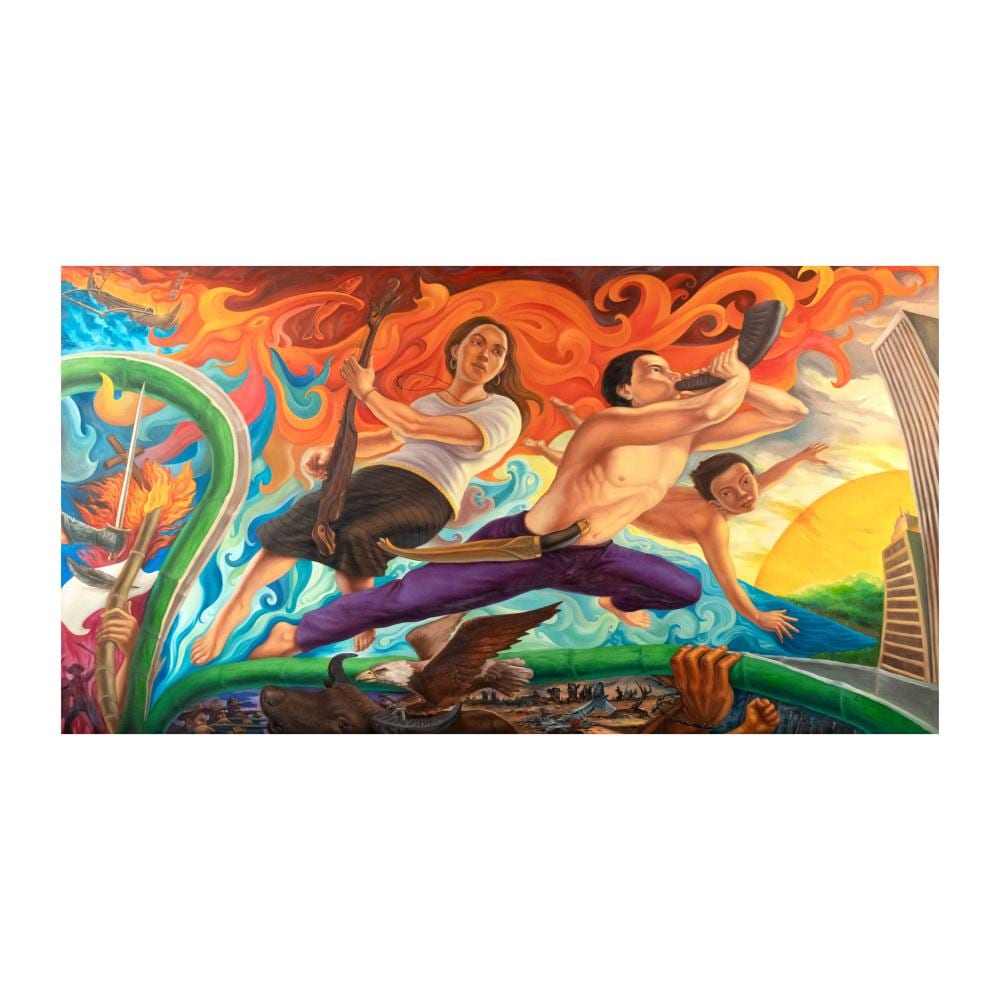
Paglaom Padayon signed and dated 1996 (lower right) oil on canvas 78" x 147" (198 cm x 373 cm) The Sanggawa collective, founded in December 1994 by Elmer Borlongan, Karen Flores, Mark Justiniani, Joy Mallari, and Federico Sievert, believed in the inherent power of art as a unifying voice that transcends race, religion, sexuality, and social status. The name of the group is a contraction of the Tagalog phrase "isang gawa," which means "one creation." True to its name, the Sanggawa was bonded by a single vision, setting aside their stylistic preferences to produce a homogeneous work. The Sanggawa's origins can be traced back to two artist collectives in the 1980s: the Artista ng Bayan (ABAY) and the Salingpusa, both of which created socio-politically significant works that mirrored the sentiments and struggles of the ordinary Filipino. In particular, the Salingpusa group, which counted among its original members Emmanuel Garibay, Elmer Borlongan, Jose John Santos III, Mark Justiniani, Antonio Leano, Karen Flores, Joy Mallari, Anthony Palomo, Mikel Parial, and Ferdie Montemayor and emerged around the time of the People Power Revolution of 1986, was nurtured by neurologist and art collector Dr. Joven Cuanang, who invited them to hold painting and sketching sessions in his Antipolo weekend house, particularly in the area now known as the Silangan Gardens, the current location of the Pinto Art Museum. The Salingpusa artists initially gathered and hung out for informal art sessions at the famed Hinulugang Taktak, where Dr. Cuanang discovered them and learned of their precarious situation as artists, i.e., the difficulty in securing major galleries to showcase their works. Dr. Cuanang organized exhibitions for the Salingpusa called the "Sampayan," in which they hung their paintings on clotheslines strung within the gardens for the physician's art-loving friends to choose from, helping, in the long run, the Salingpusa artists advance. From the Salingpusa emerged the Sanggawa, created at a time when the former's members were now beginning to forge their individual paths. The Sanggawa diverged from the Salingpusa practice of making each artist's personal style stand out in a single work. Instead, the Sanggawa wedded each painter's technique, resulting in one work that appears to be painted by a single artist, an espousal of a collectivist attitude rather than an individualistic one. On many occasions, fellow former Salingpusa artists Garibay, Palomo, and Parial joined them in painting murals. The Sanggawa artists had their breakthrough in 1995 with the show Vox Populi, Vox Dei: Mga Gawang Editoryal. The show was first mounted at the EDSA Shangri-la, and soon presented at the Cultural Center of the Philippines, even travelling abroad to Australia that same year for their international debut. The group exhibited at the now-defunct Ray Hughes Gallery in Sydney, then one of the most premier centers of art in Australia, founded by the legendary art dealer, Ray Hughes. Palo-Sebo, one of the works in the exhibition, was eventually acquired by Brisbane's Queensland Art Gallery, Queensland's premier art institution. The Sanggawa also painted an outdoor mural for the University of New South Wales, one of Australia's most prestigious universities, titled Getting into the Out. The years from 1996 to 2000 witnessed the Sanggawa go from strength to strength as they toured more parts of the world to participate in exhibitions in New York, California, Brisbane, Hiroshima, and Texas. Notably in 1996, the Sanggawa staged their North American debut, participating in the group shows Traditions/Tensions: Contemporary Art in Asia held at the Asia Society Galleries in New York City and Memories of Overdevelopment: Philippine diaspora in Contemporary Art mounted at the University of California, Irvine, to whom they loaned one work from their landmark Vox Populi, Vox Dei show. This work on offer in this auction, Paglaom Padayon, was one of those that the Sanggawa painted during their prime years. A mural-sized painting, it was notably acquired by a Philippine conglomerate. The title is a Cebuano phrase that translates to "move forward with hope" (paglaom = hope, padayon = carry on, move forward, keep going). Nowhere in this work can the Sanggawa members' various styles be seen. Instead, they meld, echoing the work's central theme: the Filipinos' collective power, fueled by a shared vision of the nation's advancement. Rendered in vibrant, tropical colors, the work presents a montage of the Filipino nation's turbulent history and empowering future, serving as an homage to the spirit of Botong Francisco's 1964 mural, Filipino Struggles Through History, with both masterpieces depicting the historical development of the Filipino identity as a result of centuries of contact, subjugation, and struggle. The work also very much captures Botong’s painting style, infusing it with elements of magical realism filled with allegories and symbolism, evoking a feeling of both familiarity and dreamlike delight that stays in character with the painting’s intent. On the upper left, the balangay is shown treading the high seas as it facilitated migration, trade, and commerce in the pre-colonial Philippines. The rough seas mark a transition to the turbulent Spanish colonial rule, depicted through the symbolism of the sword and the cross, the instruments of pacification. Below are rendered the colors blue, red, and white, the colors of the French flag (and eventually the Philippine flag), whose 18th-century revolution inspired and influenced both Rizal (represented by the quill), Bonifacio, and the Katipunan. Interestingly, the way the quill and the revolutionaries are placed within a specific color sparks curiosity: the quill resting on the blue and white represents Rizal and the propagandistas' initial aim of peaceful reform and the katipuneros seemingly veiled underneath by a red banner, signifying their eagerness to shed blood in the name of freedom (although Rizal implicitly supported the revolution, as proven by Pio Valenzuela’s 1914 memoirs and his final sworn testimony in 1917). In the lower center of the painting rests a summary of the most significant turning points of the 20th century: the Philippine-American War and the subsequent American colonization (represented by the bald eagle, a US national symbol, wrangling the kalabaw), the tragedy and destruction of World War II, and the brutal and repressive dictatorship (represented by the clenched fist and a hand enmeshed in barbed wires, which Martial Law activists used a symbol of oppression, referenced to in this work as a geared battalion of the infamous MetroCom). Juan de la Cruz and Inang Bayan emerge from a splitopen bamboo. They are the modern-day Malakas and Maganda, armed with symbols of peace and harmony: the Mindanaoan kutyapi and the tambuli, instruments that sing of both hope and defiance for the Filipino people as they navigate both the turbulent seas and the scorching flames in their shared aim of inclusive progress and genuine self-determination. A third figure can be seen: a boy seemingly flying. He represents the youth of the nation, the inheritors of a legacy of a continuous struggle to explore, reclaim, and affirm our nationhood, a mark of our historic identity as stalwarts of resistance and freedom. Paglaom Padayon is a powerful image of the triumph of the Filipino spirit in every generation, forged by fire and consumed by the passionate flames of desire. (Adrian Maranan)