Have one like this?
Upload a photo for a free check of what yours may be worth.
Lot description
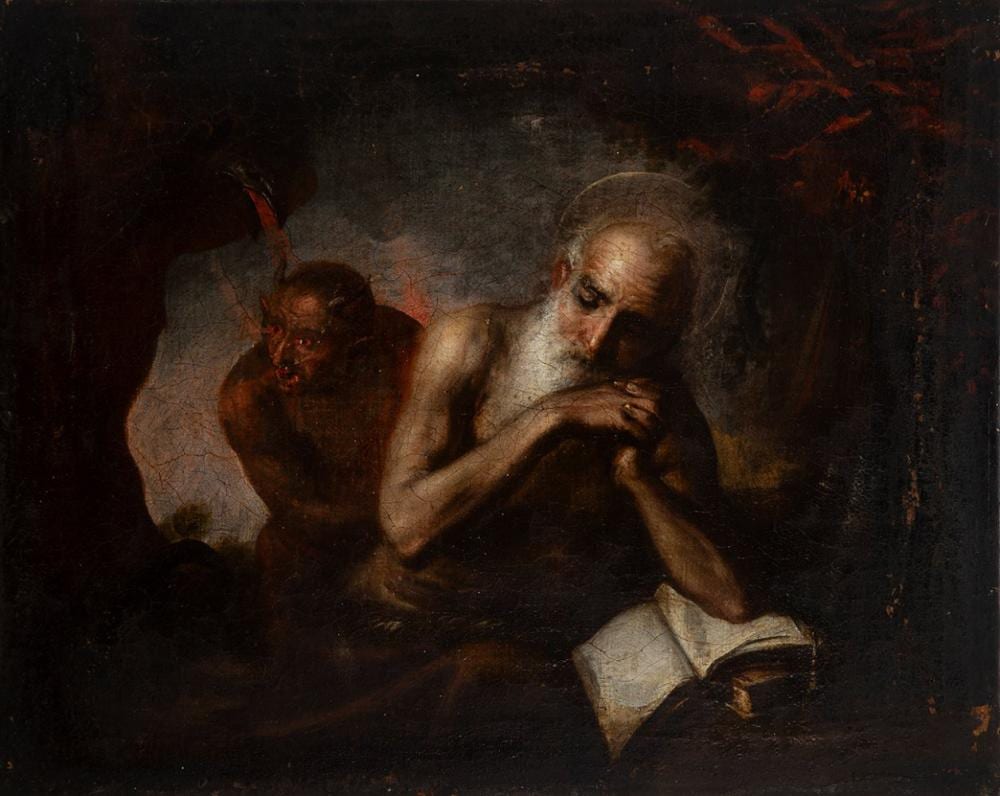
JUAN CARREÑO DE MIRANDA (Avilés, Asturias, 1614 - Madrid, 1685). "Holy hermit tempted by the devil". Oil on canvas. Preserves original canvas. Measurements: 44 x 55,5 cm. In this work, Juan Carreño de Miranda constructs a scene of deep spiritual intensity marked by a deliberately ambiguous iconography. The figure of the saint, withdrawn in the solitude of the ascetic retreat, can be identified as much with Saint Jerome as with Saint Anthony Abbot, or even with a synthesis of both models of eremitical sanctity. The presence of the open Bible refers to meditation on the divine word, traditionally associated with St. Jerome, while the environment of temptation and isolation evokes the episodes proper to St. Anthony Abbot. This silent combat between good and evil finds its formal correlate in the pictorial language of Carreño, who displays a masterful mastery of chiaroscuro to intensify the tensions between light and shadow. The careful treatment of the faces and the dramatic use of lighting not only underline the inner conflict of the saint, but also inscribe the work with full coherence in the baroque aesthetic, where visual contrast becomes an effective vehicle for religious narrative and devotional emotion. From the stylistic point of view, the painting has close affinities with other compositions by the artist, such as St. Francis of Assisi preaching to the birds (Museo del Prado, no. P008169), especially in the modeling of the faces through dense impastos and touches of pure white that enliven the pictorial surface. Likewise, the red curtain that bursts into the upper left corner refers to a recurrent resource in Carreño's work, also present in El festín de Herodes (Museo del Prado, nº P003088), where it fulfills a clearly theatrical and scenographic function. It is also worth noting the compositional similarity of the figure of the saint with that of the drawing known as Modelo echado, preserved in the Biblioteca Nacional, whose attribution oscillates between Velázquez and Carreño himself, which reinforces the stylistic dialogue between the two masters. Juan Carreño de Miranda (Avilés, 1614 - Madrid, 1685) was one of the most important figures in Spanish Golden Age painting, outstanding both in the field of religious painting and courtly portraiture. Trained in Madrid and closely linked to Velázquez's circle, he knew how to combine the solemn gravity of sacred themes with a pictorial language of great vitality and technical refinement. His work reflects in an exemplary manner the spirit of his time, in which emotional intensity and narrative clarity are placed at the service of faith. The Temptations of St. Jerome eloquently embodies the constant dialogue between the human and the divine that runs through Carreño's production, where the fragility of man and the presence of evil are always ultimately subjected to the serene light of faith and the promise of redemption. We are grateful for the help of Don Juan Carlos Gómez Aragüete in cataloguing the work and identifying the artist. Preserves original cloth and is in good condition.