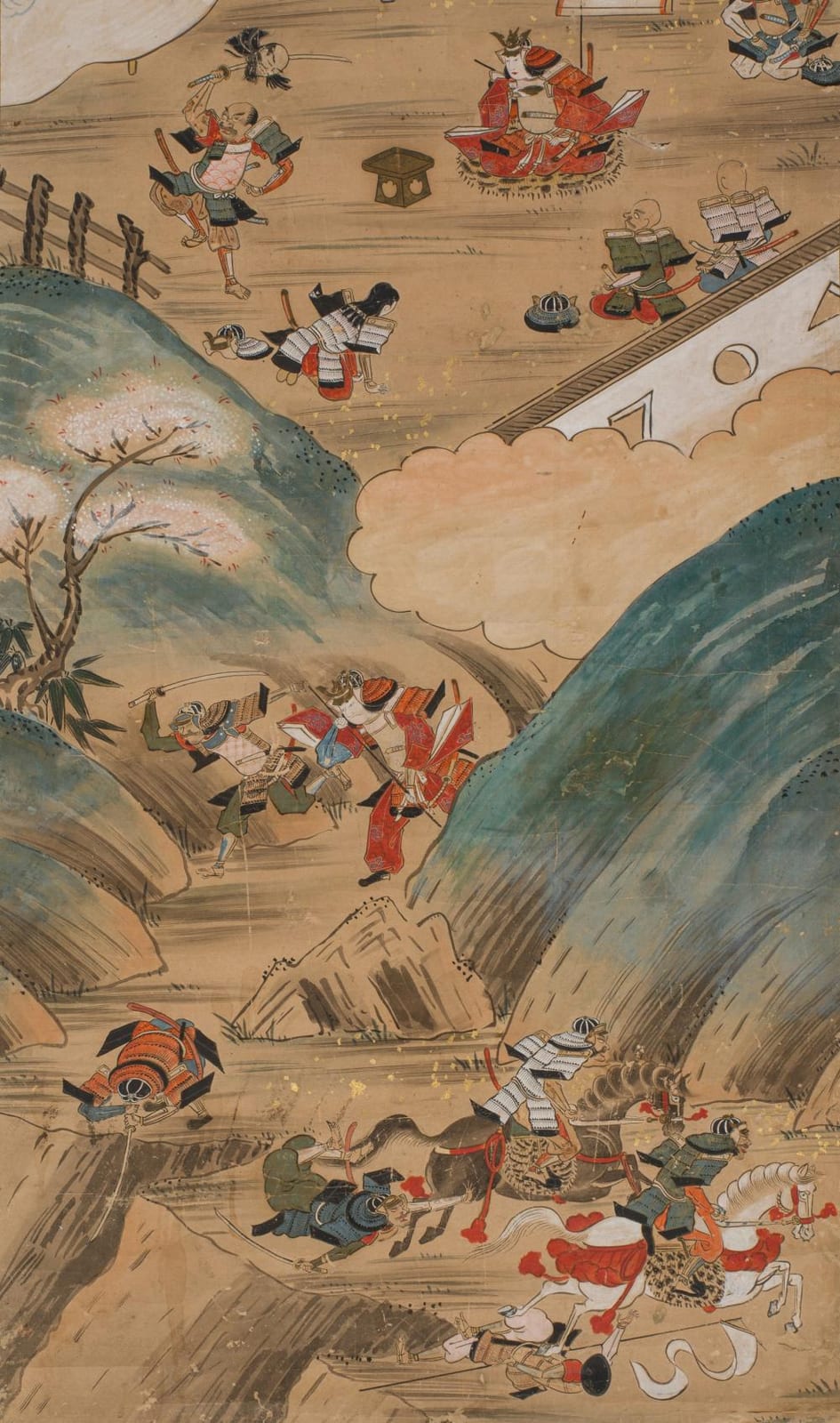
Lot description
WATANABE KAZAN (1793-1841): A SCROLL PAINTING OF SAMURAI By Watanabe Kazan (1793-1841), signed Kazan shosha, two seals Japan, early to mid-19th century, Edo period (1615-1868) Painted with ink and watercolors on mulberry paper with some square gold leaf specks, and mounted as a hanging scroll with a silk brocade frame and wood rollers (jiku). Depicting two vivid narrative scenes showing a high-ranking samurai. In the upper scene, a kubi jittei (head-viewing ceremony) is taking place, the commanding samurai sits calmly at the center of his encampment, clad in full armor and enjoying a cup of sake, surrounded by retainers, a severed enemy head is ceremonially presented to him, displayed on a sword. The lower scene portrays the same noble figure, now in pursuit of a group of fleeing enemies or rogue samurai, accompanied by a retainer, he chases down the culprits, who are escaping on foot, stumbling, but also on the two horses they stole. Signed and sealed in the upper left corner: Signature: Kazan shosha 崋山[…][…] Seal: Henchô no in 邊登之印 (“Seal of Henchô”) Image SIZE 122 x 48,5 cm, SIZE incl. mounting 189 x 72 cm Condition: Overall good condition with some wear and soiling, expected flaking and rubbing to pigment with associated touchups. The mounting with usual traces of wear and age. Creasing and folds. With an inscribed wood tomobako (storage box) Watanabe Kazan was born Watanabe Sadayasu in Edo (Tokyo) to a poor samurai family, and his artistic talent was developed from an early age. His family served the lord of the Tahara Domain, located in present-day Aichi prefecture. Watanabe himself served the lord of Tahara as a senior counselor, one of his achievements being said to be protecting the domain from even a single death from starvation during the Tenpo famine. He was heavily influenced by the artistic styles of the West, forming a unique style with elements of Japanese and European art. On the one hand, he was a traditionalist Confucian, who believed in filial piety and loyalty to his daimyo, and on the other he was enthusiastic about Western ideas regarding science and politics. He wrote two private essays which were interpreted as being critical of the Shogunate's defense of Tokyo Bay and promoting Western ideas. Although these papers were discarded by Watanabe, they were found, and he was tried and exiled to his home province of Tahara. One of the conditions of his exile was that he wouldn't sell his paintings, however Watanabe continued selling his paintings in secret due to financial hardships. This was eventually discovered, leading to the suppression of his works and house arrest. Due to the political turmoil involved in this, Watanabe committed ritual suicide (seppuku) to amend for the embarrassment he caused his lord.