Have one like this?
Upload a photo for a free check of what yours may be worth.
Lot description
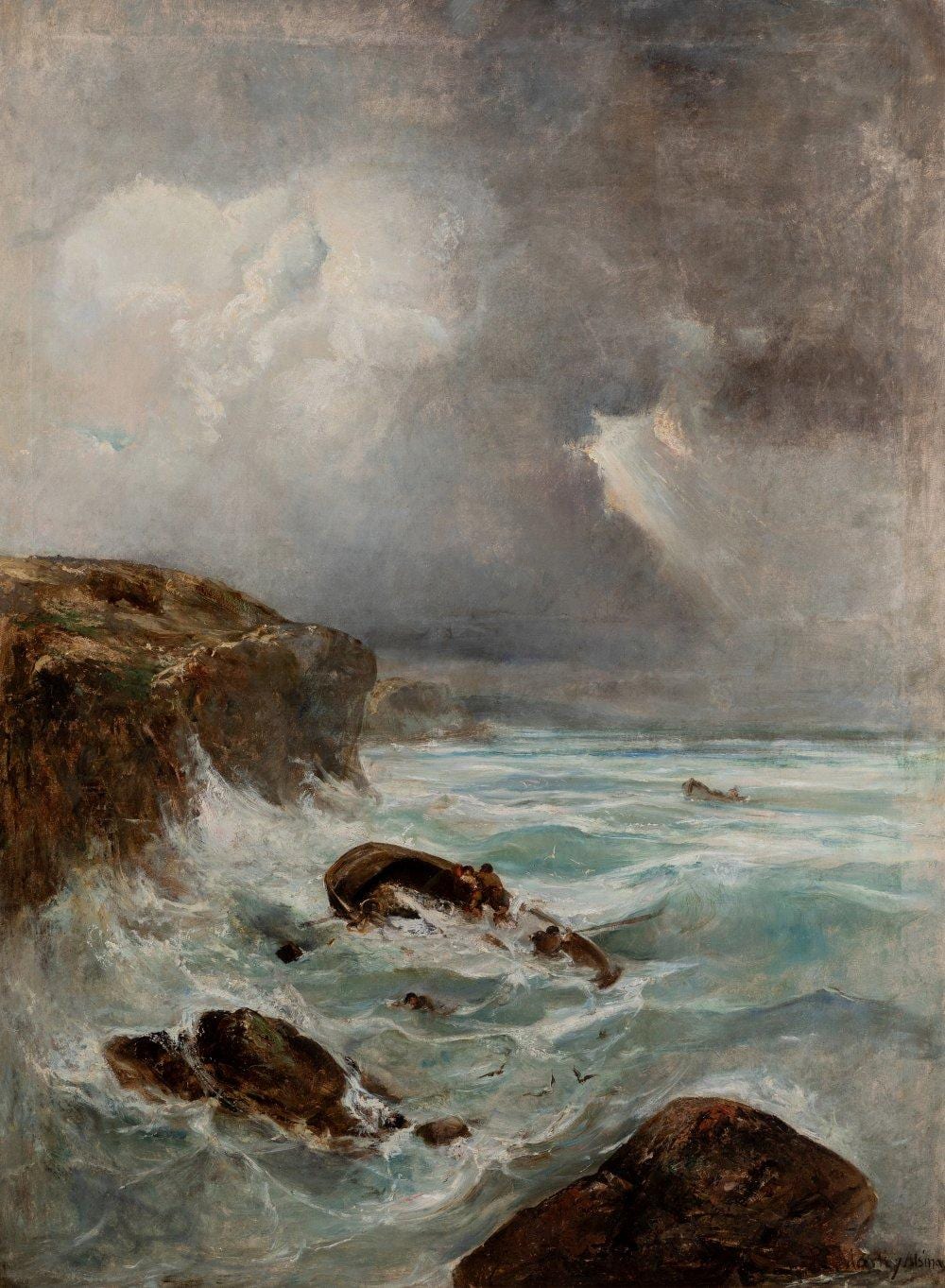
RAMÓN MARTÍ ALSINA (Barcelona, 1826 - 1894). "The shipwreck. Oil on canvas. Signed in the lower right corner. Measurements: 140 x 104 cm; 154 x 110 cm (frame). The composition, of unusual vertical format in the marine genre, presents a dramatic scene dominated by the force of the sea and the instability of the moment. In the foreground, a precarious boat, buffeted by the waves, sways in the tumultuous waters, on the verge of shipwreck. In it, two human figures (minimal compared to the magnitude of the surroundings) struggle to maintain their balance, underlining the tension between the fragility of man and the indomitable power of nature. The raging sea, treated with a dense and vigorous brushstroke, violently strikes the rocks and rugged coasts, where the white foam bursts in contrast with the somber tones of the water. A leaden and silver sky, with dense and heavy clouds, visually and emotionally prolongs the agitation of the ocean, establishing a tonal dialogue between sea and atmosphere. Considered today as the most important figure of Spanish realism, Martí Alsina is framed within the European avant-garde of the time. He revolutionized the Spanish artistic panorama of the 19th century, was a pioneer of the study of life and the creator of the modern Catalan school, as well as the master of a whole generation, with disciples of the importance of Vayreda, Urgell or Torrescassana. He began his studies in Philosophy and Literature, alternating them with night classes at the School of Fine Arts in Barcelona until 1848. Once he finished this first apprenticeship and decided to take up painting, he took his first steps in the Maresme region, where he began to earn his living doing naturalistic portraits and landscapes in a "plen air" style. In 1852 he became a teacher of line drawing at the Escuela de la Lonja in Barcelona, and two years later he began to teach figure drawing, a post he held until the accession to the throne of Amadeo de Saboya. In 1853 he traveled to Paris, where he visited the Louvre and became familiar with the work of Horace Vernet, Eugène Delacroix and French romanticism. Later he would become acquainted with the work of Gustave Courbet, the greatest exponent of realism. In 1859 he was appointed corresponding academician of the Academy of Fine Arts of Sant Jordi in Barcelona. His first important exhibition was the General Exhibition of Fine Arts in Barcelona in 1851. From that moment on he exhibited regularly in Barcelona, Madrid and Paris, and was invited to the Universal Exposition of the French capital in 1889. Among his prizes, the medals obtained in the National Exhibitions of Madrid stand out, third in 1858 with the work "Last day of Numancia" and second in 1860 with his landscape. In his last years he lived in seclusion, focusing his efforts on the search for new forms of expression, with a brushstroke close to impressionism. Among his themes we find numerous landscapes and seascapes, urban views (especially of Barcelona), portraits and human figures, genre scenes, temperamental female nudes, history painting and biblical scenes. On few occasions he dedicated himself to still life, although he also painted some of them. Works by Martí Alsina are preserved in the Prado Museum, the Thyssen-Bornemisza, the National Art Museum of Catalonia, the MACBA, the Museum of the Abbey of Montserrat and the Museum of l'Empordà, in Figueras.