Have one like this? Check yours freeOr have an appraiser value it
Lot description
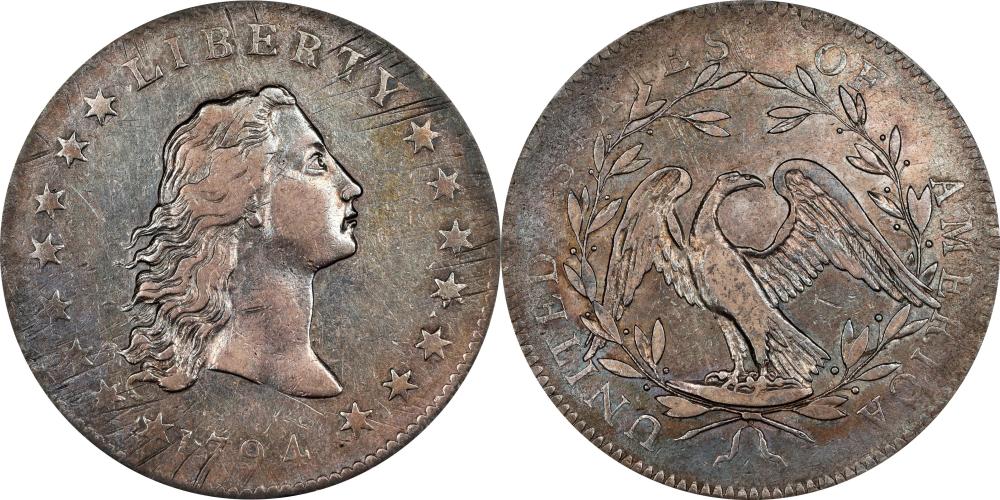
With its tiny mintage of 1,758 pieces and a documented provenance of every example to David Rittenhouse, the American scientist and Founding Father who served as first Director of the Mint, the 1794 dollar would be a landmark rarity without any further qualifications. Its place in American and world history looms much larger, however, as the very first United States dollar represents the mustard seed beginning of one of the most important currencies civilization has ever seen. The standard unit of American coinage is known in every corner of the globe, more widely valued than perhaps any money since the Spanish eight reales was accepted on the shores of every ocean on the planet and arguably since the Roman denarius held financial dominion over the Western World, from the tip of the British Isles to the furthest reaches of trade into Africa and Asia. The world has never known a currency more highly valued and sought than the American dollar, and any collector who seeks to honor that history places a silver dollar from 1794 atop their want list. Roughly 140 to 150 examples have been traced into the modern era, a survivorship that outpaces most American issues from the 18th century in any composition. Martin Logies listed 134 discrete survivors in 2010. A handful have been discovered since then, including this coin. The intentionality of the preservation of this issue underscores that even in 1794 and the decades that followed, antiquarians and the historically-minded recognized that the first American dollars were significant testaments of this nation's birth and profound souvenirs of the genesis of its economic power. Despite the curatorial impulses these coins inspired, most have been well worn or mishandled. A choice or high grade example is a prize available to very few. When James A. Stack purchased this coin, a 1794 dollar was already a major acquisition for an advanced collector. One in this grade would have been valued at $1,000 or more in the late 1940s. Despite the significant number of major rarities like this one that were in dealer inventories in the era following World War II, he chose this coin, a selection that underscores his wise connoisseurship. Mr. Stack, with plentiful resources and right-of-first-refusal access to the best inventory New York City's coin dealers had on offer, had an opportunity to choose from a perhaps unimaginable array of 1794 dollars in his collecting era. The ledgers of the collection of Virgil Brand, divided by court order in 1937 and largely dispersed while Mr. Stack was active, reflect that Brand gathered 10 1794 dollars before his death in 1925 (one was later revealed to be an electrotype, leaving a net of nine coins). The Col. E.H.R. Green Estate collection, also broken up during Stack's collecting era, contained 11, meaning those two collections included no less than 1/7 of the entire survivorship of the issue. The substantial census assembled by Jack Collins identified just four of Green's coins: the PCGS SP-66 Neil-Carter coin, the PCGS AU-55+ Granberg coin, the Stickney-Newman NGC AU-50, and the PCGS EF-40 Cleneay coin. Collins was unable to trace any of the coins he recorded back to the Brand Collection, though undoubtedly most or all of them were captured from later appearances. This piece is one of very few 1794 dollars unknown to Collins (and, later, Martin Logies, whose published census built upon the work done by Collins and Breen) that have appeared on the market in recent years. Most have come from European sources, including an example from the UK that was offered in our August 2021 ANA sale and an example on display at the Rijksmuseum in Amsterdam, on loan from the collection of the Koninklijk Oudheidkundig Genootschap (the Royal Antiquarian Society). This is certainly the finest previously unrecorded 1794 dollar to have been found in an American collection since Collins completed his work. While we have no documentation related to its provenance before its inclusion in the James A. Stack Collection, the absence of any appearances of this coin in any plated catalog consulted by Collins, Logies, and our research strongly suggests it was a piece that had been hidden in the Green Collection or the Brand Collection since the late 19th or early 20th century before being acquired by Stack privately. A coin of this value and importance would have been plated in any catalog that actually offered illustrations, making it probable that Green or (more likely) Brand would have acquired it privately as well. Eric Newman had his pick of the 11 coins from the Green holdings, and documents from the Newman/B.G. Johnson partnership cite the coins Newman declined in favor of the coin he kept: the unique Specimen (too expensive at the time), the PCGS-55+ Granberg coin (priced nearly 50% higher than the nice NGC AU-50 Newman kept and thus not a great value proposition), and the Cleneay coin, a PCGS EF-40 that would have cost Newman nearly as much as the one he chose. The currently offered coin likely would have been mentioned in those documents had it been in the Green Collection. Brand acquired his nine specimens between 1893 and 1920. The last he acquired was the most expensive at $500; considering the fact that the unique Specimen brought just $900 in 1945, it's hard to imagine the one Brand paid so much for wasn't either the Specimen or the superb Boyd-Rogers coin. Four of Brand's coins (including the electrotype) were purchased for between $115 and $125 between 1893 and 1917; the remaining five cost $15, $20 (2), or $75 (2). This coin's quality would have likely ranked it with the pieces priced between $75 and $125 in Brand's collection. One of those, acquired privately in 1910 from the collection of ANA President Judson Brenner via the Chicago Coin Company, was priced at $75 and described by B.G. Johnson during the dispersal as "very good for coin, file marks on obverse." That could be this coin, or one of dozens of others. If this coin, it's instructive to see how it could trade privately for well over a century. This coin shows a strike that is crisp and well centered. Mr. Stack, like collectors today, undoubtedly recognized that the dollars of 1794 are usually weak on the left obverse periphery (a byproduct of axial misalignment of the dies), and are quite often soft around the borders of the reverse. The piece he added to his superb cabinet shows every one of the 15 stars on the obverse, eight to the left and seven to the right. Adjustment marks affect stars 1 through 3, but they remain fully outlined and boldly defined. While adjustment marks are present around much of the obverse, fortunately they do not inhibit any of the peripheral details. The date is clear, though the bases show their usual softness, with more significant adjustment marks at 17 than 94. The most significant adjustment lines cross TY of LIBERTY and the area above and around star 12. The central obverse is very well struck, showing a portrait of Liberty impressed boldly enough to obliterate evidence of adjustment in the fields and at center. No notable adjustment lines extend into the central device, only a few short vestiges remain around Liberty's ear. A nearly horizontal contact mark centered on Liberty's neck is the only noteworthy contact mark on the obverse, and an old scratch under the bust truncation peters out before it reaches star 15. The surfaces show beautifully subtle tones of pastel blue and autumnal gold with traces of russet, lively and natural in appearance and effect. Some trivial hairlines are seen under strong lights and magnified scrutiny, and a single infinitesimal rim tick is nearly invisible on the rim adjacent to the lower reaches of star 7. Liberty's face remains beatific, her profile clear-eyed and looking slightly upward. The overall visual appeal of the obverse is superb. The reverse is likewise a victory of preservation and an aesthetic triumph. Strong evidence of frosty luster remains around design elements and in areas of the delicately toned fields. Golden gray yields to pastel blue and more robust gold tones below the eagle. The centering is excellent, and denticles are present around the entire circumference of that side. The usual left peripheral softness limits detail in the denticles near 9 o'clock on the reverse, affecting the tops of ST, though the tops of D of UNITED and AT of STATES are a bit lacking in definition as well. The softness seen at the tops of ERICA at lower right is less significant, as is the lightly granular planchet texture that remains due to insufficient striking pressure in the region. Aside from the usual striking issues common on most examples of the first large coin the coiners of the Philadelphia Mint had yet attempted, the reverse is essentially immaculate, with neither visible adjustment lines nor contact marks of consequence. Magnified scrutiny finds some dull marks right of the second S of STATES and among the leaves and branch below that letter, and a single contact mark is noted under the wing at right, but this reverse is free of distractions in a way few examples of this issue can offer. Mr. Stack chose to acquire a specimen of this coin whose level of wear left the devices bold on both sides. Liberty is well defined, and the eagle is remarkably crisp. Both sides are free of distracting planchet flaws, a common characteristic on this type due to the difficulties of producing large silver planchets from cast ingots and rolled stock with crude technology and little expertise. No 1794 dollar is perfectly made, even those in Gem condition, but this one is far better made than most. Likewise, no 1794 dollar offers ideal aesthetic appeal (even the $10 million Carter-Cardinal specimen has adjustment marks), but this example is choice and beautiful for its assigned grade. We have not sold an example graded EF-45 or finer since August 2021, when a newly discovered NGC AU-55 CAC was presented for the first time, bringing $840,000 (the MS-63+ Boyd-Cardinal coin in our November 2025 Showcase Auction is yet to be sold as of this writing). Though we've offered a total of two AU coins and four Mint State coins in the last 20 years, we've not offered any certified EF examples since August 2006. All others we've brought to market have either been graded VF or lower or problem coins that received Details grades. The two AU coins were the piece cited above and a PCGS AU-58+ that brought $910,000 in our March 2017 sale. The four Mint State coins ranged in grade from NGC MS-62 (December 2020 at $1,050,000) to PCGS MS-66+ (the Pogue coin that brought $4,990,000 in September 2015). The absence of coins graded Extremely Fine is notable, as this grade represents a sweet spot for many collectors. The return of this coin to the market is as much an opportunity for the modern generation of collectors as it was when James A. Stack acquired it in the 1940s. While our contemporaries may not have the ability to choose from a couple dozen 1794 dollars floating around at the same time, if they did, it would not be surprising if many would make the same choice as Mr. Stack. A 1794 dollar with this sort of balance, grade, and visual appeal is rare, and the chance to buy one is very rare indeed.