Have one like this?
Upload a photo for a free check of what yours may be worth.
Lot description
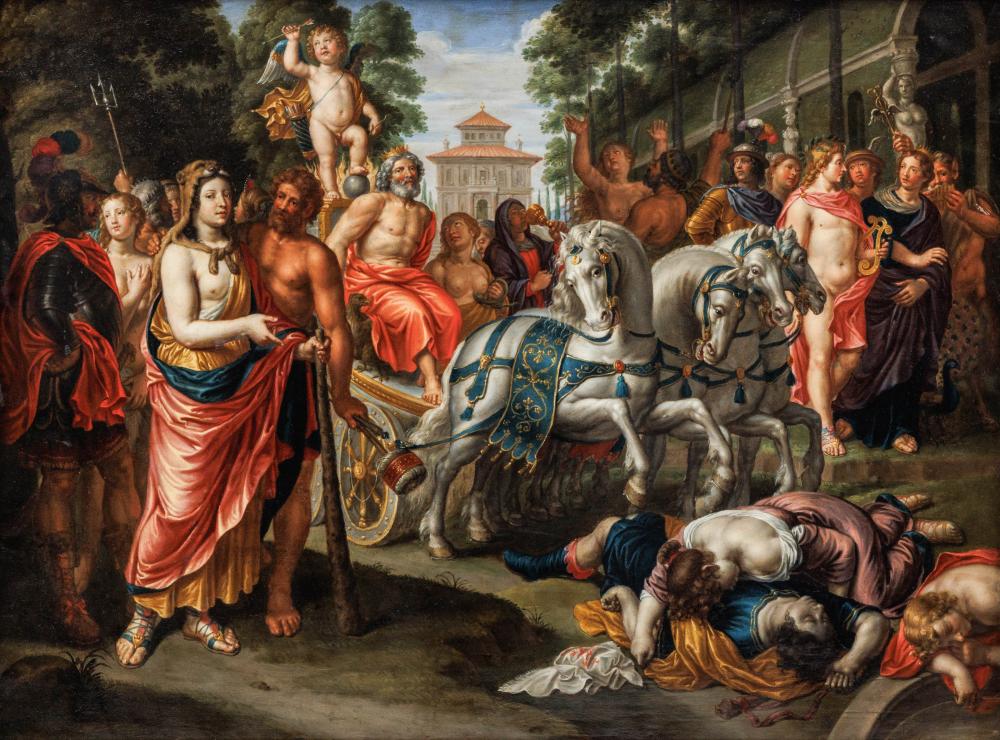
Description EN The Triumph of Jupiter and Cupid, ca. 1640. Oil on copper. Auction Sotheby’s London, 19 December 1985, lot 117 Private collection, Copenhagen Gallery and Art Dealers Sabatier, Verden, Germany Auction Schloss Ahlden, 7 September 2020, lot 1114 Private collection, Belgium Certificate: Dr Jean-Pierre De Bruyn Emeritus Professor Dr Hans Vlieghe Both authors date the work to the 1640s. Pieter Van Lint (Antwerp 1609 - 1690) was an important Antwerp 17th century Baroque painter of religious and mythological scenes, mainly on copper. Initially a pupil of Artus Wolffort, he became a master in the Antwerp Guild of St. Luke in 1632. He spent time in Paris and Rome (1631-1640). Through Antwerp art dealers Guilliam Forchondt and Matthijs Musson, his work on copper found strong sales in Spain and in the Spanish colonies. Works by Pieter Van Lint are in the Collection of the Princes of Liechtenstein, the Collection of the Prado, in the Cathedral of Our Lady in Antwerp, the Paul-Getty Museum in Los Angeles, the Museum of Budapest, the Hermitage in St. Petersburg, the Brabants Museum in 's Hertogenbosch and in the Salesianerinnenkirche in Vienna, among others. He is a contemporary of Erasmus Quellinus, among others. In this depiction, Amor rides his sea chariot in a leafy garden with a berceau decorated with caryatids and a mansion in the background. The chariot with Amor depicts the Triumph of Love. Amor has placed his foot on a globe and holds up one of his love arrows triumphantly, while Zeus, the supreme god (accompanied by his fixed attribute, the eagle) is carried along on the chariot. Four white horses pull the chariot surrounded by many figures: all of them victims of love. Zeus is seated with his hands tied behind his back. In the lower right near the well can be seen Narcissus looking at his reflection; beside him the lifeless bodies of Pyramus and Thisbe. Thisbe's bloodied scarf lies on the ground and the sword, with which she killed herself, protrudes from her back. In front of the berceau a motley procession of still more victims of love pass by; in front Apollo with his lyre and crowned with a laurel wreath, beside him Hera with her fixed attribute the peacock. Behind him Pan with his pan flute, Mercury with his winged hat and caduceus and Perseus in armor. The procession is concluded by Pluto, who violently overpowers Proserpina, who desperately raises her arms to heaven. Prominent in the foreground on the left are Hercules and Omphale, who have exchanged attributes. Hercules has her bobbin and spinning skirt in her hand and Omphale carries his lion skin and club. She points to the tragic love pair Pyramus and Thisbe and looks at the viewer as if to say how quickly love can end in a tragedy. Behind them can be seen Mars and Venus. Venus is wrapped in Vulcan's net, in which she and Mars were caught during their adultery. Behind them Neptune with his trident and a female figure, possibly representing Amphitrite. (Source: I. Wolf, Twee schilderijen van Peter van Lint over Liefde en Vruchtbaarheid in Oud Holland 2016 volume 129) A slightly larger version is in the Prado in Madrid (inv. no. 1632). Description FR Le triomphe de Jupiter et Cupidon, vers 1640. Huile sur cuivre. Vente aux enchères Sotheby’s Londres, 19/12/1985, lot 117 Collection privée, Copenhague Galerie et commerce d'art Sabatier, Verden, Allemagne Vente aux enchères Schloss Ahlden, 7/9/2020, lot 1114 Collection privée, Belgique Certificat: Dr Jean-Pierre De Bruyn Professeur émérite Dr Hans Vlieghe Les deux auteurs situent l'œuvre dans les années 1640. Pieter Van Lint (Anvers 1609 - 1690) est un important peintre baroque anversois du 17ème siècle, spécialisé dans les scènes religieuses et mythologiques, principalement sur cuivre. D'abord élève d'Artus Wolffort, il devient maître de la guilde anversoise de Saint-Luc en 1632. Il séjourne à Paris et à Rome (1631-1640). Par l'intermédiaire des marchands d'art anversois Guilliam Forchondt et Matthijs Musson, ses œuvres sur cuivre se vendent bien en Espagne et dans les colonies espagnoles. Des œuvres de Pieter Van Lint se trouvent, entre autres, dans la collection des princes de Liechtenstein, la collection du Prado, la cathédrale Notre-Dame d'Anvers, le musée Paul-Getty de Los Angeles, le musée de Budapest, l'Ermitage de Saint-Pétersbourg, le Brabants Museum de 's Hertogenbosch et la Salesianerinnenkirche de Vienne. Il est contemporain d'Erasmus Quellinus, entre autres. Dans cette représentation, Amor chevauche son char de mer dans un jardin verdoyant avec, à l'arrière-plan, un berceau décoré de cariatides et une maison de campagne. Le char avec Amor représente le triomphe de l'amour. Amor a posé son pied sur un globe et brandit triomphalement l'une de ses flèches d'amour. Zeus, le dieu suprême (accompagné de son attribut fixe, l'aigle) est transporté sur le char. Quatre chevaux blancs tirent le char entouré de nombreux personnages, tous victimes de l'amour. Zeus est assis, les mains attachées. En bas à droite, près du puits Narcisse regarde son reflet; à côté de lui, les corps sans vie de Pyrame et de Thisbé. L'écharpe ensanglantée de Thisbé gît sur le sol et l'épée avec laquelle elle s'est tuée sort de son dos. Devant le berceau, un cortège coloré d'encore plus de victimes de l'amour passe; devant Apollon avec sa lyre et couronné d'une couronne de laurier, à côté de lui Héra avec son attribut fixe le paon. Derrière lui, Pan avec sa flûte de Pan, Mercure avec son chapeau ailé et son caducée et Persée en armure. Le cortège se termine par Pluton, qui maîtrise violemment Proserpine, laquelle lève désespérément les bras au ciel. Au premier plan à gauche se trouvent Hercule et Omphale, qui ont échangé leurs attributs. Hercule tient sa bobine et sa jupe dans sa main et Omphale porte sa peau de lion et sa massue. Elle montre le couple d'amoureux tragiques Pyrame et Thisbé et regarde le spectateur comme pour dire à quel point l'amour peut se terminer rapidement dans une tragédie. Derrière eux, on aperçoit Mars et Vénus. Vénus est enveloppée dans le filet de Vulcain, dans lequel elle et Mars ont été pris lors de leur adultère. Derrière eux Neptune avec son trident et une figure féminine, représentant peut-être Amphitrite. (Source: I. Wolf, Twee schilderijen van Peter van Lint over Liefde en Vruchtbaarheid in Oud Holland 2016 volume 129 Une version légèrement plus grande se trouve au Prado à Madrid (inv. no. 1632). Beschrijving NL De Triomf van Jupiter en Cupido, ca. 1640. Olieverf op koper. Veiling Sotheby’s London, 19.12.1985, lot 117 Privéverzameling, Kopenhagen Galerie en Kunsthandel Sabatier, Verden, Duitsland Veiling Schloss Ahlden, 7.9.2020, lot 1114 Privéverzameling, België Certificaat: Dr. Jean-Pierre De Bruyn Em. Prof. Dr. Hans Vlieghe Beide auteurs situeren het werk in de jaren 1640. Pieter Van Lint (Antwerpen 1609 – 1690) is een belangrijk Antwerps 17de eeuwse barokschilder van religieuze en mythologische taferelen, vooral op koper. Aanvankelijk een leerling van Artus Wolffort, werd hij meester in de Antwerpse Sint-Lucasgilde in 1632. Hij verbleef een tijd te Parijs en Rome (1631-1640). Tijdgenoot van o.m. Erasmus Quellinus. Via Antwerpse kunsthandelaars Guilliam Forchondt en Matthijs Musson vond zijn werk op koper een sterke afzet in Spanje en in de Spaanse kolonies. Werk door Pieter Van Lint bevindt zich onder meer in de collectie van de Prinsen van Liechtenstein, in het Prado, in de Onze-Lieve-Vrouwekathedraal te Antwerpen, het J. Paul Getty Museum te Los Angeles, het Museum van Budapest, de Hermitage te Sint-Petersburg, het Brabants Museum te ’s Hertogenbosch en in de Salesianerinnenkirche te Wenen. Op deze voorstelling rijdt Amor op zijn zegewagen in een lommerrijke tuin met een berceau, gedecoreerd met kariatiden, en een landhuis op de achtergrond. De wagen met Amor verbeeldt de Triomf van de Liefde. Amor heeft zijn voet geplaatst op een wereldbol en houdt één van zijn liefdespijlen triomfantelijk omhoog, terwijl Zeus, de oppergod (vergezeld van zijn vaste attribuut, de adelaar) op de wagen wordt meegevoerd. Vier witte paarden trekken de wagen die omgeven wordt door vele figuren: allen slachtoffers van de liefde. Zeus zit met zijn handen vastgebonden op zijn rug. Geheel rechtsonder bij de bron is Narcissus te zien, kijkend naar zijn spiegelbeeld; naast hem de levenloze lichamen van Pyramus en Thisbe. De bebloede sjaal van Thisbe ligt op de grond en het zwaard, waarmee zij zichzelf doodde, steekt uit haar rug. Voor de berceau trekt een bonte stoet van nog meer slachtoffers van de liefde voorbij; voorop Apollo met zijn lier en bekroond met een lauwerkrans, naast hem Hera met haar vaste attribuut de pauw. Daarachter Pan met zijn panfluit, Mercurius met zijn gevleugelde hoed en caduceus en Perseus in harnas. De stoet wordt afgesloten door Pluto, die met geweld Proserpina overmeestert, die radeloos haar armen ten hemel heft. Prominent op de voorgrond links bevinden zich Hercules en Omphale, die geruild hebben van attribuut. Hercules heeft haar klos en spinrok in de hand en Omphale draagt zijn leeuwenhuid en knots. Zij wijst op het tragische liefdespaar Pyramus en Thisbe en kijkt de beschouwer aan alsof zij wil zeggen hoe snel liefde in een tragedie kan eindigen. Achter hen zijn Mars en Venus te zien. Venus is gewikkeld in Vulcanus’ net, waarin zij met Mars gevangen werd tijdens hun overspel. Achter hen Neptunus met zijn drietand en een vrouwenfiguur, die mogelijk Amphitrite voorstelt. (Bron: I. Wolf, Twee schilderijen van Peter van Lint over Liefde en Vruchtbaarheid in Oud Holland 2016 volume 129) Een iets grotere versie bevindt zich in het Prado te Madrid (inv.nr. 1632).