Have one like this? Check yours freeOr have an appraiser value it
Lot description
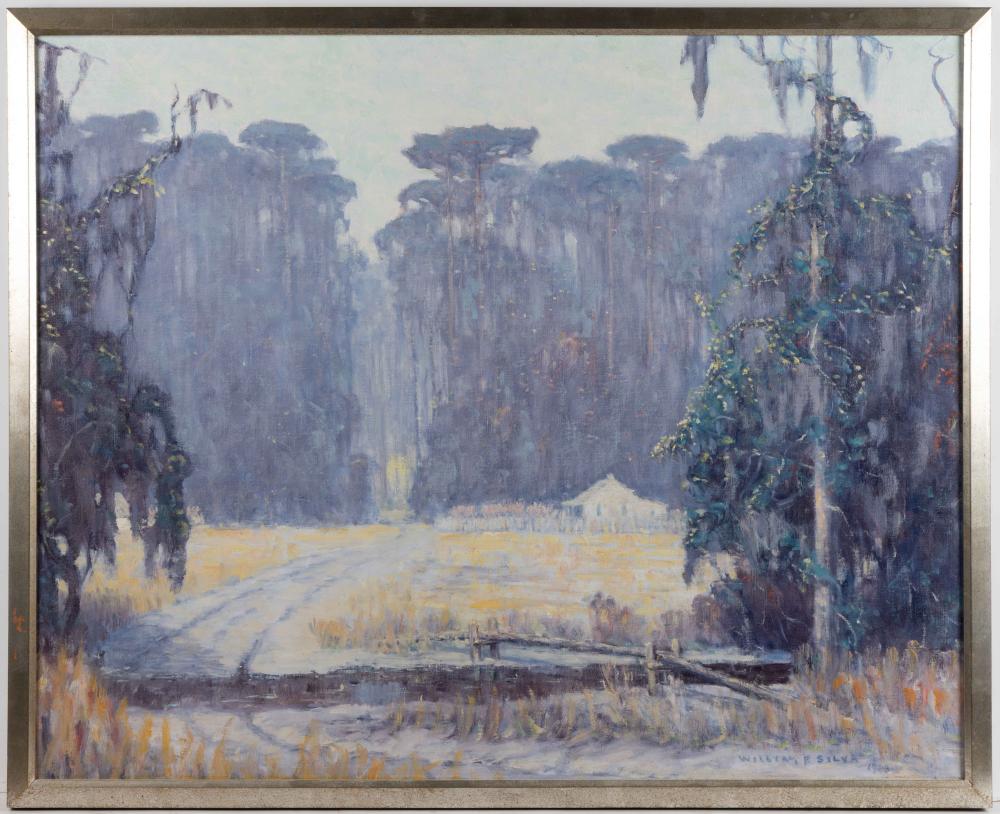
WILLIAM POSEY SILVA (AMERICAN, 1859-1948) GEORGIA LANDSCAPE PAINTING, oil on canvas, a large and impressive example featuring a rustic footbridge and dirt lane leading to a cabin backed by towering pine trees draped in Spanish moss and small yellow blossoms, signed and dated lower right, titled Jessamine Time in Georgia to stretcher verso. Dated 1938. 31 1/2" x 39 1/4" sight, 34" x 41 3/4" OA. Catalogue Note: Born in Savannah, Georgia, William Posey Silva (1859-1948) did not pursue art full-time until later in life. He initially studied engineering but then took over the family china business based in Chattanooga, Tennessee upon the death of his father. It was during this period in the heart of Appalachia that he returned to painting, often sketching the mountain landscapes around him. In 1907 at the age of forty-eight, and with the full support of his wife, Silva left the family business and ventured to Paris to pursue a career as an artist. In France, he studied under Jean Paul Laurens and Henri Royer at the Academie Julian, becoming immersed in the Impressionist style that would characterize his work thereafter. He quickly gained recognition and drew acclaim for his work at various showings and even held a solo exhibition at a Parisian gallery in 1909. Upon his return to Tennessee in 1910, Silva began submitting work widely and won a silver medal at the Appalachian Exposition in Knoxville that same year. In 1914, he and his wife moved to Carmel, California, where they would remain for the next thirty-five years, helping to found the important artist colony that was just taking root there. Though based on the West Coast, Silva often revisited his native Savannah and other parts of the coastal South. In the 1920s he was an important figure in the Charleston Renaissance, and some of his most iconic work includes atmospheric depictions of lowcountry terrain. The present work, impressive in scale, typifies his mature Impressionist style and was likely executed en plein air in the region around Savannah, Georgia.