Have one like this? Check yours freeOr have an appraiser value it
Lot description
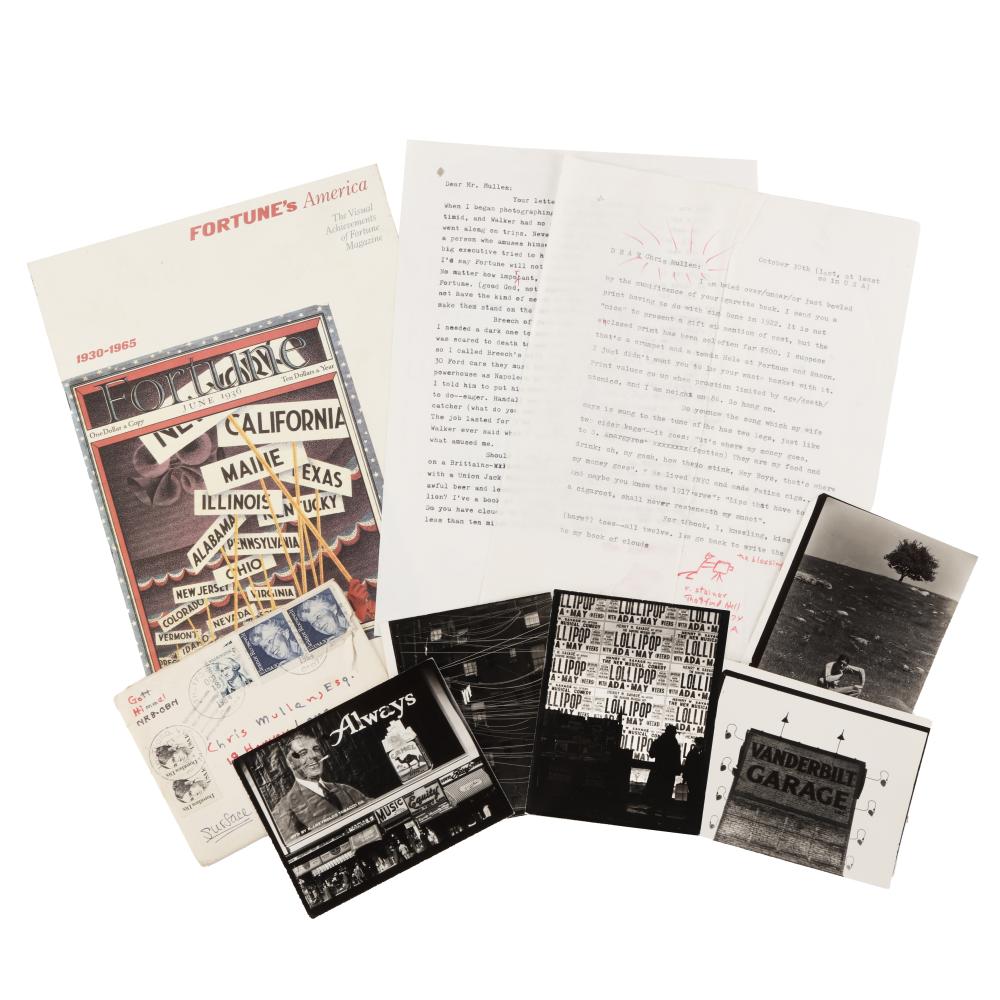
A fascinating archive of five contact prints and correspondence exchanged between American photographer Ralph Steiner and British curator Chris Mullen between September & October 1984. Each print signed and dated by the photographer in pencil, each measuring 10 x 12.7cm, comprising Clothesline, 1925, printed 1981; Always Camels, 1922, printed 1979; Vanderbilt Garage, 1924, printed 1981; Lollipop, 1922, printed 1979; and Self-Portrait Being Foolish, 1929, printed 1981. Together with a copy of Mullen's exhibition catalogue, titled Fortune's America: The Visual Achievements of Fortune Magazine, 1930-1965 [published by the University of East Anglia Library, 1985]; one letter from Mullen, and two response letters from Steiner, with one stamped envelope. "On my first job -- to do a portrait of the new president of General Motors -- I discovered that my photographing for Fortune put me a peg or two higher than the head of General Motors, and I never found in the several years a big executive who wasn't anxious to do what I asked in order to get his face into the first page of Fortune." -- Ralph Steiner, A Point of View, 1978 In 1984, as British curator Chris Mullen was assembling an exhibition charting the visual history of Fortune Magazine, he sought out the perspective of American photographer and filmmaker Ralph Steiner (then 85 years old). Steiner had been a long-time contributor to Fortune, making a name for himself, and for his intriguing, abstracted formal compositions, in the magazine as early as 1930, when they published his iconic American Rural Baroque shadow study. Mullen, who was preparing the exhibition for the University of East Anglia, was interested in a different body of work, however. In his first letter to Steiner, he asks for insights into his 1948-1949 series photographing heads of the largest American corporations at the time. Mullen writes, "...would you be prepared to say how on earth you managed to extract from them such lively/eccentric poses, from the Bantam cock strut of Ernest Breech to the Simian gloom of James Palmer..." What follows from Steiner is an entertaining response over the course of two letters, which tells the story of how he came to upend the traditional corporate portrait, infused with his unique sense of humour. In his letters, he enclosed four contact prints of some of his best-known 1920s abstract studies, alongside a 1929 self-portrait. He writes, "It is not 'nice' to present a gift with mention of cost, but the enclosed print has been sold often for $500. I suppose that's a crumpet and toad-in-hole at Fortnum and Mason..." Qty: (5)