Have one like this? Check yours freeOr have an appraiser value it
Lot description
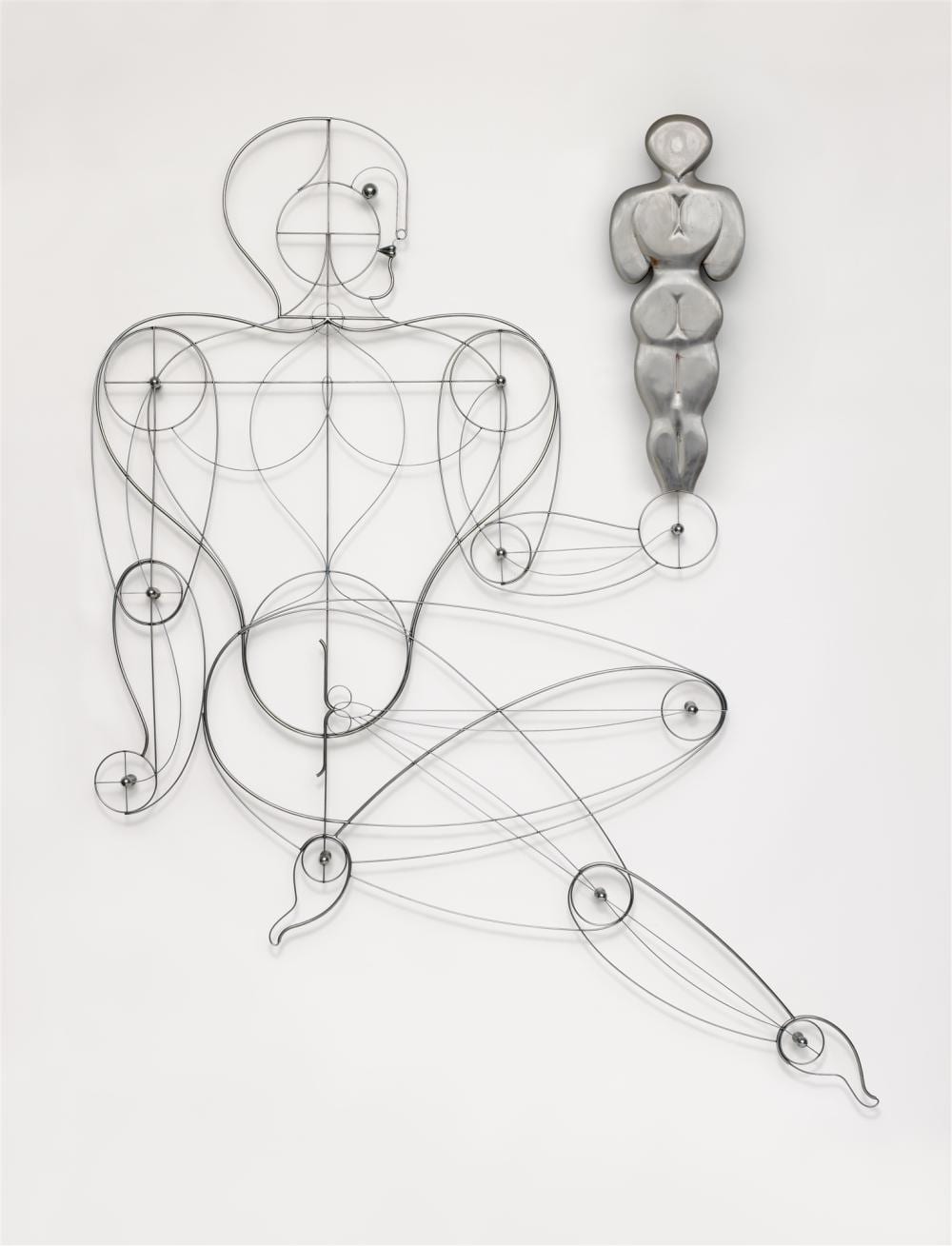
Exemplar "hors commerce" aside from the edition of 10 casts made from 1968 ff. Artistically speaking, 1930 was an extremely significant year for Oskar Schlemmer. He began his professorship at Breslau’s renowned academy of art, his wall paintings for the Folkwang Museum brought him the public recognition he had long been waiting for and he was finally able to give real form to the lengthy preliminary work he had been doing on a dematerialised, floating image of a human figure through the nearly three-metre-tall wire figure “Homo”. The work up for auction here, “Homo”, is from Schlemmer’s combined home and studio in Sehringen near Badenweiler. The monumental wire figure was commissioned by Erich Rabe MD, who had the three-part work installed in the two-storey foyer of the house Adolf Rading built for him in Zwenkau, near Leipzig. With two pen-and-ink drawings that are also entitled “Homo” serving as his starting point, Schlemmer used three coloured metal wires made of copper, brass and nickel to develop a two-dimensional stylised figure conceived in linear and geometric terms. The head and bent legs are done in profile, in contrast to the powerful upper body, which is depicted frontally. The figure’s circular right hand holds a delicate, embossed-metal sculpture of a female figure depicted from behind. At the Rabe House, a monumental profile of a face made of a metal band that cast a shadow was located to the right of this constellation and responded to it. A metallic element made up of concentric circles of wire served as the central link connecting them. As Karin v. Maur writes, Schlemmer had found a medium particularly suited to him in wire sculpture: “This is revealed not just through the joy with which he took up the opportunity to carry out his work on a monumental scale at the beginning of the thirties but also through his highly developed sense for the graphic contour, for the weightless and filigree, for the precise and absolute, which had already manifested itself early on in the one-dimensional pen-and-ink drawings and ultimately had to inevitably lead him to wire as a sculptural contour” (Karin v. Maur, Oskar Schlemmer. Das plastische Werk, Stuttgart 1972, p. 74). Even if Schlemmer only rarely discussed the meaning of his works and also only wrote about technical aspects in the case of this piece, the echoes of the creation motif, of Adam and Eve, are obvious here. Schlemmer’s wire sculptures, the idea for which came from the period around 1920, place him among the pioneers in the invention of these dematerialised works. Neither in the case of Alexander Calder nor Pablo Picasso, who were experimenting with the medium of wire around that same time, are such clear and precisely planned wire sculptures to be found among their drawn preliminary steps or their realised works.