Have one like this? Check yours freeOr have an appraiser value it
Lot description
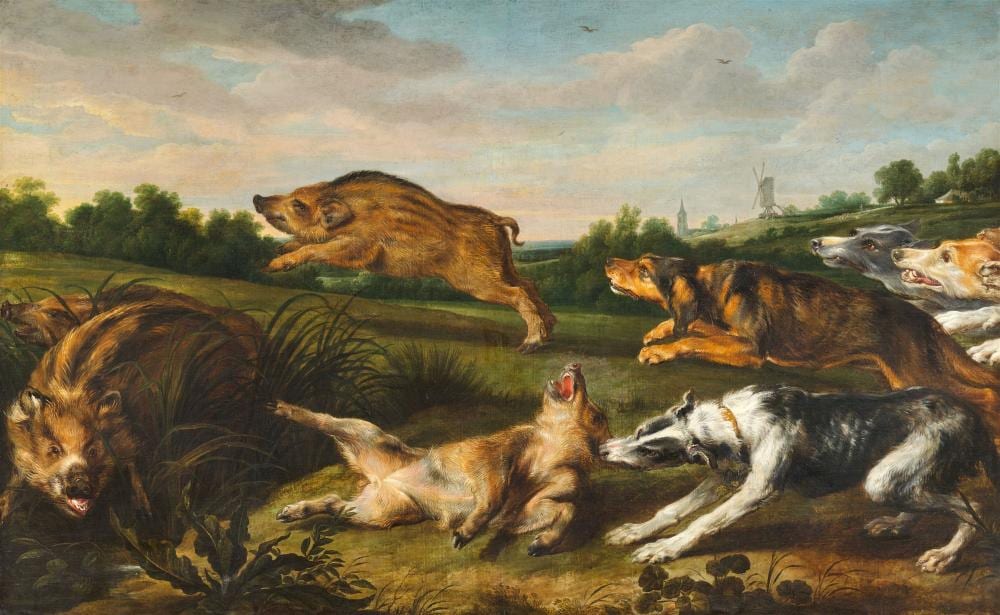
Frans Snyders is considered one of the most renowned Flemish painters of the 17th century, both for his still lifes and his hunting scenes. Rubens' animal and hunting paintings served as a model for Snyders. He developed into a true genius in the invention of varied hunting scenes and compositions in which animals played a prominent role. This painting, depicting young wild boars being hunted by dogs, shows Snyders at the height of his powers. Unlike Rubens' hunting scenes, this depiction does not focus on the humans as hunters, but on the animals. Three greyhounds and a pointing dog have tracked down the young wild boars, known as squeakers. One boar flees, a second tries to hide behind the bushes but is ready to fight, and the third, lying on the ground, has been caught by the ear by a greyhound. The dogs, rushing into the image in a hunting frenzy, form a diagonal with the young boar running up the slope, which reinforces the dynamism of the scene. The pain of the pig bitten in the ear in the foreground of the picture is almost audible. Snyder perfected his accurate observation of the animals' physiognomy and behaviour in conjunction with precise depictions of texture in this work. Snyders often painted scenes of hunting with fearsome wild boars fighting savagely for their lives. However, only one other depiction of young boar by his hand has survived. The painting ‘Greyhound Catching a Young Wild Boar’ in the Museum of Fine Arts in Ghent (inv. no. 1920-L) is a smaller version of the present picture, in which the dog drags the piglet across the ground by its ear. In her monograph on Frans Snyders, Hella Robels dates 'Hunting Young Wild Boars' to the 1620s and attributes a preparatory drawing to the painting, which is housed in the Fitzwilliam Museum, Cambridge (fig. 2; inv. no. PD 720-1963). According to Robels, this preliminary study proves that the painting is an invention by Snyders and refutes the original attribution to Paul de Vos and Jan Wildens (Hella Robels, Frans Snyders, Munich 1989, no. Z 36, pp. 414–15). Confusion with paintings by his pupil Paul de Vos occurs due to his use of the same subjects and stylistic influence. From 1636 onwards, Snyders and Vos painted numerous animal and hunting scenes for the Torre de la Parada hunting lodge and other palaces belonging to King Philip IV of Spain, most of which hung as supraportas above doors and windows. This work was carried out as part of the king's famous commissions to Rubens, in which many other Antwerp artists were involved. Abb 1/Fig. 1: Frans Snyders, Jagd auf Frischlinge, Feder in Braun, braun laviert / Hunt for Young Wild Boars, pen in brown ink, brown wash © The Fitzwilliam Museum, University of Cambridge.