Have one like this?
Upload a photo for a free check of what yours may be worth.
Lot description
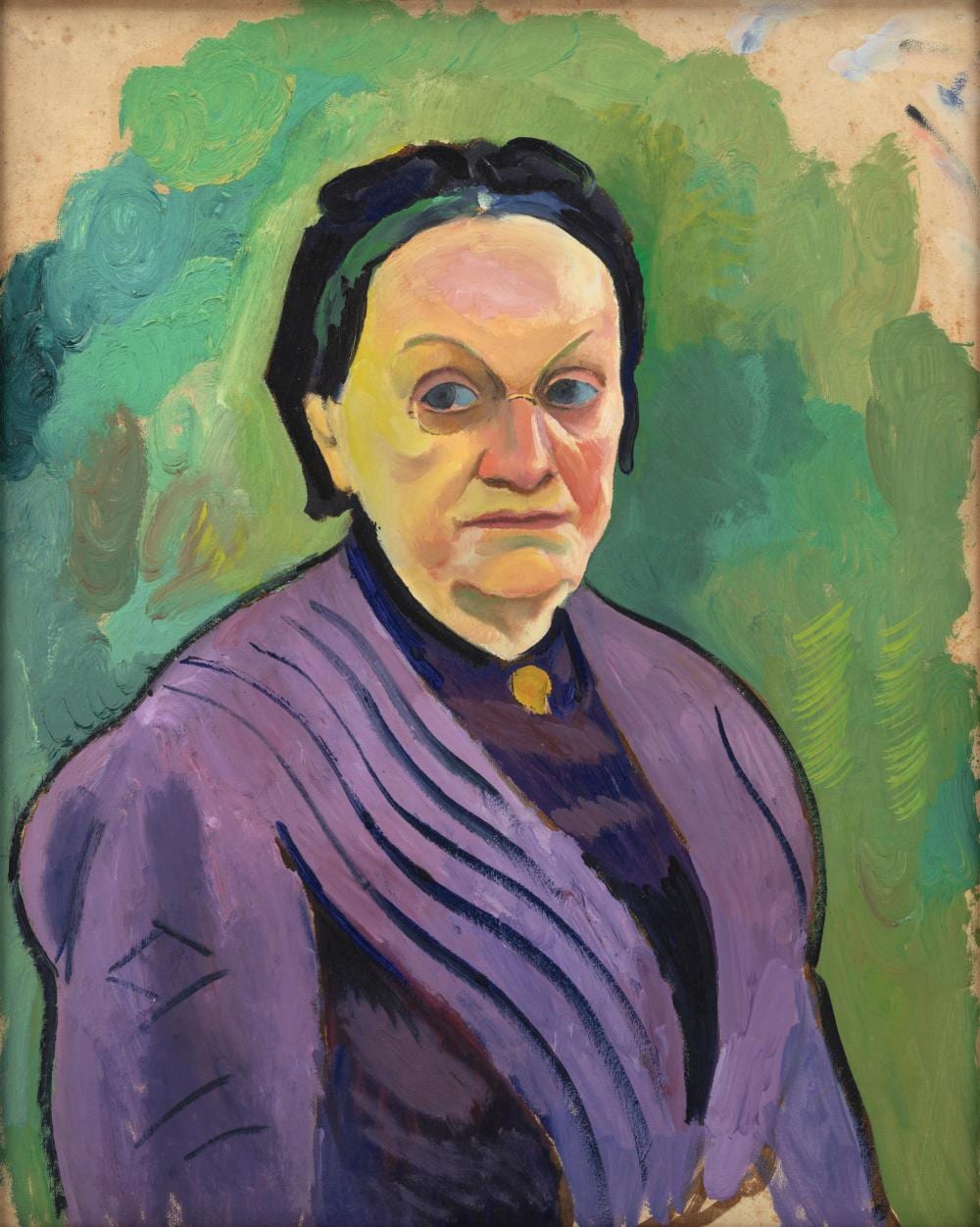
(Meschede 1887–1914 Perthes les Hurlus) Porträtstudie Katharina Koehler (Portrait Study of Katharina Koehler), 1911, verso signed, titled and dated with ink August Macke, Porträtstudie Frau Nettchen Koehler 1911, oil and pencil on board, laid down on wood, 60.5 x 49 cm, framed Provenance: Estate of the artist Private Family Collection, Germany, 1957–2015 With Alexander Ochs, Berlin, 2016 Private Collection, Germany Exhibited: Bielefeld, Kunsthalle Bielefeld, O Mensch! Das Bildnis des Expressionismus, 28.11.1992–14.2.1993 Bielefeld, Kunsthalle Bielefeld, Gustav Vriesen und die Kunst. Die Entdeckung der Moderne in Bielefeld, 10.4.2022–04.09.2022 Literature: Gustav Vriesen: August Macke, Stuttgart 1957, p. 323, no. 279 with ill. Ursula Heiderich: August Macke: Gemälde: Werkverzeichnis, Ostfildern 2008, no. 299 with ill. Exh. cat. August Macke Haus, Bonn 2000, p. 102, p. 62 with ill. In the portrait study of Katharina Koehler, Macke’s personal style breaks away from his academic style. The brushwork becomes freer, and the color itself carries the emotion. Instead of objective observation, a lively interplay of colored areas and light takes center stage - a step toward the vibrant chromatic expressiveness that characterizes his mature work. This work was also created within the circle of the Koehler family, the family of Macke’s wife Elisabeth, who played a decisive role in supporting him. Bernhard Koehler, Elisabeth´s uncle, became a central patron of the avant-garde: he supported August Macke and Franz Marc, supported the publication of Der Blaue Reiter, and backed Herwarth Walden’s exhibition project, Erster Deutscher Herbstsalon in Berlin, thereby providing visibility and infrastructure for the new artistic movement. The Koehler family was vital to the avant-garde because they did not merely purchase art – they enabled it. Bernhard Koehler established regular stipends for artists, opened his Berlin villa as a museum for modern art, and generously lent works for exhibitions – acting as a catalyst for networks, public awareness, and the art market. At the same time, he acquired significant works of European modernism at an early stage (including Monet, Renoir, Cézanne, van Gogh, Gauguin, Matisse) and built an outstanding collection of Macke and Marc. This unique combination of financial support, curatorial vision, and logistical aid made the Koehler family central figures in the milieu of the early twentieth-century avant-garde.