Have one like this?
Upload a photo for a free check of what yours may be worth.
Lot description
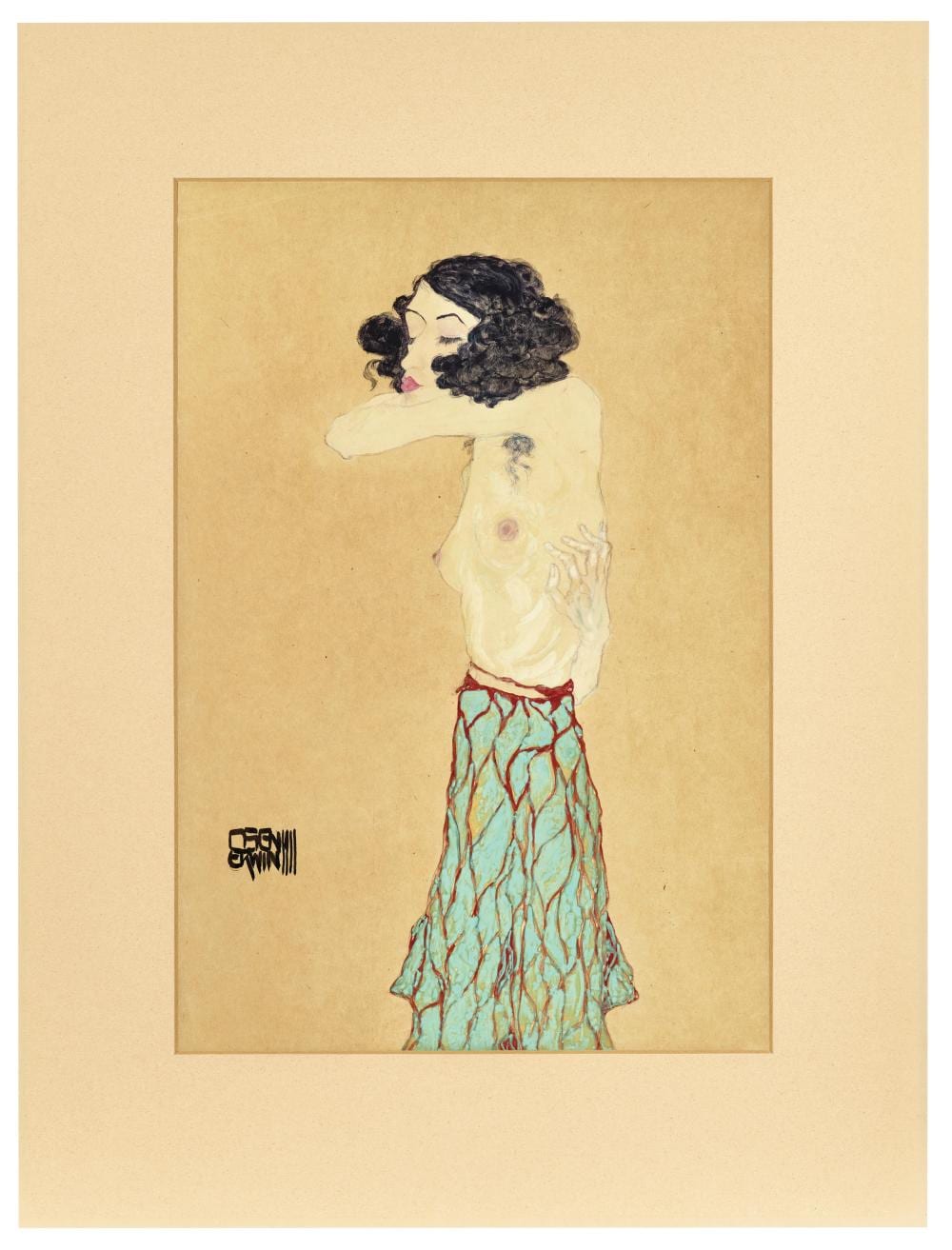
(Vienna 1891–1970 Dortmund) Halbakt mit Rock. Die Tänzerin Moa Mandu (Half-Nude with skirt. The dancer Moa Mandu), signed and dated OSEN ERWIN 1911, titled on the reverse Selbstmörderin (Suicidal woman), watercolour, gouache and pencil on paper, 45 x 34 cm, framed Provenance: Galerie Hassfurther, Vienna (1981) Private Collection, Vienna Compare: Christian Bauer, Erwin Osen. Egon Schieles Künstlerfreund, Munich 2023, cf. „Sitzender Halbakt“, ill. p. 99 Erwin Dominik Osen was one of the most vibrant figures of the Viennese theater and artistic scene around 1910, embodying an untamed and versatile creativity as actor, mime, dancer, as well as stage designer and painter. Around 1909, Egon Schiele encountered Osen and became captivated by his joie de vivre and nonconformity. This encounter blossomed into a profound friendship and intense artistic exchange. Anton Peschka, Schiele’s brother-in-law, even described Osen as a “catalyst in Schiele’s shift from Art Nouveau to Expressionism and in overcoming Gustav Klimt”. Over the following two years, Schiele documented their friendship in nine portraits and numerous back studies. Their paths diverged with the outbreak of war in 1914. Around 1911, Erwin Dominik Osen met the dancer Moa Mandu, a star of the suburban Viennese stages. According to Arthur Roessler, her appearance was “spectacular and mysterious,” described as a “willowy dancer with a mask-like calm frozen on her pale face beneath a blue-black center part.” Osen and Mandu soon became a kindred pair, but Egon Schiele – who shared a studio with Osen – was also captivated by her delicate figure, which “moved mechanically at the tender joints,” and by her “melancholically matte eyes, shadowed brown-blue, framed by long lashes and heavy lids.” The dancer became a welcomed model for both artists, though only four watercolors by Osen are known. The present work is a new discovery and, based on its 1911 date, may be among the earliest portrayals of the dancer. Noteworthy is Osen’s signature, featuring his full name and the date “1911,” executed in a graphically compact, square form as a bold statement. The parallel to Egon Schiele’s signatures from the same year onward is unmistakable. (see Christian Bauer, 2001)