Have one like this? Check yours freeOr have an appraiser value it
Lot description
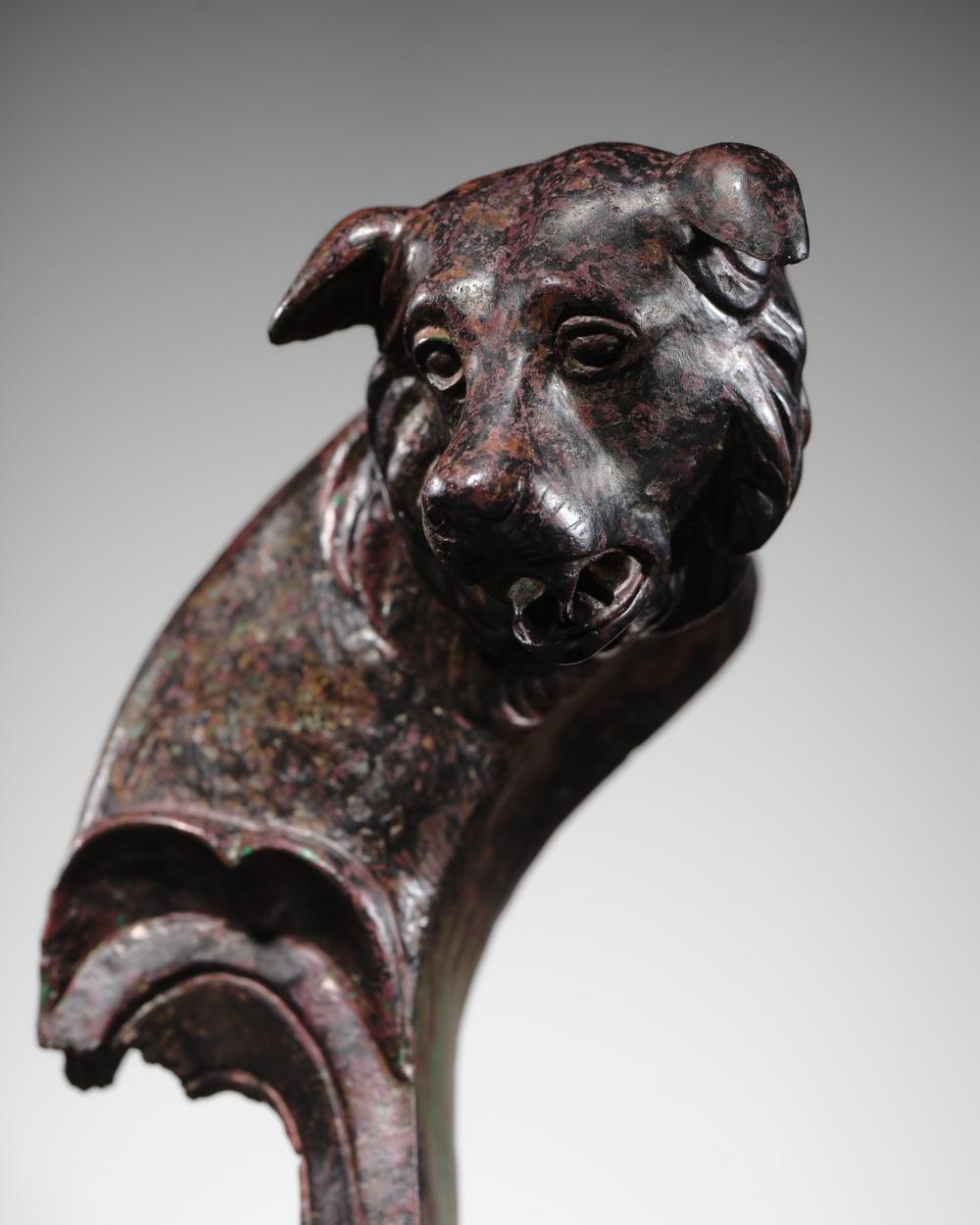
† A FINELY CAST ROMAN BRONZE ‘MOLOSSIAN DOG’ FULCRUM TERMINAL, MID-2ND CENTURY AD Roman Empire. The headboard of a coach (fulcrum) finely cast as a head of a Molossian dog turned sharply to the right, with vigorously rendered facial features, gaping jaws revealing bared teeth, incised whiskers, flanked by dropping ears and a thick layered mane. Provenance: A European private collection. Sotheby’s New York, 7 December 2001, lot 127, sold for USD 8,500 or approx. EUR 17,000 converted and adjusted for inflation at the time of writing. Galerie Robert Hecht Jr, acquired from the above. The Bonita L. Cobb Collection in Florida, United States, acquired from the above and thence by descent. A copy of an invoice from Robert E. Hecht Jr, dated 23 August 2004, confirming the dating and provenance above, accompanies this lot. A copy of an insurance appraisal from Eric Lang Peterson Certified Appraisals, dated 1 February 2005, accompanies this lot. This valuation states a price of USD 20,000 or approx. EUR 34,000 (adjusted and converted for inflation at the time of writing). Robert E. Hecht Jr. (1919-2012) was a prominent American antiquities dealer who over more than five decades built a reputation for sourcing and selling ancient artworks to major museums and collectors. He studied classics and archaeology (including at the American Academy in Rome), and became best known, among other high-profile transactions, for arranging the sale of the Euphronios Krater to the Metropolitan Museum of Art. Condition: Very good condition with ancient wear, commensurate with age. A few small cracks to the edges, and obvious losses. A fine, naturally grown patina overall, with distinct malachite encrustation. Weight: 463 g (excl. stand), 715 g (incl. stand) Dimensions: Height 13.3 cm (excl. stand), 24 cm (incl. stand) With an associated metal stand. (2) Fulcra, the ornamental headboards of Roman couches, were often adorned with animal heads that lent symbolic meaning to the furniture used in elite social and ritual settings. Mules were a particularly favored motif, their close association with Bacchus underscoring the symposium’s festive and Dionysian character. The present example represents a Molossian dog, a now-extinct breed originating in Epirus, celebrated in antiquity for its imposing size and formidable power. Such works are exceedingly rare: until the late 1980s, only five further fulcra of this type had been recorded, underscoring both the scarcity and importance of this remarkable survival. Literature comparison: Compare a related bronze fulcrum with a bust of a maenad and sleeping Ariadne, dated to the 2nd century BC-first half of the 1st century AD, 22 cm wide, in the Arthur M. Sackler Museum, Harvard University, object number 1987.130. Auction result comparison: Type: Related Auction: Christie’s New York, 9 June 2011, lot 142 Price: USD 128,500 or approx. EUR 156,000 converted and adjusted for inflation at the time of writing Description: A roman bronze fulcrum terminal, circa 1st century B.C.-1st century A.D. Expert remark: Compare the closely related modeling, dating and size (15.2 cm). Note the different subject. Auction result comparison: Type: Related Auction: Christie’s New York, 16 June 2020, lot 31 Price: USD 22,500 or approx. EUR 24,000 converted and adjusted for inflation at the time of writing Description: A roman bronze roundel with a Molossian hound, circa 1st-2nd century A.D. Expert remark: Compare the related subject, modeling and dating. Note the different purpose of this object. 13% VAT will be added to the hammer price additional to the buyer's premium - only for buyers within the EU.