Have one like this? Check yours freeOr have an appraiser value it
Lot description
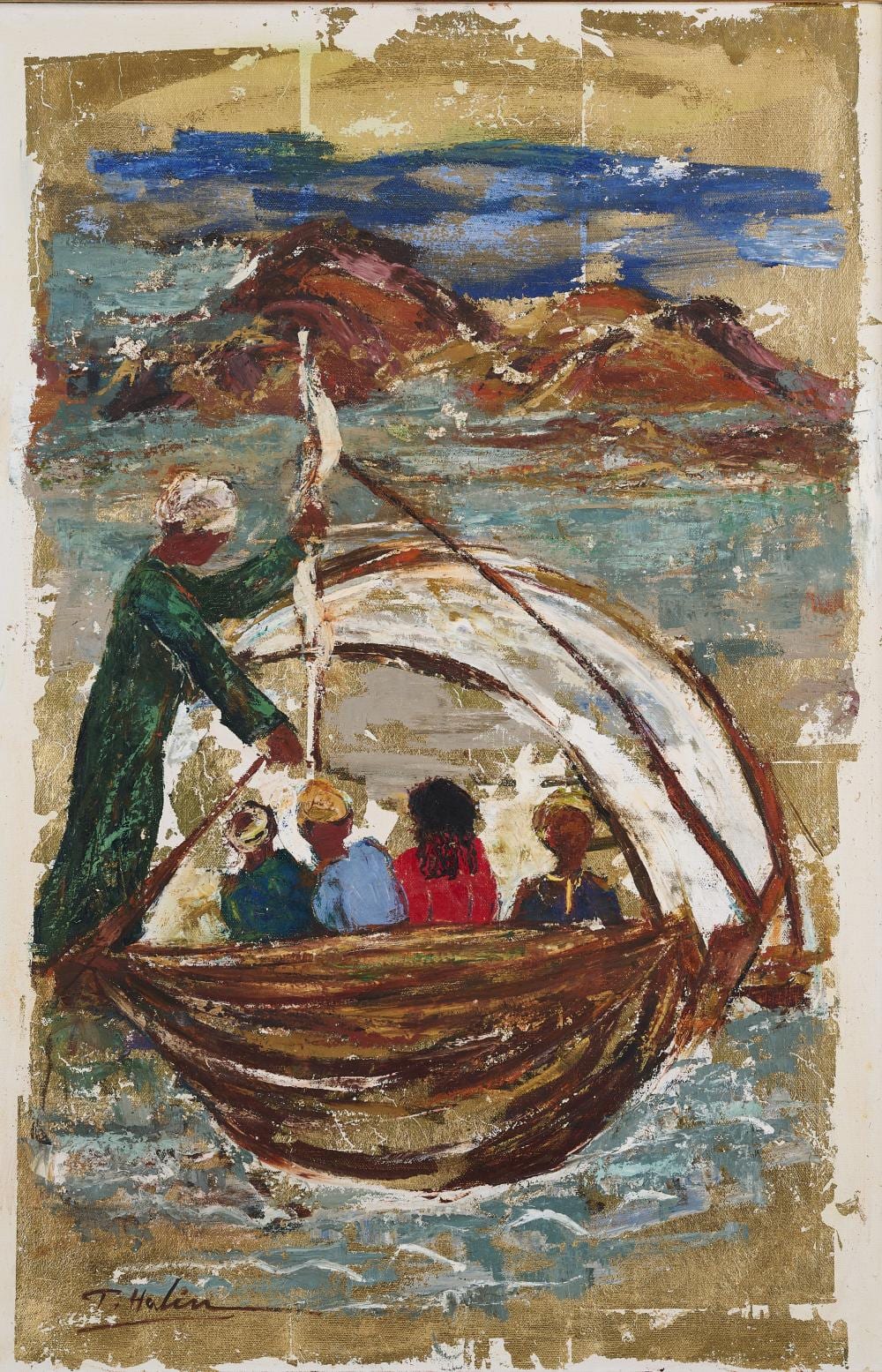
TAHIA HALIM (EGYPTIAN 1919-2003) FIGURES ON A BOAT signed T. Halim lower left oil on canvas 75.5 x 48.5; 29 3/4 x 19in 89.5 x 64cm; 35 1/4 x 25 1/4in (framed) Property of a Distinguished Collector, London Provenance Acquired from a private collection in Cairo in the 1980's Tahia Halim was born in Dongola, Sudan. From an early age, she demonstrated a strong interest in art while her father served as chamberlain to King Fouad (1868–1936) in Cairo. After completing her secondary education privately within the royal palace, Halim enrolled at Cairo’s Academy of Fine Arts. During her post-secondary education, Halim was mainly exposed to academic and impressionist styles. This was due to the Euro-centric curriculum at the Academy and the influence of her instructors. She later trained under the Lebanese painter Youssef al-Traboulsi and the Greek artist Alecco Jerome. In 1940, Halim met the avant-garde artist Hamed Abdalla (1917–1985). The two married five years later and, in 1949, moved to Paris, where they both attended the Academie Julian. Halim returned to Cairo in 1951. A significant turning point in her artistic journey came in 1959, when she was sent to Nubia - the land of her birth - to document the process of building the Aswan High Dam on the Nile, which flooded much of Nubia and forced the relocation of over 100,000 people. There, she became fascinated by the rural way of life and the authentic character of the Nubians, whom she viewed as embodying centuries-old traditions of the land. Her paintings serve as visual diaries, preserving daily life through vivid colours, earth tones, bold figuration, and impasto techniques inspired by both Coptic and Ancient Egyptian styles. These simple, evocative forms encapsulate the beauty and vibrancy of the Southern Nile. Works like Figures on a Boat capture routine scenes with artistic exaggeration and emphasise harmonious composition over strict proportion, celebrating Nubia's rich history and Halim’s innovative approach. Her emphasis on Nubian subjects reflected a broader movement among Egyptian artists to reclaim cultural identity during the post-colonial era, which resonated with audiences seeking national pride. Halim’s artistic choices were also shaped by the political environment of the time, as Egyptians sought to distance themselves from colonial authority. Her celebrated career includes having works in several international collections. Notably, she became the first woman to be awarded the Guggenheim International Prize in 1958, an honour that highlights her significant contribution to Egyptian art and her lasting legacy.