Have one like this?
Upload a photo for a free check of what yours may be worth.
Lot description
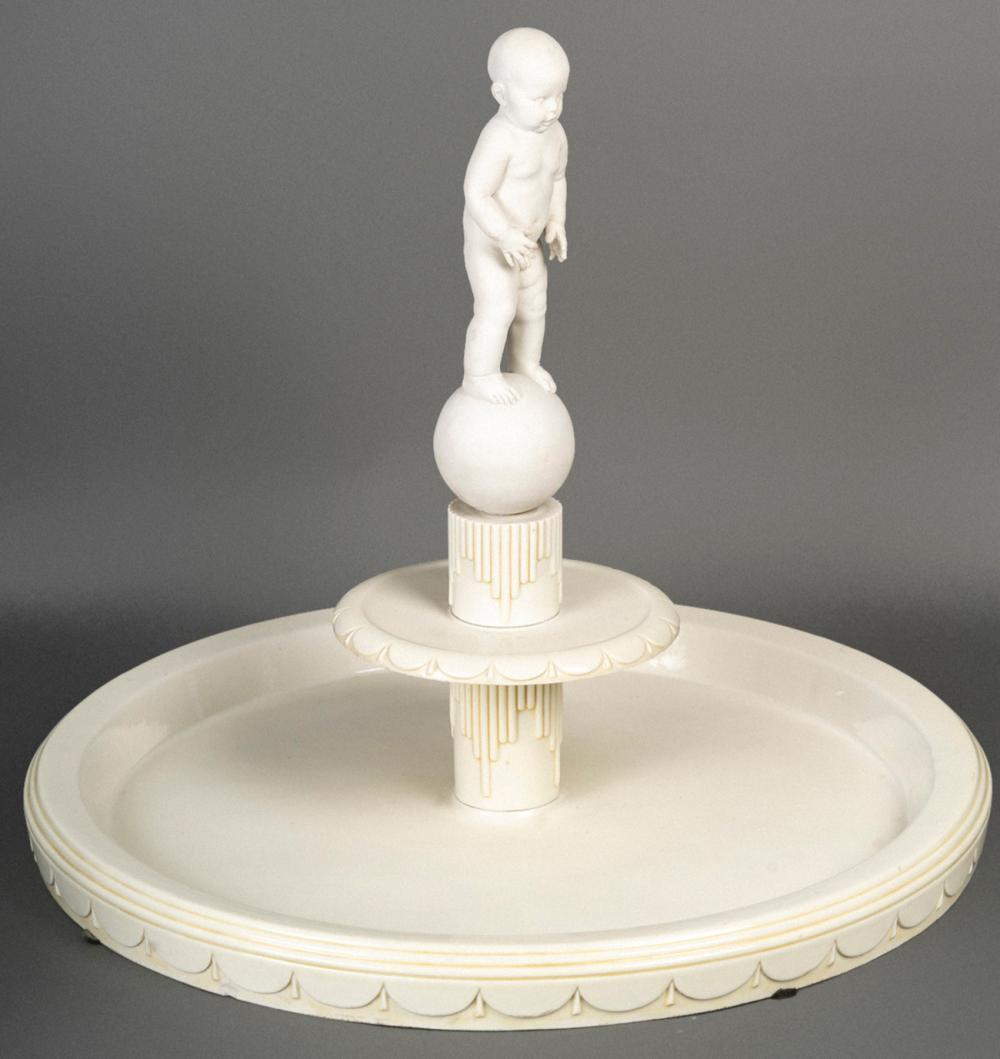
MAX BLONDAT (Crain, Burgundy, 1872 - Paris, 1925) and SÉVRES. Centerpiece "L'équilibre". Porcelain and biscuit. Max Blondat realized his sculpture "L'équilibre" for the Hôtel du Collectionneur of Jacques Émile Ruhlmann on the occasion of the International Exhibition of 1925 in Paris. Measurements: 47 cm in height; 54 cm in diameter. The piece in question is one of the most refined materializations of the aesthetic ideology of Max Blondat, a Burgundian sculptor whose career is closely linked to the dawn of Art Deco. His creation, significantly titled "L'équilibre", was originally conceived to decorate the Hôtel du Collectionneur, on the occasion of the International Exhibition of Modern Decorative and Industrial Arts held in Paris in 1925. In the version offered to us by the Manufacture Nationale de Sèvres, the work becomes a lavish centerpiece, blending sculptural language with ornamental functionality with harmonious naturalness. The composition is articulated around the figure of a naked child, a paradigm of innocence and timeless grace, standing on a sphere: a universal symbol of perfection and harmony. This delicate balance is in turn supported by a fluted column, reminiscent of classical architecture, which gives the whole an air of solemnity tempered by the childlike sweetness of the figure. The column evokes a fountain by extending into a circular dish, the outer walls of which are chiseled with tassels and festoons. Max Blondat was an Art Nouveau and Art Deco sculptor trained at the École Germain-Pilon in Paris. In 1890 he exhibited a plaster medallion at the Salon des Artistes Français. He later perfected his technique in the workshop of Mathurin Moreau. In 1892, he entered the Ecole des Beaux-Arts in Paris, signing his first works with his mother's name Henry. He also produced ceramics with Edmond Lachenal the Sèvres factory or wrought iron works with Edgar Brandt. He worked with the Siot-Decauville foundries and the Valsuani foundry. He also created jewelry for Chambon and Hermès. In 1906, he was a founding member of the French Decorative Art Society. A part of his works is exhibited in the Museum of the Thirties in Boulogne-Billancourt. One of his most famous creations is the fountain of the Jeunesse (youth), representing three children watching three frogs.