Have one like this? Check yours freeOr have an appraiser value it
Lot description
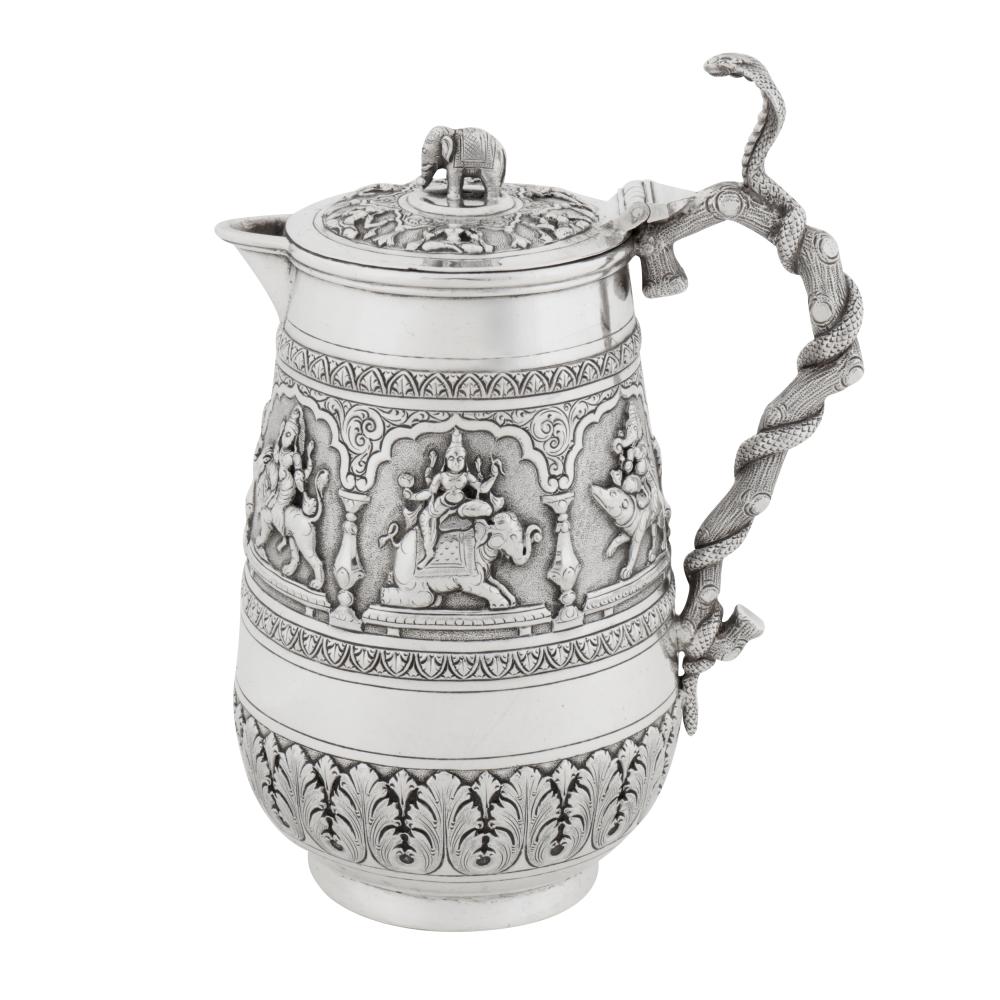
Bangalore circa 1900 by Krishniah Chetty A late 19th / early 20th century Anglo – Indian silver jug Raj period. Of rounded tapering cylindrical form upon a collet foot. The cast handle formed and textured as a cobra environed around a branch, leading to a hinged gently domed lid surmounted by a finial formed as a caparisoned elephant statant. The body with embossed band in the swami work in the Madras style of gods upon their vahana, Indra upon an Elephant, Ganesha uncharacteristically upon a dog, Karktikeya upon a peacock with serpant, Parvati upon a lion, Durga upon a tiger, Kalki upon a horse Nirrti upon a man, and Shiva upon Nandi the bull, all within shaped architraves between pilasters, heightened with flat chased scrolls. The base section with a band of stylised acanthus leaves, the lid with a band of swami work. Marked underneath C. KRISHNIAH CHETTY, BANGALORE, SILVER. Height – 15.9 cm / 6.25 inches Weight – 383 grams / 12.31 ozt Notes: The firm of Krishnan Chetty was the most productive in Bangalore, and is in all likelihood responsible for producing this bowl. They supplied Bombay retails such as Tarachand Pursram Ramswam. Satinised plain areas are a distinctive characteristic of Bangalore made silverware, this decorative technique is particularly susceptible to wearing away. Wilkinson notes that “[t]he silversmiths of Bangalore produced fine quality work particularly in Swami and in a jungle pattern showing wild animals in a frieze.” Wilkinson, W., (1999)., Indian Silver 1858-1947: Decorative Silver from the Indian Sub-Continent and Burma Made by Local Craftsmen in Western Forms. London, Wynyard R T Wilkinson, p. 165. Another near identical jug by this workshop, differing only in that the finial was of a figure of Vishnu upon the elephant that was not included on this model as well as a differencing of the gods was sold Kingham’s 11 Sep 2025, lot 54a (£1100 hammer)