Have one like this?
Upload a photo for a free check of what yours may be worth.
Lot description
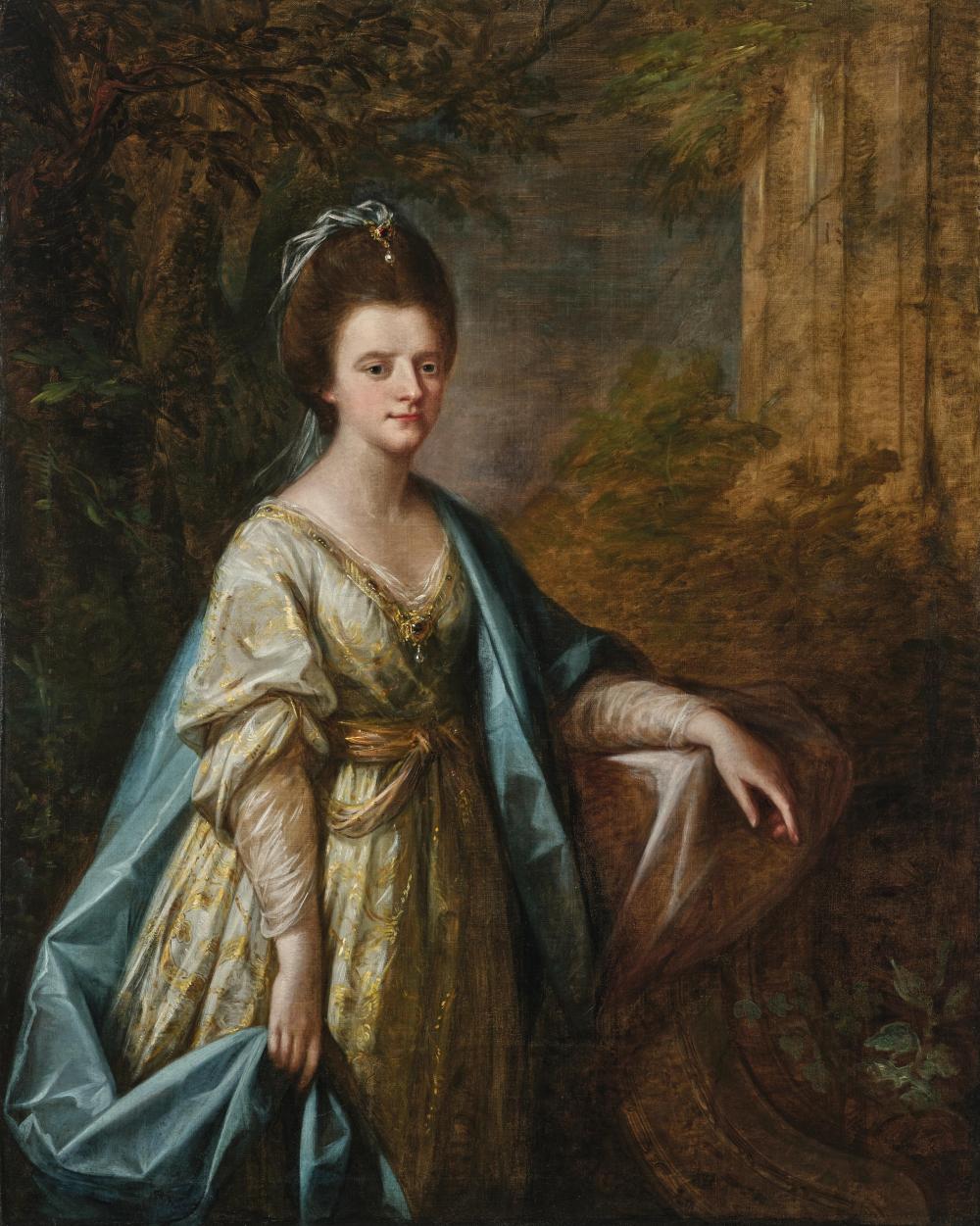
(Chur 1741–1807 Rome) Portrait of Lady Anne Simpson, née Lyon (1746–1821), circa 1773, oil on canvas, 128 x 102 cm, framed Provenance: probably commissioned by Sir John (circa 1738 – before 1789) and Lady Anne Simpson (1746–1821) for Bradley Hall, Durham; probably by descent to their daughter Mary Susannah Simpson (1773–1845), wife of Thomas Henry Liddell, 1st Lord Ravensworth (1775–1855); thence by descent, Eslington Park, Northumberland; Eslington Park sale, Anderson & Garland, London, 6 November 1951, lot 489; art market, England; where acquired by the present owner Literature: V. Manners and G. C. Williamson, Angelica Kauffmann, R.A. Her Life and her Works, London 1924, p. 203, no. 2 (listed under ‘Lord Ravensworth, Eslington’) We are grateful to Bettina Baumgärtel for confirming the attribution of the present painting after examination of the original. This elegant and refined portrait, lost to scholarship for much of the twentieth century, represents a significant rediscovery within the oeuvre of Angelika Kauffmann, the Swiss-born painter who rose to extraordinary prominence in London society during the 1760s and 1770s. The sitter, Lady Anne Simpson, née Lyon, was the daughter of Thomas Lyon, 8th Earl of Strathmore, and Lady Jane Lyon, Countess of Strathmore. Her marriage in 1768 to John Simpson of Bradley Hall, County Durham, allied two prominent families, and it was likely on this occasion that the couple commissioned portraits from Kauffmann, whose reputation in Britain was then at its zenith. Lady Anne is depicted in three-quarter length, turning gently to her right, set against a wooded landscape which opens onto a fluted classical column. This architectural element is more than decorative: it provides a subtle visual dialogue with the portrait of her husband, in which a similar column motif is employed. The composition achieves a harmonious balance between landscape, architecture, and figure – one of Kauffmann’s hallmarks. The sitter’s attire is rendered with great delicacy: over a simple white gown she wears a transparent overdress threaded with gold embroidery, its luminous surface catching the light, which is captured with extraordinary finesse. Draped across her figure is a sash of soft dove-blue, a chromatic counterpoint that frames her presence with quiet grandeur. The portrait belongs to a distinguished type first developed by Kauffmann in her celebrated 1767 likeness of Queen Charlotte, a painting that established the fashionable courtly prototype of female portraiture in Britain. Aristocratic women soon sought to be depicted in a similar manner, both to emulate royal taste and to participate in a new aesthetic of refinement and virtue. In Lady Anne’s portrait, the carefully poised hands, the gentle turn of the head, the intricate hair ornaments, and the richly embellished neckline all recall this influential model, underscoring Kauffmann’s unique position as the arbiter of elite portraiture in Georgian England. The rediscovery of this painting significantly enriches our understanding of Kauffmann’s London period. It testifies not only to her technical mastery of costume and fabric, but also to her ability to combine portraiture with the allegorical and the ideal. Kauffmann’s portraits rarely convey mere likeness; instead, they elevate their sitters into timeless exemplars of virtue, grace, and cultivated femininity. Lady Anne, presented here with serene composure and understated dignity, embodies precisely the qualities admired by her contemporaries and so memorably captured by Kauffmann’s brush. The identity of the sitter has long been obscured by the existence of another portrait titled ‘Anne Simpson’, believed to represent her mother-in-law, Anne Clutterbuck Simpson. This confusion is clarified by the early reference in Manners and Williamson’s 1924 catalogue and is further supported by the original inscription on the reverse of the frame ‘WIFE of SIMPSON’. Taken together with the securely signed and dated companion portrait of John Simpson (1773), now in two versions in the Belvedere, Vienna (inv. no. 8504) and in the National Portrait Gallery, London (inv. no. NPG 1485), the present painting can confidently be dated to the same moment in Kauffmann’s career. The Simpson family of Bradley Hall held an important position in County Durham in the north of England throughout the eighteenth century. John Simpson, Esq., husband of Lady Anne, not only maintained the estate as a centre of landed influence but also cultivated ties with London’s cultural world, commissioning portraits that reflected both lineage and social aspiration. Bradley Hall itself, with its architectural grandeur and landscaped grounds, provided the ideal backdrop for such expressions of family prestige. The commissioning of companion portraits from Angelika Kauffmann was therefore not merely a private act of commemoration but a deliberate statement of refinement and participation in the artistic currents of Georgian Britain. These works linked the Simpsons to a broader network of aristocratic patrons who sought to immortalise their identity through art of the highest order.