Have one like this? Check yours freeOr have an appraiser value it
Lot description
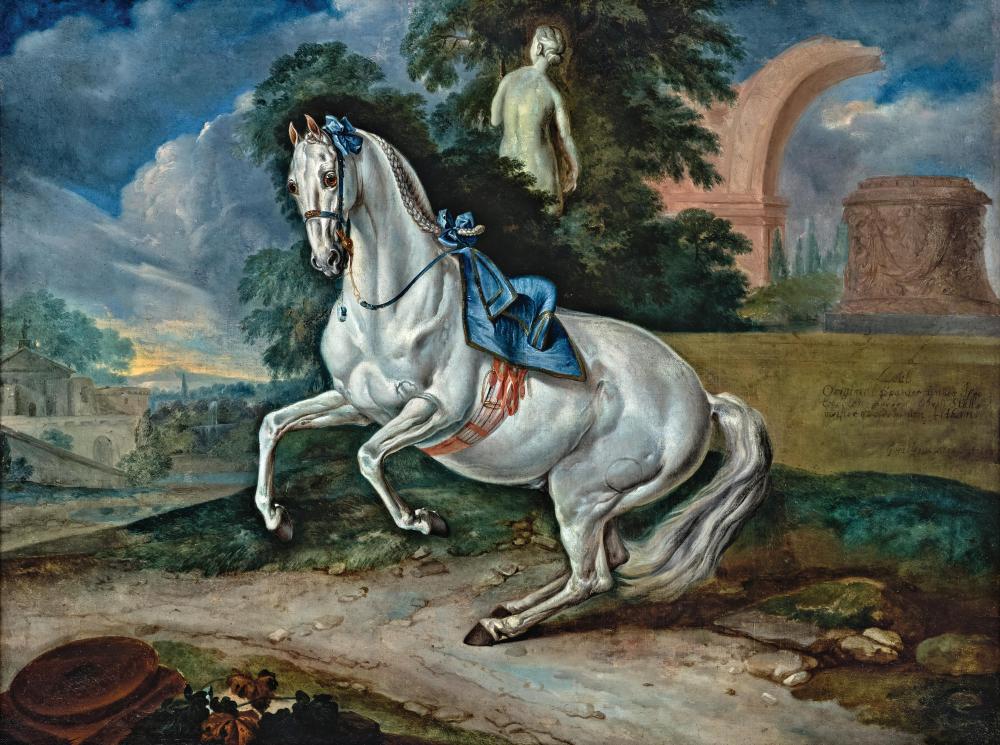
(Bruxelles 1672–1737 Vienna) A portrait of the stallion Léal performing the levade inscribed, signed and dated on the pedestal: Léal / Original Spanier unter Ihro / Excelenz … Obrist Stall = / meister Grafen von Althan / J. G. v Hamilton A° 1721, oil on canvas, 47.5 x 63.5 cm, framed The present painting depicts Léal, the prized stallion owned by Count Johann Michael von Althann, Imperial Master of the Horse, one of the closest confidants of Emperor Charles VI. The animal is shown performing the levade, one of the most demanding movements of the haute école, in which the horse raises its forelegs and balances gracefully at an angle of approximately 30 degrees. This pose, both a feat of training and a symbol of control, encapsulates equestrian ideals of balance, elegance, and nobility. The inscription on the stone pedestal underscores the significance of the horse and its owner, situating the painting within a tradition of equestrian portraiture that elevated distinguished horses to the level of princely sitters. Indeed, in Habsburg Vienna the Lipizzaner was no mere animal, but an emblem of dynastic authority and imperial grandeur. Johann Georg de Hamilton was the son of James Hamilton, a Scottish still-life painter active in Brussels, and brother to the artists Philipp Ferdinand and Karl Wilhelm de Hamilton. Establishing himself in Central Europe, Johann Georg rose to prominence as a court painter, first in the service of the Princes of Schwarzenberg and Liechtenstein, and later under Emperor Charles VI himself. His work included portraits, still lifes, and hunting scenes, but it was his equestrian paintings, particularly of the Lipizzaner stallions, that secured his reputation. The Lipizzaner breed itself held a privileged position in Habsburg imagery. Founded at the stud farm in Lipica (in present-day Slovenia), the line combined Spanish, Neapolitan, and Arabian bloodlines, producing horses prized for their agility, endurance, and beauty. They were reserved almost exclusively for the imperial stables and the aristocratic elite. Charles VI’s foundation of the Winter Riding School in Vienna in 1729 institutionalised the display of the horses and to this day the Spanish Riding School remains one of the most enduring symbols of Austrian imperial culture. Hamilton’s paintings of these horses – portrayed individually, often with inscriptions naming their lineage, owners, and achievements – function both as records of the imperial stud and as works of art in their own right. They were intended not merely to document, but to celebrate the prestige of the animals and, by extension, their illustrious patrons. The present canvas, dated 1721, belongs to this distinguished group.