Have one like this?
Upload a photo for a free check of what yours may be worth.
Lot description
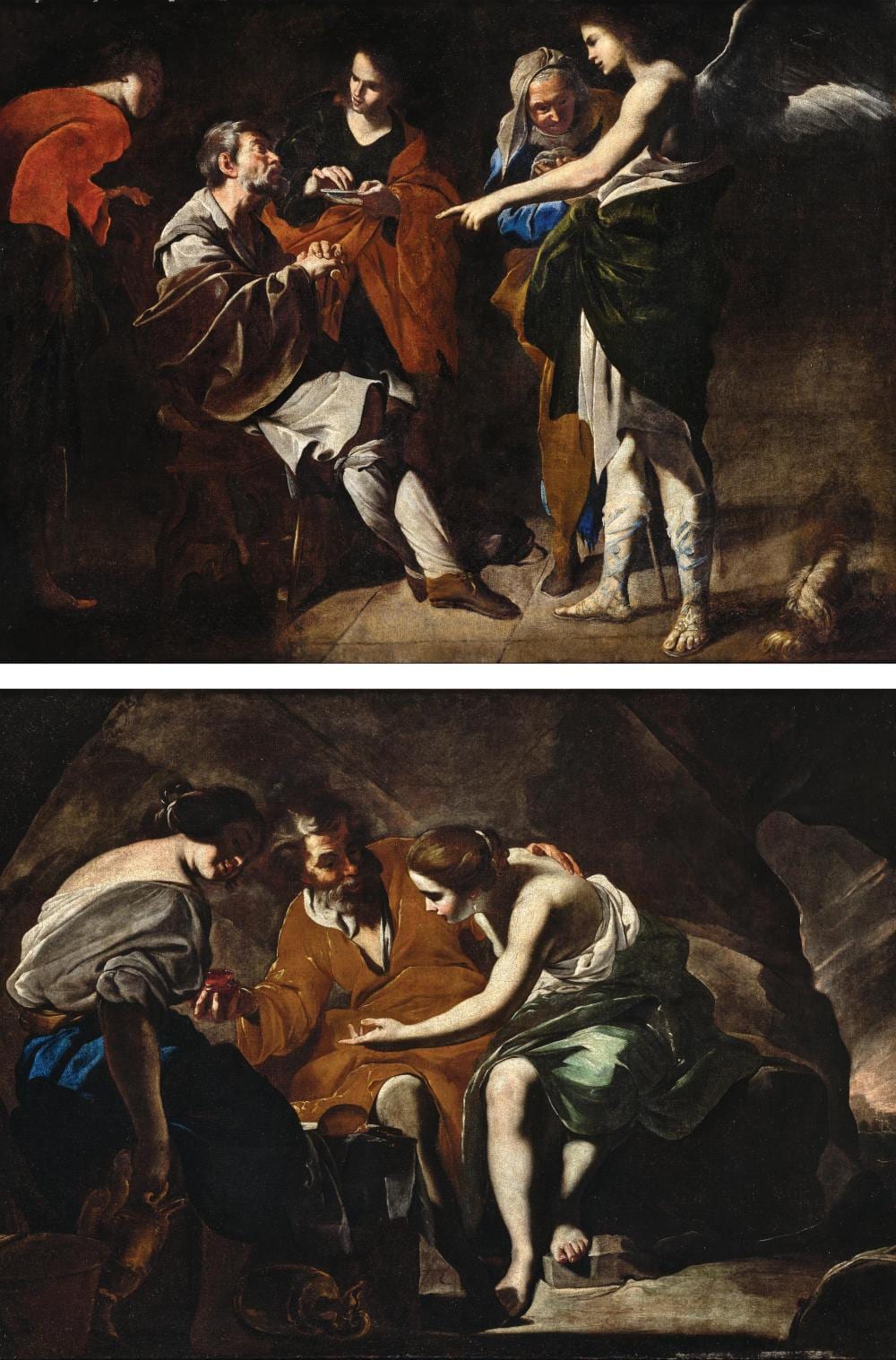
(Naples 1618 – ?1654) Tobias curing the blindness of Tobit; and Lot and his daughters, oil on canvas, 67 x 90 cm and 68 x 92 cm, framed, a pair (2) Provenance: Collection of Don Ignacio Despujol y Rigalt, II Conde de Caspe; by descent to his widow, Doña Isabel Trénor y Palavicino, Condesa de Caspe, Spain; where acquired by the great-grandfather of the present owner, 1923 Literature: N. Spinosa, Nuevas aportaciones al catalogo de Bernardo Cavallino, in: In Sapientia Libertas, Escritos en Homenaje al Profesor Alfonso E. Pérez Sánchez, Madrid/Seville 2007, pp. 368–369, figs. 3 and 4 (as Bernardo Cavallino); N. Spinosa, Grazia e tenerezza ‘in posa’. Bernardo Cavallino e il suo tempo. 1616–1656, Rome 2013, p. 307, nos. 41 and 41.1 (as Bernardo Cavallino) Bernardo Cavallino was a pivotal figure in seventeenth-century Neapolitan painting. His work exemplifies a synthesis of Baroque expressivity and classical restraint, distinguished by its refined execution, attenuated figures, and lyrical compositional structure. In contrast to the tenebrist realism of contemporaries such as Jusepe de Ribera, Cavallino’s oeuvre is marked by a poetic sensibility and a nuanced use of chiaroscuro that privileges atmosphere over drama. His paintings, including the present works, demonstrate a cultivated pictorial language that anticipates the elegant tendencies of the Rococo. Nicola Spinosa dates the present works to circa 1640 (see literature). It is possible that the present paintings were created independent of one another or as part of a larger series. Cavallino returned to the subject of Tobit on several occasions including The Healing of Tobit in the Gemäldegalerie Alte Meister, Kassel (inv. no. GK 467), which has been dated somewhat later than the present comparable work (see op. cit. Spinosa, 2013, cat. no. 50). Cavallino arranged both scenes of the present paintings with striking theatricality, employing a masterful use of light to accentuate the roles and gestures of the protagonists. Particularly noteworthy is the fully illuminated figure of the Archangel Raphael in the foreground of the Tobit scene, set within a sombre interior. The subject of Lot and his Daughters was also treated by other Neapolitan painters in first half of the seventeenth century, among them Battistello Caracciolo, Andrea Vaccaro, and Artemisia Gentileschi. Artists who were active in a period of flourishing and dynamic art production in Naples, catering to patrons from religious institutions, the aristocracy and the Spanish viceroyalty.