Have one like this?
Upload a photo for a free check of what yours may be worth.
Lot description
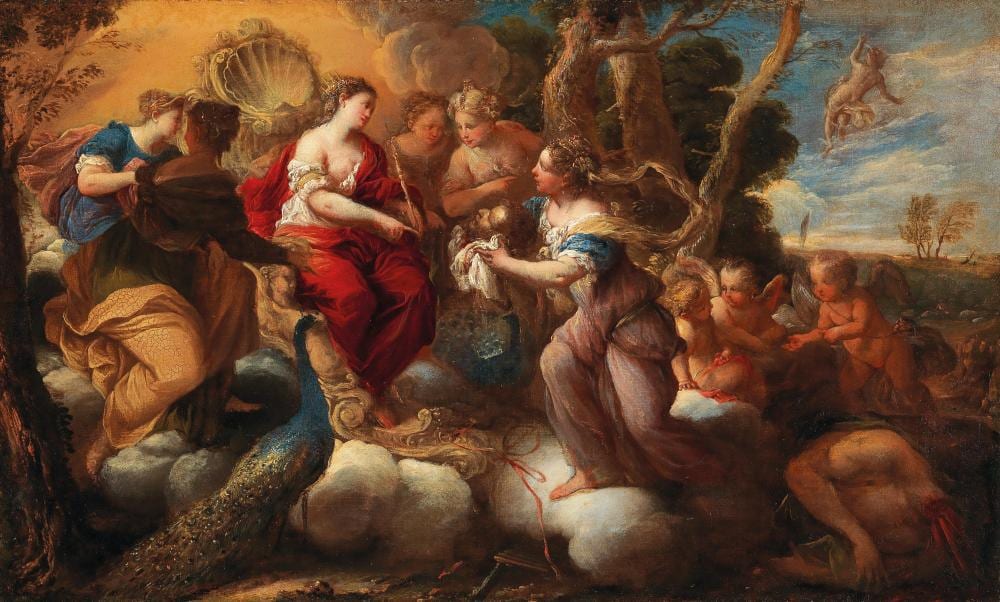
(Genoa 1635 – after 1681) Juno and Argo, oil on canvas, 52 x 86 cm, framed Provenance: Private collection, South America; where acquired by the present owner We are grateful to Anna Orlando for confirming the attribution of the present painting and for her help in cataloguing this lot. The present unpublished painting is an important addition to the oeuvre of Stefano Magnasco. The paint surface, with its bright palette and the quality of the composition, make this work one of the painter’s most significant achievements. This work is the product of an artist who was entirely steeped in the Baroque style. It illustrates the influence of Magnasco’s master, Valerio Castello, along with the additional innovations of Pietro da Cortona and his school in Rome, both of which reflect Magnasco’s studies during the five or so years he spent living in Rome. The depiction of the landscape in the present painting particularly suggests its creation to have been during the artist’s Roman period, as can be illustrated by comparisons with works from this time. On the basis of these observations, this small masterpiece by Stefano Magnasco can be dated to about 1660. Stefano Magnasco, father of the celebrated Alessandro, was born in Genoa in around 1635. He received his training from Valerio Castello, moving to Rome in around 1656, at which time there was an outbreak of the plague in Genoa. He did not return to the town of his birth until around 1660. The artist’s final decade of activity, (1660-1672), revealed a painter whose pictorial language had undergone a complete renewal. Working on a large scale he entirely abandoned the light touch he had learned from Valerio Castello, instead seeking a greater sculptural quality in his figures, which are now firmly drawn and outlined, filled out with clearly defined fields of colour. However, in small scale canvases such as the present painting, he retained a pleasant lightness of touch which he successfully manages to unite with a certain monumental quality, particularly in the figures. This painting represents a passage from Ovid’s Metamorphoses (I: 721-728). The goddess Juno, represented enthroned among the clouds and surrounded by her maidens, was the wife and sister of Jupiter, the King of Olympus. The god’s many betrayals ignited the rage of Juno, and the present painting relates to the story of her decision to engage Argus, the ‘monster of one hundred eyes’, to guard Jupiter’s lover, the maiden Io. Jupiter, becoming aware of her actions, engages Mercury to kill Argus. We see here the severed head of Argus being presented to Juno, who, in response, removes the monster’s one hundred eyes, placing them on the tail feathers of her sacred bird, the peacock, which is displayed here in great splendour in the foreground, illustrating the mythological source of the peacock’s magnificent tail.