Have one like this?
Upload a photo for a free check of what yours may be worth.
Lot description
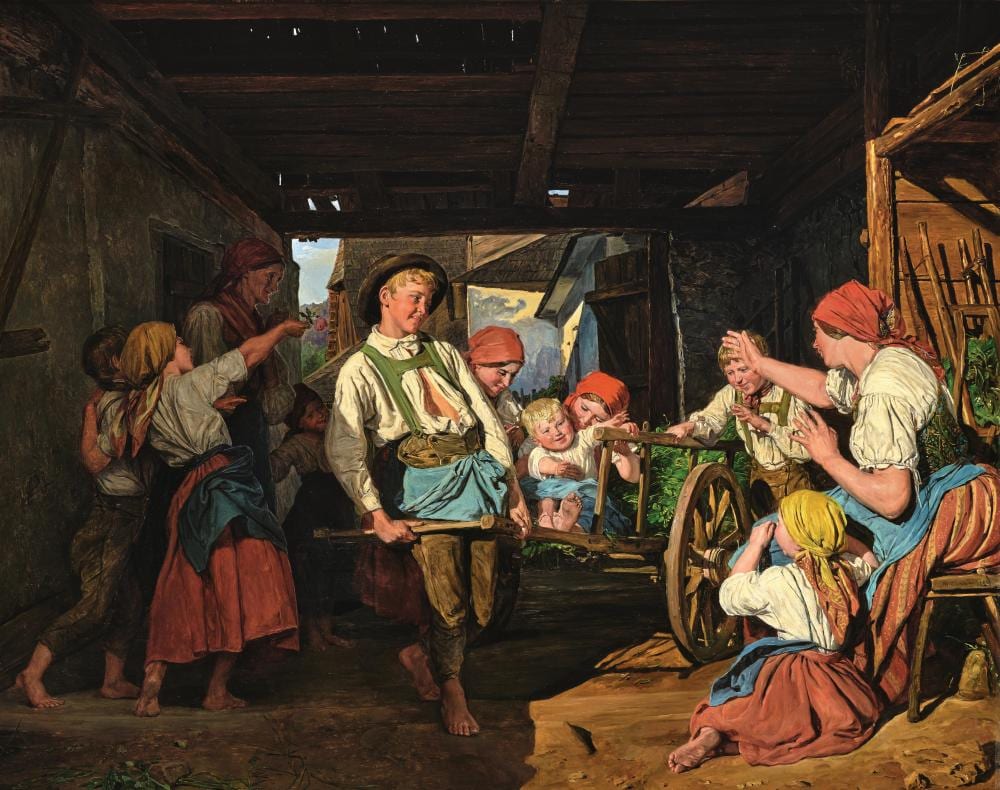
(Vienna 1793–1865 Hinterbrühl) Hansl’s first outing (Homecoming children), signed, dated Waldmüller 1858, oil on panel, 63 x 79 cm, framed Provenance: With Galerie Miethke, Vienna, 1907; Sale, Kunstsalon Pisko, Vienna, 11 November 1908, lot 126; Sale, C. J. Wawra, Vienna, 26 February 1918, lot 236; Collection Friedrich Fischer (1859 – 1923), Vienna, acquired from the above; By descent, Collection Grete Henriette Klein, née Fischer (1884 – 1962), Vienna/Mödling, since 1923; probably with Galerie Maria Almas-Dietrich, Munich, 1938; Reichskanzlei, Berlin and ‘Sonderauftrag Linz’, (Linz-No. 205), since July 1938; Recovered by the Allied Forces 30 June 1945 in Altaussee (no. 1539) and sent to the Munich Central Collecting Point (Mü No. 1740); Transferred to the Bavarian Prime Minister, Munich, 10 June 1949; Treuhandverwaltung für Kulturgut at the Federal Foreign Office of the Federal Republic of Germany, Munich, 22 February 1952; Property of the Federal Republic of Germany, since 1960; Museum Wiesbaden, permanent loan from the Federal Republic of Germany, 1966 – 2009; Anhaltische Gemäldegalerie Dessau (Georgium), loan from the Federal Republic of Germany, March 2017 - May 2020; Museum Wiesbaden, loan from the Federal Republic of Germany, 2021 – 2025; Restitution to the heirs of Grete Henriette Klein, 2025. Exhibited: Galerie Welz, Salzburg, summer 1937, cat. no. 40; Residenz Salzburg, 15 June - 15 September 1953, cat. no. 137; Museum Wiesbaden, Neues aus dem 19. Jahrhundert: von Kühen, edlen Damen und verzauberten Landschaften oder Von der Liebe zur Kunst, 30 April - 26 September 2021. Catalogued and illustrated in: Arthur Roessler, Gustav Pisko, Ferdinand Georg Waldmüller. Sein Leben, sein Werk und seine Schriften, vol. 2, Vienna 1907, pl. p. 244; Bruno Grimschitz, Ferdinand Georg Waldmüller 1793 – 1865, Salzburg 1957, p. 357, no. 879; Rupert Feuchtmüller, Ferdinand Georg Waldmüller 1793 – 1865. Leben, Schriften, Werke, Wien, Munich 1996, p. 514, no. 962; Michael Krapf, Ferdinand Georg Waldmüller 1793 – 1865. Die Genrebilder, Salzburg 2019, p. 340, no. 138. The present lot is a genre painting of museum quality by Ferdinand Georg Waldmüller, marked by several layers of historical significance: on the one hand, it reflects the artist’s personal withdrawal from the Viennese art scene; on the other, it bears witness to the fate of Grete and Karl Klein, whose family was persecuted under the National Socialist regime and dispossessed of their art collection. This horizontal-format painting of 1858 constitutes a later variant of Waldmüller’s 1854 composition entitled “The Children Returning Home”. In the present work, however, the artist does not depict the moment of arrival, but rather that of departure. It was already listed in 1908 under the title “Hansl’s First Ride”. The viewer looks into a barn animated by a lively scene. At the centre stands a young boy pulling a simple handcart behind him. Seated within is a girl who clasps her younger sibling Hansl firmly with her arm. The cart is surrounded by excited children, all of whom turn their attention towards the siblings seated in the barrow. At the right foreground, the mother, sitting on a stool, stretches out her hands towards her children, issuing energetic instructions or perhaps engaging in playful banter. In the left background, in the shadowed recess of the barn, the grandmother stands with her hands clasped before her breast, gazing anxiously upon the commotion. Particularly unusual and expressive is the orchestration of light: the direct source, sunlight streaming into the barn, accentuates the boy and thus directs the viewer’s focus towards him, the children in the cart, and the group in the right foreground. At the same time, the shadow cast upon the boy’s sleeve visually links the figures standing in the dark with the rest of the scene. Backlighting and shadow endow the composition with expressive force, vitality, and a sense of cheerfulness. A low vantage point enhances the immediacy and striking plasticity of the depiction. In this painting, Waldmüller masterfully captures a fleeting instant, a momentary snapshot such as only photography would later be able to reproduce. Full of movement and effect, and animated by the light pouring into the barn, he brings out the details of the scene with remarkable clarity. A recurrent compositional principle in Waldmüller’s work is the juxtaposition and simultaneous unification of different generations within a single image. He often sketched his scenes directly onto the support, always requiring a real-life model from which to work. To this end, he assembled young peasant boys and girls in his studio, arranging them in groups as the composition demanded. In this manner, gestures and turns of the body occasionally acquired a dramatic quality, which he deliberately employed to articulate pictorial space. The closely knit groups of figures served as the foundation for the perspectival construction, as is particularly striking in his multi-figure paintings. The movements of the arms and the directions of the gaze function as unifying elements, through which Waldmüller interweaves several figures within a confined space without compromising the naturalness, authenticity, and vitality of the scene. In the field of genre painting Ferdinand Georg Waldmüller was unsurpassed—a quality already recognised by his contemporaries. It was widely acknowledged that he possessed a keen sensitivity to the sentiments and circumstances of ordinary people. Romantic idealisation is absent from his works: his concern lay with the precise rendering of everyday life and the depiction of genuine scenes from lived experience. His endeavour was thus directed towards the unadulterated representation of what he observed with his own eyes. In his paintings, the viewer can discern both the acuity of observation and the dedication with which Waldmüller engaged with his subjects, as well as his genuine interest in them and the affection with which he portrayed them. He studied people in their respective situations with great care in order to capture individual emotions. No other artist of his generation represented children with comparable mastery, employing his meticulous powers of observation to animate the full expressive potential of each scene. Ferdinand Georg Waldmüller was a vehement advocate of the study of nature, a position that set him in opposition to the prevailing academic norms of his time. In 1845 he submitted to the Academy the first draft of his reformist ideas on academic instruction, and the following year he published his polemical treatise which ultimately led him to call for the dissolution of the Academy in 1857. This forceful attack on academic practice, together with the articulation of what were at the time revolutionary ideas, provoked considerable resistance. As a consequence, in September 1857 the Vienna Academy forced him into early retirement with a reduced pension. Towards the end of his life Waldmüller thus fell into disfavour and obscurity, and it was only around the turn of the century that he once again received recognition, through exhibitions and Arthur Roessler’s monograph. The esteem accorded to the artist in the years that followed is evident in the case of “Hansl’s First Ride”, for which the then owner was approached with a loan request. An agreement was reached, and in the summer of 1937 the painting was exhibited at the Galerie Welz in Salzburg. Shortly after the painting was displayed at the Salzburg exhibition in the summer of 1937, Grete Klein was compelled in July 1938 to submit the asset declaration mandated by the National Socialist regime. She was dispossessed of her villa in Mödling, and the painting, most likely through the dealer Maria Almas Dietrich, was entered in 1938 into the Munich Führerbau under inventory number 205. From there, in September 1944, it was transferred with the eleventh evacuation transport to the salt mine at Altaussee, and in July 1945 it was recovered by the American military and transferred to the Central Collecting Point in Munich. In June 1949 it was placed under the trusteeship of the Bavarian Minister-President, before being transferred in 1952 to the Federal Republic of Germany’s Trust Administration for Cultural Assets. From this body the work was lent in 1953 to the Province of Salzburg for the Waldmüller exhibition in the Residenz. In 1960 the painting, as former Reich property, passed into federal ownership and has since remained on permanent loan from the Federal Republic of Germany to museums. In 2025 the work was restituted to the heirs of Grete Henriette Klein and is now being offered for sale on their behalf.