Have one like this?
Upload a photo for a free check of what yours may be worth.
Lot description
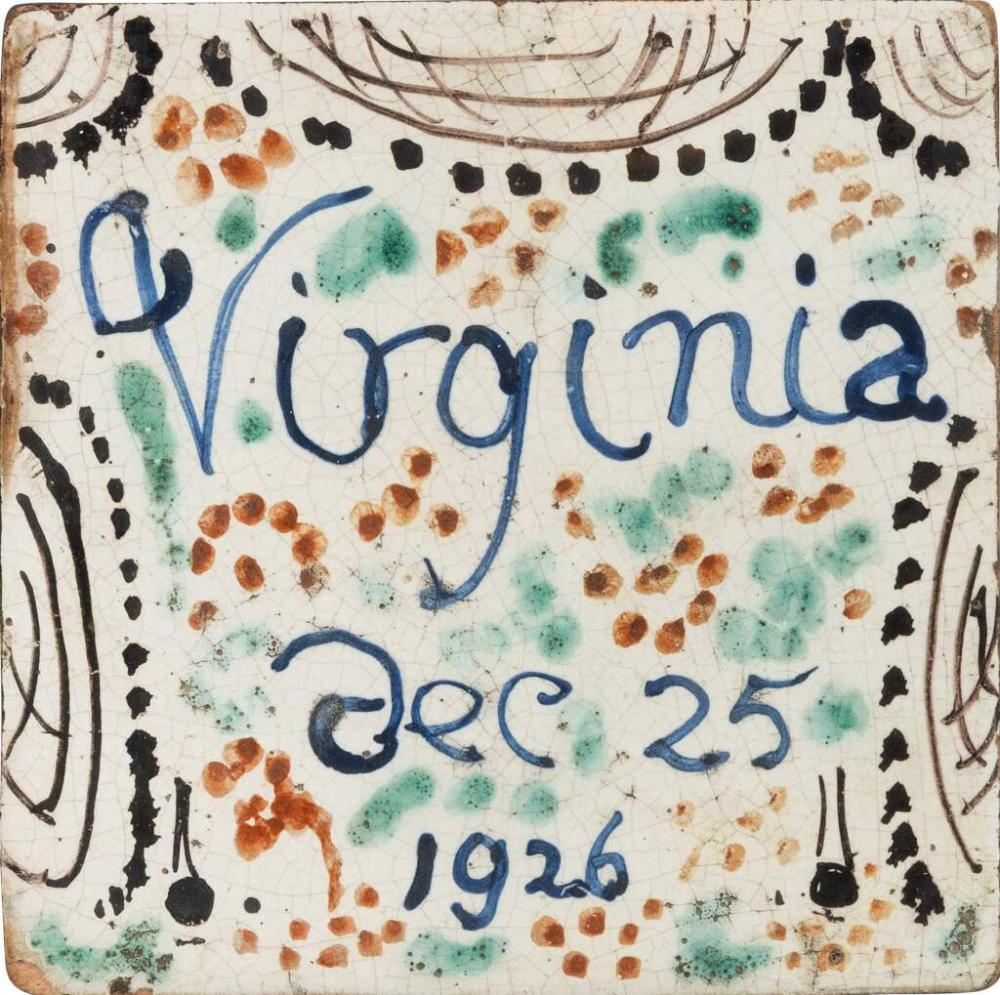
Vanessa Bell — [Virginia Woolf] A striking tile created by Vanesa Bell for her sister, Virginia Woolf, ca. Christmas 1926 Earthenware tile (152 x 152 mm). Glazed; minor chips to edges. Mounted and framed (overall 286 x 286 mm); not examined out of frame. “Virginia, December 25, 1926” An exceptional encapsulation of the Bloomsbury Group, embodying the bonds that Bell and Woolf shared as sisters and artists. “Nessa and I formed together a close conspiracy. In that world of many men, coming and going, in that big house with innumerable rooms, we formed our private nucleus[.]” — Virginia Woolf on her relationship with sister Vanessa Bell From the earliest moments of their lives, Virginia and Vanessa Stephen were close, with the intimacy of this relationship only increasing in depth and complexity through adulthood. Their father, Leslie Stephen, fostered an intellectual atmosphere, educating his daughters in literature, history, and the arts. In 1896, Vanessa had the opportunity to study drawing at Arthur Cope’s School of Art, and Virginia remained at home exploring various genres of literature and experimenting with her own writing style, setting in motion an artistic split between the sisters, as well as a sense of competition. Indeed, in a draft of A Sketch of the Past, Virginia observed “how imperfect” she had felt compared to Vanessa, “how vain and egotistical, irritable.” However, these sentiments were largely due to Virginia’s own insecurities, which sometimes manifested as a denigration of the visual arts. Woolf suggested that writers were “terribly exposed with life,” while painters “withdraw, they shut themselves up for weeks alone with a dish of apples and a paint box.” Still, Virginia valued her relationship with Vanessa immensely, and the two relied on one another for inspiration and constructive criticism. Competition evolved into something like collaboration, with Vanessa designing the jackets for Virginia’s books, and creating 38 in total for the Hogarth Press over 30 years or so. Virginia also portrayed Vanessa in many of her works including The Voyage Out (1915), Night and Day (1919), and To the Lighthouse (1927). In late 1926, Virginia Woolf was working on To the Lighthouse, and spent that Christmas at the Eagle’s Nest in Zennor, a town on the Cornish coast, with Leanord Woolf. They were the guests of Will Arnold-Forster and his wife Katherine, or “Ka.” Ka was the daughter of Henry Fisher Cox, a British stockbroker and a Fabian. After his sudden death in 1905, his daughters were left financially independent. It was in 1906 that Ka was first introduced to the Bloomsbury group when she began attending Vanessa Bell’s “Friday Club” fine arts discussions. She also posed for Duncan Grant on numerous occasions. Ka became involved with Rupert Brooke around the same time, and they eventually became lovers. It was through Brooke’s circle that she and Virginia Woolf (then still Virginia Stephen) met in January of 1911 at a gathering at Bertrand Russell's Oxfordshire home. They became fast friends, with Ka the inspiration for Mary Datchett in Woolf's Night and Day. While Virginia’s reputation and works endured through the decades, Vanessa’s was somewhat forgotten—overshadowed by the efforts of her male counterparts in the Bloomsbury Group, and by Duncan Grant in particular. Interest in Vanessa's works—ranging from paintings, to textiles, to ceramics and beyond—was renewed with the 1976 publication of Bloomsbury Portraits by Richard Shone. In 2024’s “Vanessa Bell: A World of Form and Color” was an exhibition solely dedicated to her works, featuring over 150 pieces, including rarely seen paintings as well as ceramics, furniture and textiles. As Kayla Schawb notes: “Together, as a sisterhood, Virginia and Vanessa worked to stake their claims as female artists and thinkers to challenge the patriarchal structures that are so deeply rooted in the intellectual world.” This tile is emblematic of sisters’ special relationship, and of the artistic and intellectual movement that would come to define their lives. The present “Bell Tile” was a part of the estate of Louie Mayer, who had been the Woolfs’ cook at Monk’s House for 34 years. Virginia Woolf’s walking stick, which was found on the banks of the River Ouse following her death, was a part of the same estate, and is now in the Berg Collection at the New York Public Library. A remarkable relic that evidences the emotional, intellectual, and creative ties shared by Vanessa Bell and Virginia Woolf. REFERENCE: Duong, Ha, “Virginia Woolf and Vanessa Bell: A Portrait of the Sisters as Young Artists”: https://www.davidzwirner.com/news/2022/virginia-woolf-vanessa-bell-young-artists (accessed 26 September 2025); Schwab, Kayla, “A Tale of Two Sisters: A Modernist Collaboration Between Virginia Woolf and Vanessa Bell,” in Vassar Critical Journal: https://vassarcriticaljournal.vassarspaces.net/issues/spring-2017/105-2/ (accessed 24 September 2025); Woof, Virginia, "A Sketch of the Past," in Moments of Being (1976), ed. Jeanne Schulkind PROVENANCE: Louie Mayer