Have one like this? Check yours freeOr have an appraiser value it
Lot description
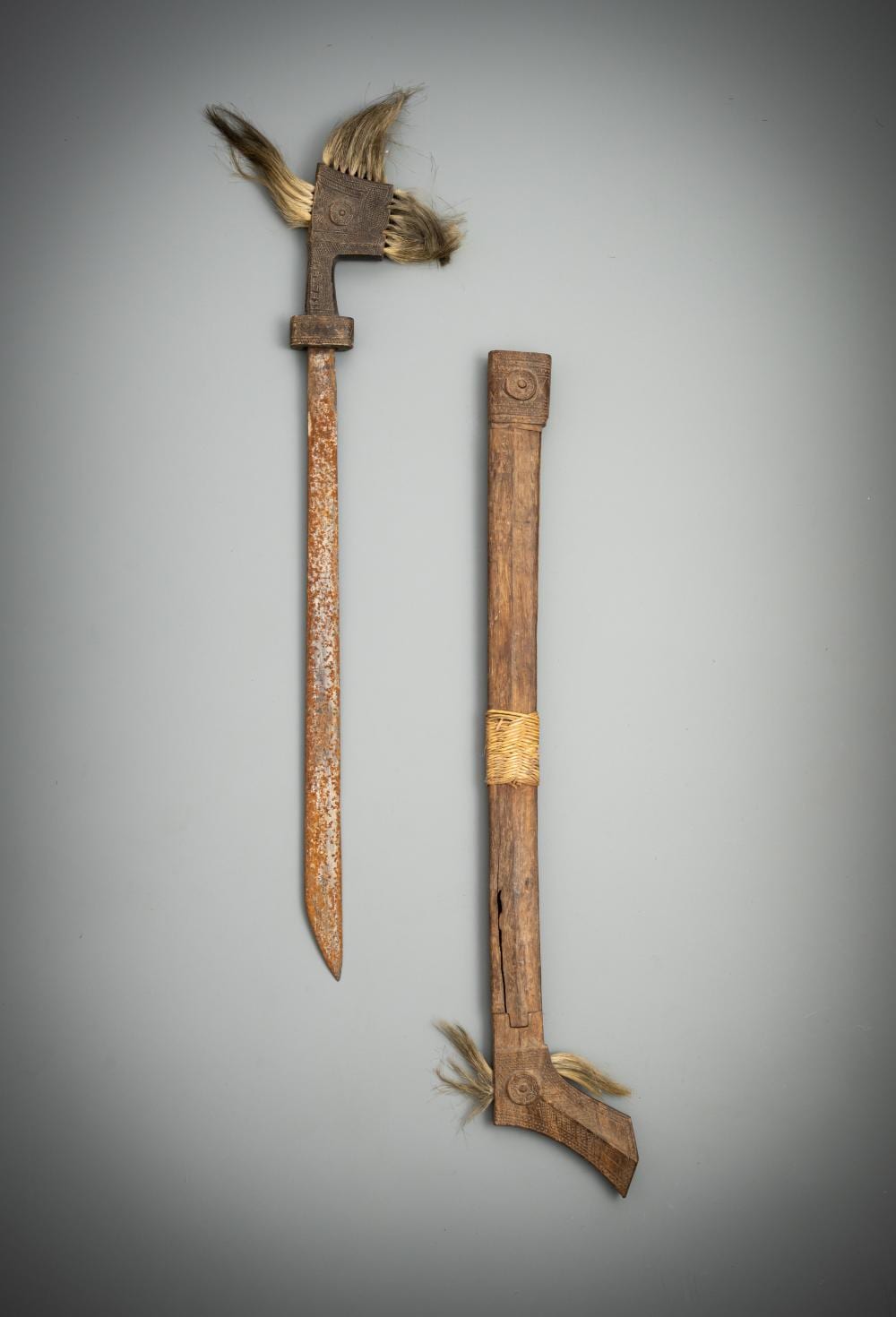
Sword "hemola" Savu, Red; East Indonesia, 19th c. L. 78 cm The object described here is a hemola, found exclusively in West Timor and the islands of Alor, Rote, and Savu, located west of Timor. The slender, forward-widening blade is made of refined steel using a composite technique. The back has a striped structure and consists of several (unordered) bars; the harder edge is forged separately. The material quality is high; professional or specialized craftsmanship is beyond question. The beige horn handle features inset horsehair tufts and very fine spiral-geometric ornaments carved in low relief. The large pommel surfaces are hollowed, lending the piece an elegant appearance despite its "boxy" appearance. The pommel and scabbard mouth bear the symbolic "eye" (mata), lending the sword its personality. The scabbard with a detached foot section is well preserved (which is a rarity). From an old Rhineland private collection, collected between 1965 and 2005 - Slight surface rust (easily removable), minimal damage The hemola sword is often associated with the islands of Rote/Roti and Sawu, but is part of a Timorese tradition. These straight-bladed swords with their distinctive pommels appear to be explicitly associated with West Timor, whereas curved blades (surik) are more common in Central and East Timor. The populations of Rote and Sawu, who claim Hindu-Javanese and Indian origins, are clearly related to the Atoni in terms of their material culture. The swords of Timor are related to those of Sulawesi and the southern Philippines (kampilán), which suggests common, very ancient origins, probably during the period of early Indian influence. The sword can be broadly assigned to the large ethnic group of the Atoni (Atoin Meto). These constitute the dominant population of West Timor. The name Atoin Meto means "natives" or "indigenous people" (atoni, "human," meto, "native"). There are also ethnic names such as Atoni Pah Meto, the "people of the dry land," or simply Meto Schwert "hemola" Savu, Rote; Ost-Indonesien, 19. Jh. L. 78 cm Das hier beschriebene Objekt ist ein hemola, das ausschließlich auf Westtimor und den westlich von Timor gelegenen Inseln Alor, Rote und Savu vorkommt. Die schlanke, sich nach vorne verbreiternde Klinge ist aus Raffinierstahl und in Komposit-Technik gefertigt. Der Rücken zeigt eine streifige Struktur und besteht aus mehreren (untordierten) Stäben, der härtere Schneidenteil ist separat angeschmiedet. Die Materialqualität ist hoch; eine professionelle bzw. spezialisierte Fertigung steht außer Frage. Beiger Horngriff mit eingesetzten Pferdehaarbüscheln und im Flachrelief eingeschnittenen, sehr feinen spiralig-geometrischen Ornamenten. Die großen Knaufflächen sind hohlgearbeitet, was dem Stück trotz der „kastenförmigen“ Anmutung Elegant verleiht. Auf Knauf und Scheidenmund das symbolische „Auge“ (mata), das dem Schwert eine Persönlichkeit verleiht. Scheide mit abgesetztem Fußteil, gut erhalten (was eine Seltenheit ist). Aus einer alten rheinländischen Privatsammlung, zwischen 1965 und 2005 gesammelt - Leichter Flugrost (leicht entfernbar), minim. best. Das Schwert hemola wird meist insbesondere mit den Inseln Rote / Roti und Sawu in Verbindung gebracht, steht aber in timoresischer Tradition. Es scheint, als seine diese gradklingigen Schwerter mit den auffallenden Knaufpartien explizit mit Westtimor verbunden, wohingegen in Zentral- und Osttimor gebogene Klingen üblicher sind (surik). Die Bevölkerung von Rote und Sawu, die sich auf hindu-javanische und indische Ursprünge beruft, ist mit den Atoni hinsichtlich ihrer materiellen Kultur deutlich erkennbar verwandt. Die Schwerter Timors sind mit jenen Sulawesis und der südlichen Philippinen (kampilán) verwandt, was auf gemeinsame, sehr alte Ursprünge wahrscheinlich in der Zeit früher indischer Beeinflussung schließen lässt. Das Schwert kann im weiteren Sinne der ethnischen Großgruppe der Atoni (Atoin Meto) zugeordnet