Have one like this?
Upload a photo for a free check of what yours may be worth.
Lot description
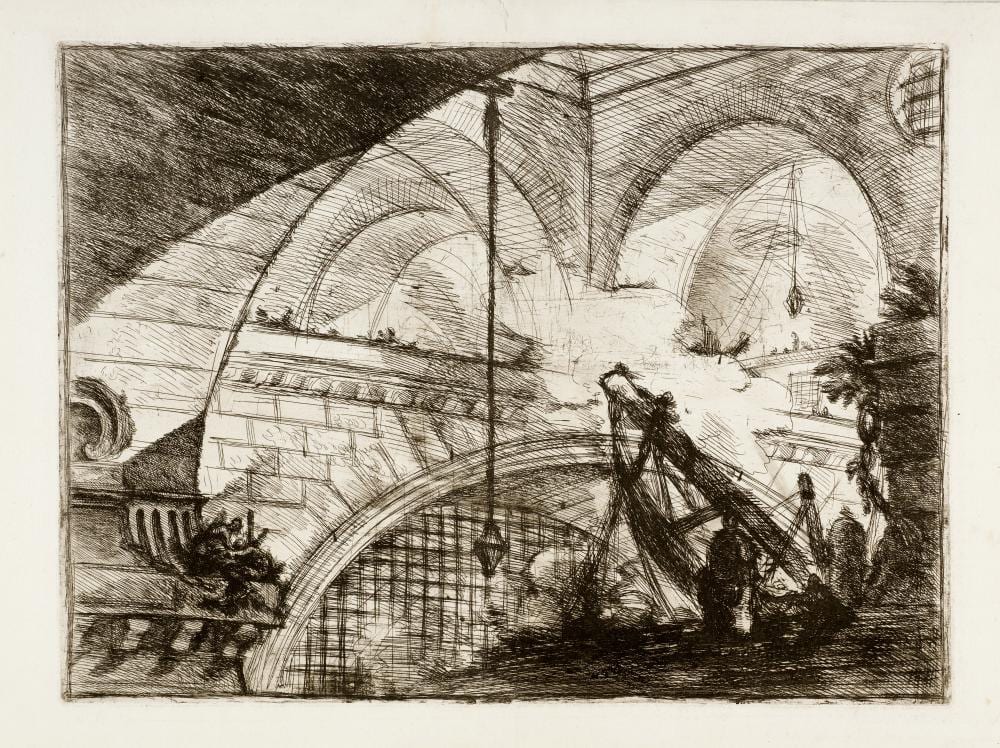
Giovanni Battista Piranesi (Mogliano 1720 - 1778 Rom) Der Bogen mit dem Muschelornament Blatt 11 der Folge "Carceri" Radierung auf Bütten mit Wasserzeichen "Lilie im Kreis" / Etching on laid paper with watermark "Lilie im Kreis" 1750 49,8x65 cm, Blattgrösse / 49.8x65 cm, sheet size Werkverzeichnis / Catalogue Raisonné Wilton-Ely 36 Robison 37/I (v. VI) Wilton-Ely 36 Robison 37/I (of VI) Zustand / Condition Schöner Frühdruck der ersten Ausgabe. Die übliche vertikale Mittelfalte, im oberen Rand ausserhalb der Darstellung kleiner Einriss. Sonst in tadelloser Erhaltung und breitrandig Fine early impression of the first edition. The usual vertical centre fold, in the upper margin outside the image a small tear. Otherwise in impeccable condition and with wide margins Konvolut / Group lot Dabei: Der Bogen mit dem Muschelornament. Blatt 11 der Folge "Carceri". Radierung auf Bütten. 50x69,5 cm, Blattgrösse. Wilton-Ely 37. Robison 37/VI (v. VII). Abdruck nach den dramatischen Überarbeitungen, die Piranesi in der zweiten Auflage ab 1761 vornahm. Laut Robisons Klassifizierung Zustand VI (v. VII), der zur vierten Druckkampagne der zweiten Auflage gehört und ab den 1770er-Jahren gedruckt wurde. Auch dieser mit vertikaler Mittelfalte und breitrandig. Das Papier leicht gebräunt. Zus. 2 Blatt Die fünfzehn Lose 3075-3089 bieten einen repräsentativen Querschnitt durch das Genre der italienischen Vedute. Erste wirklichkeitsgetreue Ansichten von Landschaften und Städten kommen in der Kunst schon um 1500 vor. Seine Blütezeit erlebt das Genre aber im Italien des ausgehenden 17. und im Verlauf des 18. Jahrhunderts. Der internationale Italien-Tourismus bot dabei einen Absatzmarkt, der in seiner Breite vor allem durch druckgraphische Blätter bedient wurde. Zu nennen sind hier an erster Stelle natürlich die Radierungen von Antonio Canaletto und Giovanni Battista Piranesi. Canalettos Neffe Bernardo Bellotto etablierte das Konzept der höchst naturgetreuen Stadtansicht auch nördlich der Alpen während Piranesi topographische Motive noch um die architektonischen Inventionen der "Carceri" erweiterte. Chronologisch betrachtet machen in der hier angebotenen Auswahl die bei dem römischen Verleger Rossi schon im 17. Jahrhundert erschienenen und von Falda, Specchi und Venturini gestochenen Folgen bedeutender Bauwerke und Brunnen in Rom den Anfang. Den zeitlichen Schlussakkord bildet dann Luigi Rossinis umfangreicher Zyklus von Rom-Ansichten, der Piranesis Grossprojekt der „Vedute di Roma“ bis ins 19. Jahrhundert weiterführt. (Siehe auch die Einzelblätter Piranesis in unserer Online-Auktion, Lose 4088ff. sowie als interessante Beispiele niederländischer Veduten die Folgen von Reinier Nooms und Pieter Schenk, ebendort die Lose 4083 und 4114.) Included: The arch with the shell ornament. Plate 11 from the series "Carceri". Etching on laid paper. 50x69.5 cm, sheet size. Wilton-Ely 37. Robison 37/VI (of VII). Impression after the dramatic reworkings that Piranesi carried out in the second edition from 1761 onwards. According to Robison's classification, state VI (of VII), which belongs to the fourth printing campaign of the second edition and was printed from the 1770s onwards. This one also with a vertical centre fold and wide margins. The paper slightly browned. Together 2 sheets The fifteen lots 3075–3089 offer a representative cross-section of the genre of Italian vedute. The first true-to-life views of landscapes and cities already appear in art around 1500. However, the genre experiences its heyday in Italy at the end of the 17th and throughout the 18th century. International tourism to Italy provided a market, which was mainly served by printed graphic sheets. Of course, the etchings by Antonio Canaletto and Giovanni Battista Piranesi must be mentioned first and foremost. Canaletto’s nephew Bernardo Bellotto established the concept of highly realistic city views north of the Alps as well, while Piranesi expanded topographical motifs with the architectural inventions of the "Carceri". Chronologically, in the selection offered here, the series of important buildings and fountains in Rome, published by the Roman publisher Rossi as early as the 17th century and engraved by Falda, Specchi, and Venturini, mark the beginning. The chronological final chord is formed by Luigi Rossini’s extensive cycle of views of Rome, which continues Piranesi’s major project „Vedute di Roma“ into the 19th century. (See also the individual sheets by Piranesi in our online auction, lots 4088ff., As well as, as interesting examples of Dutch vedute, the series by Reinier Nooms and Pieter Schenk, likewise there lots 4083 and 4114.) Erläuterungen / Comments Die in Piranesis "Carceri d’invenzione" (Kerker der Phantasie) dargestellten Räume sind uneindeutig. In keinem der Blätter sind sie abgeschlossen, wie es bei Gefängnissen der Fall sein sollte. Stattdessen bieten sich vielgestaltige Architekturen dar, bei denen Innen und Aussen fliessend ineinander übergehen. Die Perspektiven wechseln ebenso wie die Grössenverhältnisse, obschon die Konstruktionen korrekt berechnet sind. Insofern ist auch der Titel doppeldeutig. Er kann entweder phantasievolle, traumhafte Gefängnisse bezeichnen oder ein Gefängnis für die Phantasie meinen. In ihrer architektonischen Abgründigkeit eine der faszinierendsten graphischen Folgen des 18. Jahrhunderts. Beim vorliegenden Blatt handelt es sich um den I. Zustand der Platte, so wie er sowohl in der ersten als auch der zweiten Druckkampagne ("issue") vorkommt. In der dritten Kampagne wurden die von Robison beschriebenen Veränderungen zum II. Zustand vorgenommen. The spaces depicted in Piranesi's "Carceri d’invenzione" (Prisons of the Imagination) are ambiguous. In none of the sheets are they enclosed, as would be expected in prisons. Instead, multifaceted architectures are presented, in which interior and exterior flow seamlessly into one another. The perspectives shift, as do the proportions, although the constructions are correctly calculated. In this respect, the title is also ambiguous. It can either refer to imaginative, dreamlike prisons or a prison for the imagination itself. In their architectural profundity, they are among the most fascinating graphic series of the 18th century. The present sheet is the first state of the plate, as it occurs in both the first and second print campaigns ("issue"). In the third campaign, the changes described by Robison were made to create the second state. MWST / VAT Mehrwertsteuer auf dem Zuschlagspreis plus Aufgeld / VAT on hammer price plus buyer's premium Erwartete Ausrufzeit / Estimated Auction Time of Lot (+/- 30min) 12.09.2025; 10:55 h (MEST / CET) For further information visit our website (www.kornfeld.ch) Versandkosten / Shipping cost Schweiz / Switzerland: CHF 170.- Europa / Europe: CHF 270.- Übrige Länder / Other countries: CHF 360.-