Have one like this? Check yours freeOr have an appraiser value it
Lot description
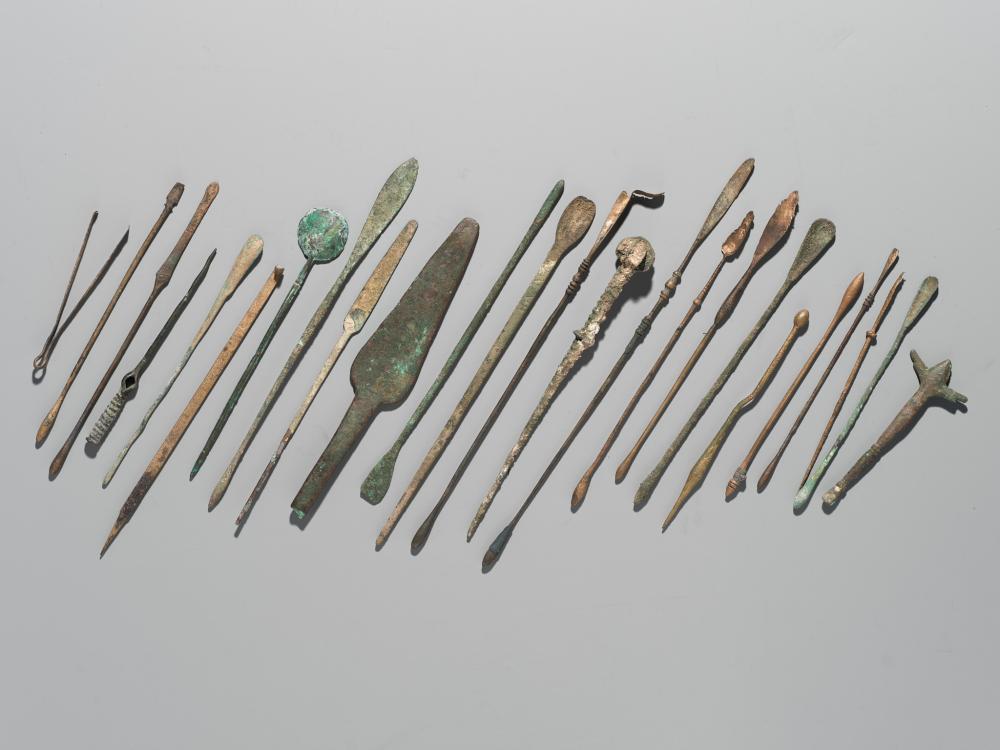
A GROUP OF TWENTY-FOUR GREEK AND ROMAN BRONZE PINS, SPOONS AND TOOLS, 1ST MILLENNIUM AD AND EARLIER This lot is a museum deaccession and is therefore offered without reserve Europe and Western Asia. Comprising eight spoons, one with a circular bowl and the others of oval form; four pins with spatula-shaped heads; ten pins with drop-shaped heads, knobs, and one with a three-pronged tip; as well as a small tweezer; and a large arrowhead. (24) Provenance: Galerie Hardt (established in 1976), Radevormwald, Germany, before 2020. Acquired by the gallery’s founder Peter Hardt (b. 1946) during his extensive travels in Asia, the first of which occurred during a formative world tour in 1973. Throughout his storied career, Peter Kienzle-Hardt organized countless exhibitions and participated in major international art fairs. He made many important contacts during this time and eventually met the Kienzle siblings, who shared his passion for Asian art and culture. A strong bond and deep friendship developed, ultimately leading to the creation of the Museum für Asiatische Kunst decades later in 2014. While the museum’s permanent exhibition predominantly comprised pieces from the Kienzle Family Collection, Peter Kienzle-Hardt supplemented it with objects from his own collection. Before his death in 2019, Horst Kienzle bequeathed his entire property to Peter and legally adopted him as his son, who has been using the name Peter Kienzle-Hardt ever since. Condition: Extensive wear, losses, signs of weathering and erosion, corrosion, remnants of gilt, and casting irregularities. All with a rich, naturally grown patina with extensive malachite encrustation. Overall good condition, commensurate with age. Weight: 204 g (total) Dimensions: Height 7-20 cm Such instruments have been found among sets of Roman and Greek surgical tools, particularly in regions spanning the Mediterranean and Western Asia. Often crafted in bronze, these tools were multifunctional, serving not only as diagnostic implements or applicators but also in a variety of practical and ritual contexts. In medical use, they may have been employed to explore wounds, apply pressure, or administer treatments during minor procedures. Beyond the clinic, similar tools were used to mix and apply medicinal salves, cosmetic preparations, and pigments for both artistic and ceremonial purposes. Literature comparison: Compare a closely related set of Imperial Roman bronze instruments, dated 1st century AD, in the British Museum, registration number 1968,0626.14. Compare a closely related Roman bronze specillum (probe), dated 1st-2nd century AD, in the Metropolitan Museum of Art, object number 17.230.96. Compare a closely related Capriot bronze arrowhead, dated to ca. 1600-1050 BC, in the Metropolitan Museum of Art, object number 74.51.5328. Compare a closely related Roman bronze spoon, dated to the 1st century AD, in the Metropolitan Museum of Art, object number 17.230.60. Compare a closely related bronze pin, excavated from the site of Tell Shemshara, Iraq, object number SH.0099-23. Compare a closely related Mycenaean bronze eyelet-type pin, dated to the 14th century BC, in the Metropolitan Museum of Art, object number 74.51.5529.