Have one like this?
Upload a photo for a free check of what yours may be worth.
Lot description
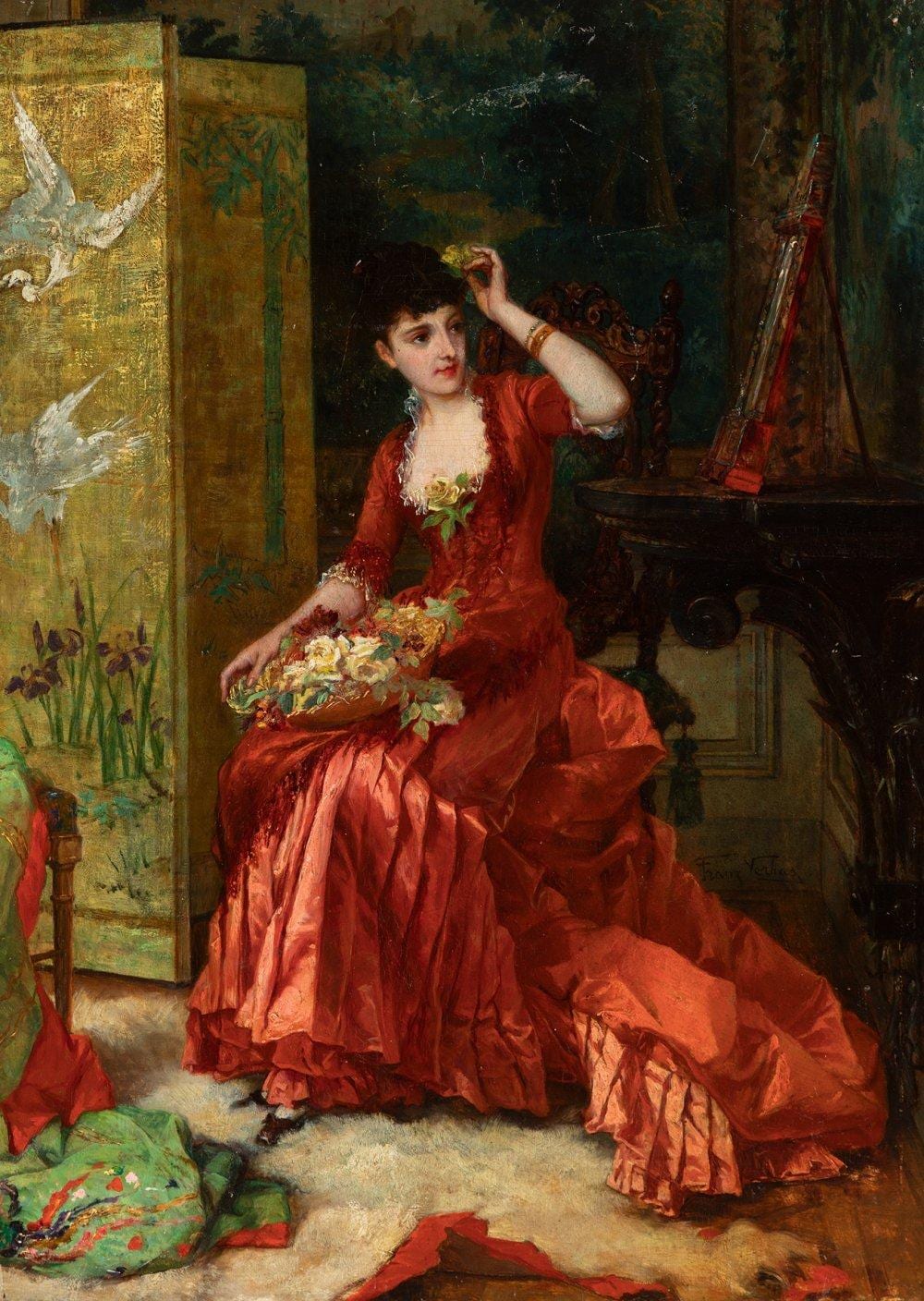
JAN FRANS VERHAS (Belgium, 1834- 1896). "Female portrait". Oil on panel. Signed in the middle right area. Measurements. 56 x 40 cm. Feminine portrait in which the author, arranges a woman elegantly dressed in full body, sitting on a chair. The author places the figure in an interior, and also adds some distance from the viewer. This is achieved by placing the lady slightly turned in three quarters with respect to the viewer. The lady fixes her gaze outside the pictorial surface, oblivious to the viewer's gaze. Jan Frans Verhas was a Belgian painter linked to the realist movement, whose artistic production included portraits, genre scenes starring children of the bourgeoisie, coastal landscapes, seascapes, still lifes and historical compositions. His style was consolidated as one of the most outstanding expressions of pictorial realism in Belgium. Initially trained by his father, Emmanuel Verhas, painter and director of the local Academy, he continued his artistic education at the Royal Academy of Fine Arts in Antwerp, where he was a disciple of Nicaise de Keyser, a leading exponent of historical romanticism. There he befriended artists such as Lawrence Alma-Tadema, with whom he would maintain a close relationship throughout his life. In 1860, after completing his studies and participating in the Prix de Rome, he undertook training trips to Paris and Italy, where he studied the great masters. From 1867 he settled in Brussels and gradually abandoned history painting to focus on depictions of contemporary life, influenced by his artistic and social environment. His work evolved towards a painting of everyday scenes, centered on the childish and bourgeois universe, characterized by a careful interior setting, a warm palette and an almost photographic detail. In the last stage of his career, Verhas turned to the coastal landscape, developing an outdoor painting in which he depicted beach scenes with vibrant light and the presence of both local figures and vacationers. Works such as Paseo en burro por la playa (Donkey ride on the beach) illustrate this interest in the contrast between social classes, portraying well-to-do families guided by local children. He was recognized with multiple official distinctions, such as the Order of Leopold and the French Legion of Honor, and his work was awarded in various international salons. His pictorial legacy, which oscillates between narrative realism, social portraiture and landscape observation, reflects an acute vision of his time, articulated through a refined technique and an aesthetic sensibility representative of the academic taste of the time.