Have one like this?
Upload a photo for a free check of what yours may be worth.
Lot description
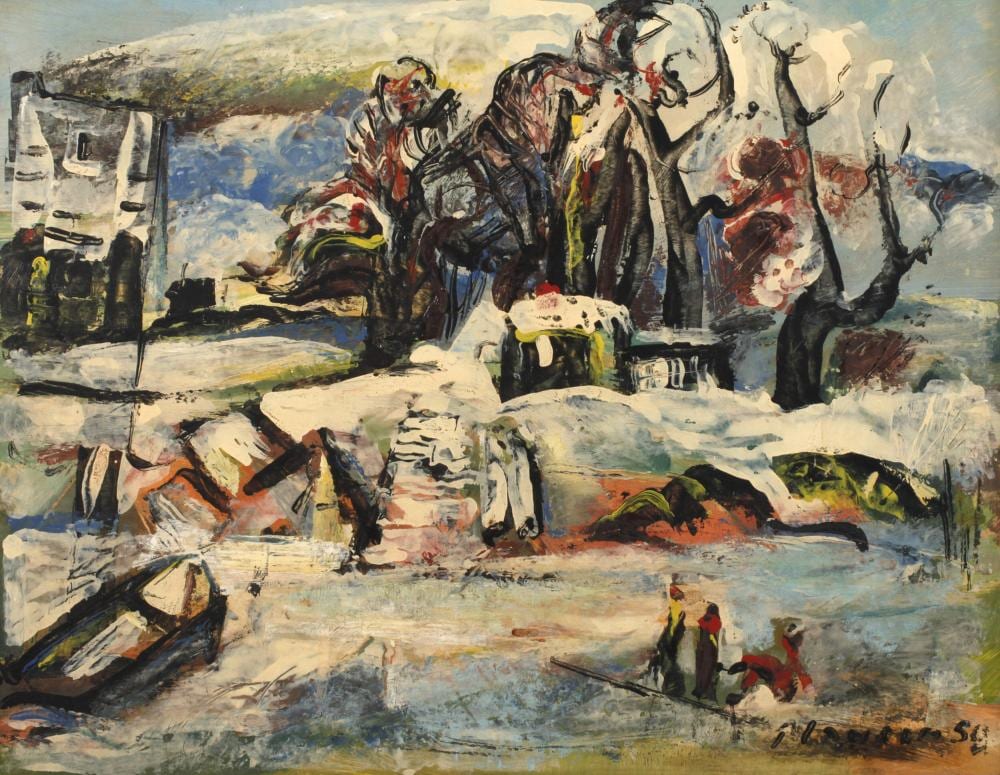
André Planson, attr., Winterliche Landschaft expressive, schneebedeckte Landschaft mit Häusern und Bäumen, im Vordergrund Personenstaffage, zwischen dem Weiß des Schnees einige Farbakzente in Gelb, Rot und Blau, etwas fauvistisch anmutende Formensprache, zum Teil in Spachteltechnik ausgeführt, zum Künstler bemerkt Benezit: "Planson ist einer der ganz Großen seiner Generation.", Öl auf Malkarton, rechts unten signiert "Planson" sowie datiert "[19]59", rückseitig diverse handschriftliche Zuschreibungsversuche von fremder Hand, schöne teilversilberte Leiste, Falzmaße ca. 43,5 x 55,5 cm. Künstlerinfo: frz. Maler, Aquarellist, Illustrator und Designer (1898 Ferté-sous-Jouarre bis 1981 Nueilly-sur-Seine), nach dem Kriegsdienst im 1. Weltkrieg Schüler von Maurice Denise an der Académie Ranson in Paris, war jedoch größtenteils malerischer Autodidakt, ab 1923 Ausstellungen an den Salons des Indépendants, d'Automne, des Tuileries sowie des Peintres Témoins de leur Temps, Ausstellungen in den USA und zahlreichen europäischen Ländern, 1932 Gewinn des Blumenthalpreises, gestaltete zahlreiche Wandfresken, unter anderem für den französischen Pavillon auf der Weltausstellung 1937, stilistische Anklänge an den Fauvismus, Quelle: Vollmer und Benezit. André Planson, attr, Winter landscape expressive, snow-covered landscape with houses and trees, in the foreground staffage of people, between the white of the snow some colour accents in yellow, red and blue, somewhat Fauvist-like formal language, partly executed in spatula technique, Benezit remarks on the artist: "Planson is one of the greats of his generation.", oil on canvas, signed "Planson" lower right and dated "[19]59", various handwritten attributions by another hand on the reverse, beautiful partially silvered mount, inner dimensions approx. 43.5 x 55.5 cm. Artist information: French painter, watercolourist, illustrator and designer (1898 Ferté-sous-Jouarre to 1981 Nueilly-sur-Seine), after military service in World War 1. He was a student of Maurice Denise at the Académie Ranson in Paris after serving in the First World War, but was largely self-taught as a painter, exhibited at the Salons des Indépendants, d'Automne, des Tuileries and the Peintres Témoins de leur Temps from 1923, exhibited in the USA and numerous European countries, won the Blumenthal Prize in 1932, designed numerous wall frescoes, including for the French pavilion at the 1937 World Exhibition, stylistic echoes of Fauvism, source: Vollmer and Benezit.